Artwork
Man Moving Abruptly
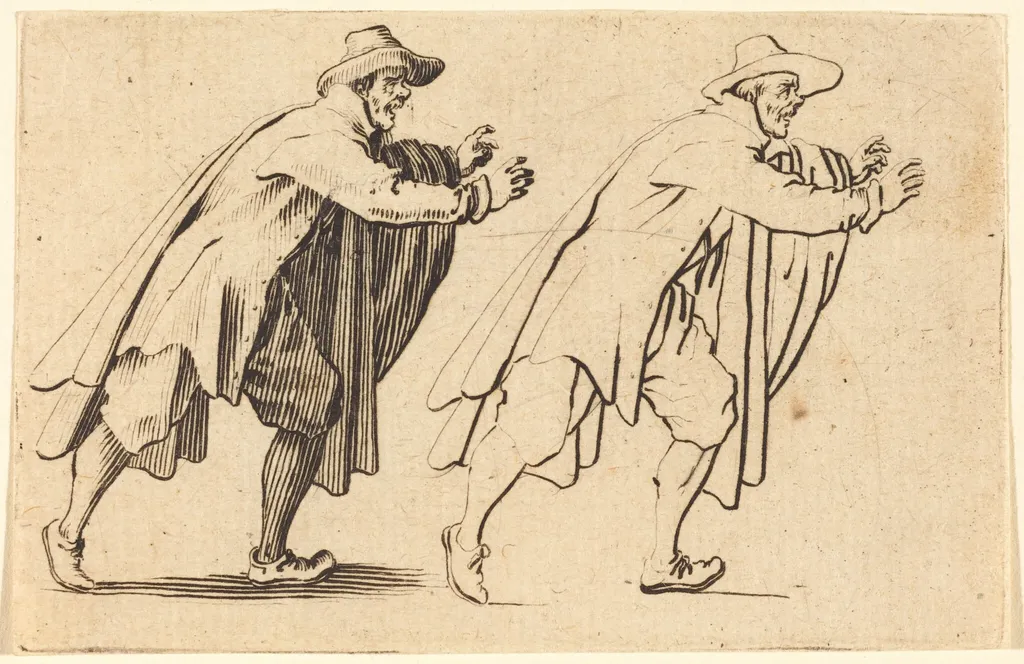
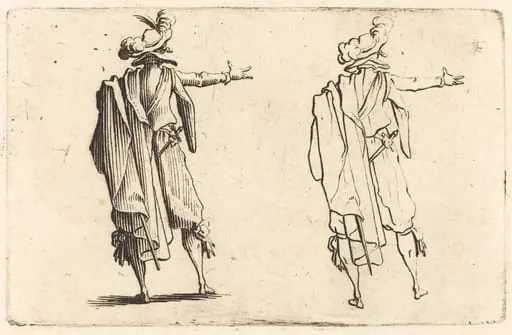
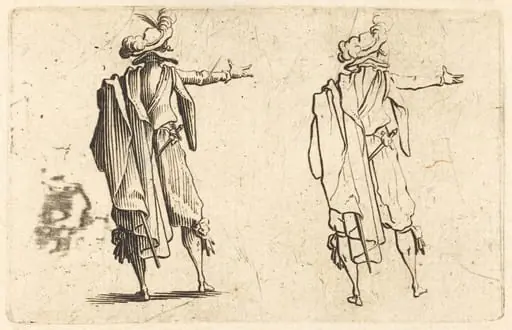
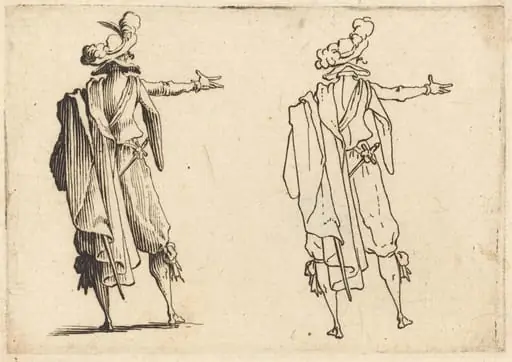
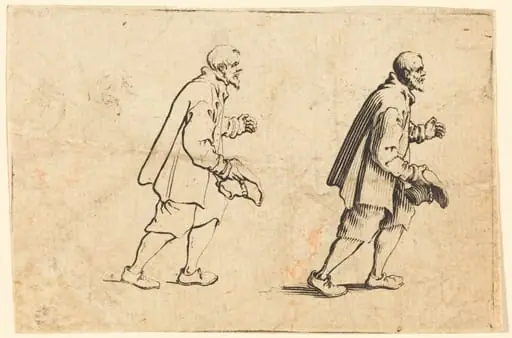
Man Moving Abruptly is an ink print by the Baroque artist Jacques Callot. It dates from 1622 and is held in the collection of the National Gallery of Art.
About this work
Overview
Created around 1622 by Jacques Callot, *Man Moving Abruptly* is an etching on laid paper that captures two figures in mid-motion.
Created around 1622 by Jacques Callot, *Man Moving Abruptly* is an etching on laid paper that captures two figures in mid-motion. As part of Callot’s vast body of work—over 1,400 prints—this piece exemplifies his interest in transient human gestures. Unlike grand historical scenes, it focuses on ordinary men caught in unscripted movement, reflecting his keen observation of daily life in early 17th-century Europe.
Subject & Meaning
The two figures, dressed in period attire—wide-brimmed hats, long coats, and striped or draped garments—appear to be in sudden motion, arms extended and legs bent as if reacting to an unseen force. Their postures suggest urgency or surprise, evoking a moment of spontaneous action rather than staged performance. Callot’s choice to depict such fleeting gestures underscores his fascination with the physicality and unpredictability of human behavior.
Technique & Style
Callot employed fine, controlled etching lines to render texture and movement, with dense hatching defining fabric folds and shadowed contours. The laid paper’s subtle grain enhances the tactile quality of the inked lines. His precise draftsmanship allows for nuanced shading without heavy tonal blocks, creating a sense of kinetic energy through line alone. The background remains minimal, directing focus entirely to the figures’ dynamic forms.
History & Provenance
The print emerged during Callot’s most prolific period, when he was active in Florence and Paris, producing scenes drawn from contemporary life. While the exact early ownership of this sheet is undocumented, it aligns with a broader circulation of his prints among collectors and artists across Europe. Its survival in multiple institutional collections suggests it was valued early for its technical precision and expressive immediacy.
Context
In the early 1600s, etching gained prominence as a medium for recording everyday scenes, distinct from traditional painting. Callot, working amid the turmoil of the Thirty Years’ War, turned his attention to soldiers, laborers, and travelers—not as symbols, but as individuals in motion. This print reflects a shift toward intimate, observational art, grounded in direct experience rather than mythological or religious narrative.
Legacy
Callot’s ability to convey motion and character through etching influenced generations of printmakers, including Rembrandt and Goya. *Man Moving Abruptly* stands as an early example of capturing transient human action with psychological realism. Its emphasis on gesture over narrative helped expand the expressive potential of printmaking, paving the way for later depictions of everyday movement in Western art.
Artist & collection

Artist
Jacques Callot was a baroque printmaker and draftsman from the Duchy of Lorraine.

 Holy Family at supper
 Restoration of the Aqueduct at Pisa
 Restoration of the Aqueduct at Pisa
 Square in Paris with Many Figures
 Square in Paris with Many Figures
 Horsemen Attacked by Robbers
 HOW WILL A COVERED PART BE CORRECTED?HOW WIKA A COVERED HEART DEED CORRECTED?
![Christ Walking on the Water [second plate], by Jacques Callot](https://artifactworldgallery.com/img/jacques-callot--christ-walking-on-the-water-second-plate--2069f3bfe4cb2126-w320.webp) Christ Walking on the Water [second plate]
Christ Walking on the Water [second plate]