Artwork
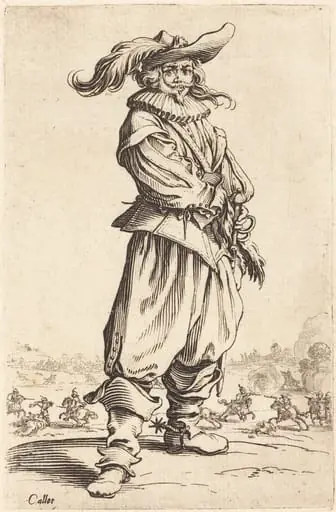
Military Commander on Foot
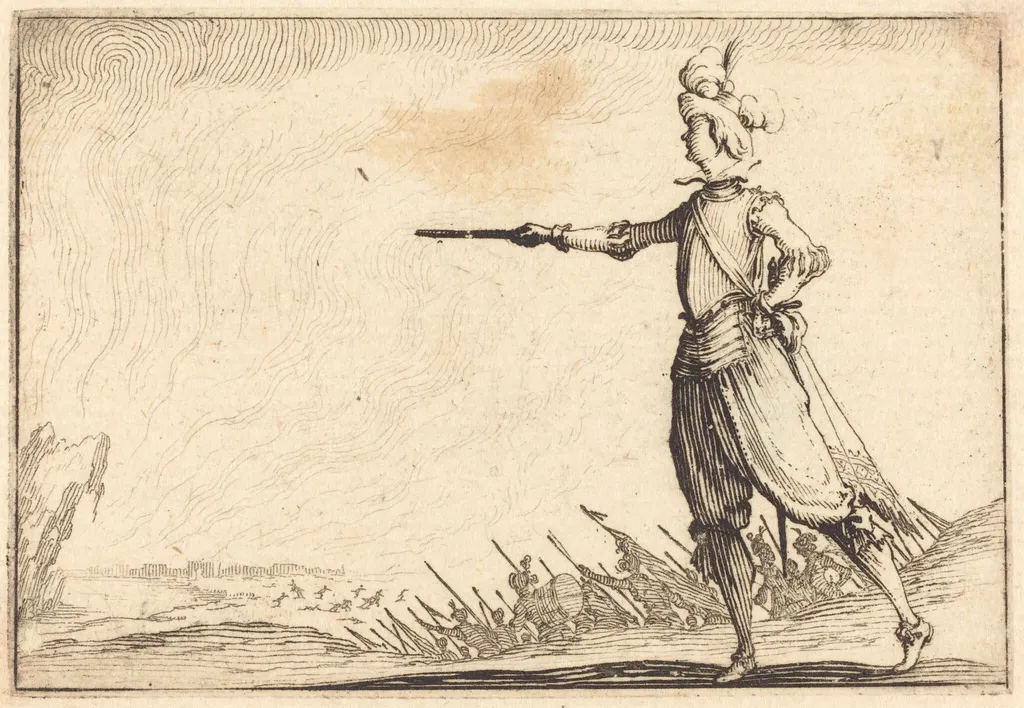
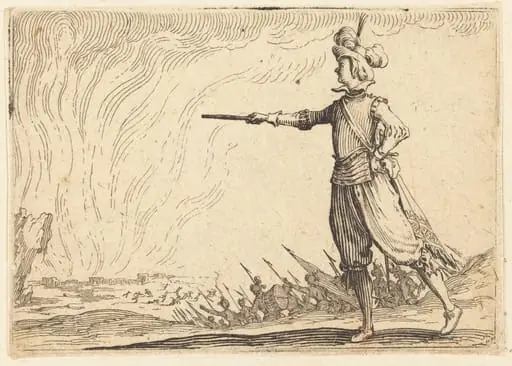
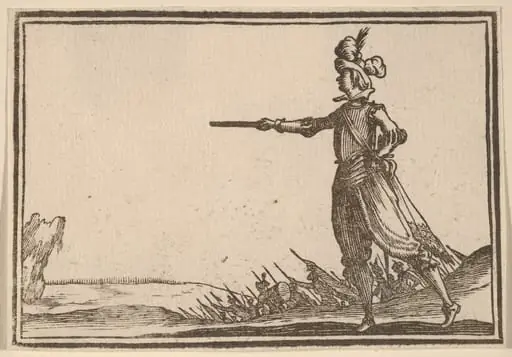
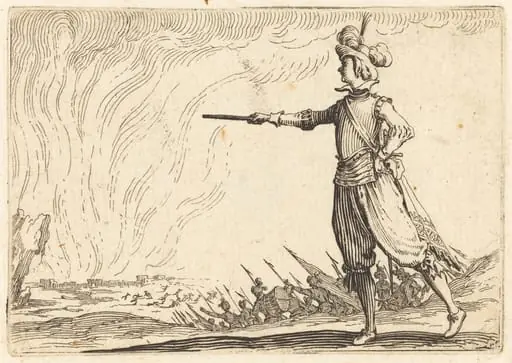
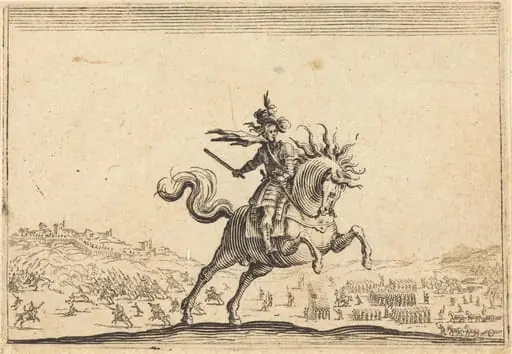
Military Commander on Foot is an ink print by the Baroque artist Jacques Callot. It dates from 1617 and is held in the collection of the National Gallery of Art.
About this work
Overview
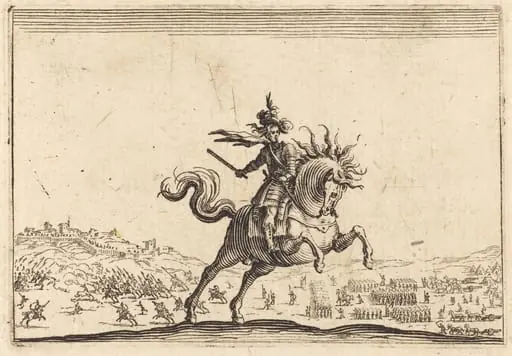
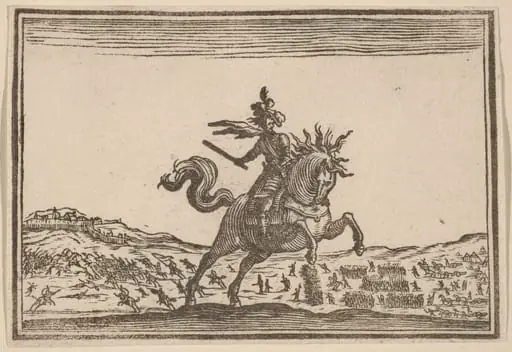
Created around 1617 by Jacques Callot, this etching on laid paper depicts a solitary military figure on a coastal rock. As one of over 1,400 prints by the Lorrainer artist, it exemplifies his focus on the visual language of early 17th-century warfare. The composition balances a single dominant figure with a distant group of troops, emphasizing scale and discipline within a natural setting.
Subject & Meaning
The central figure, a commander in armor, stands alert with sword in hand and one arm extended, suggesting command or direction.
The central figure, a commander in armor, stands alert with sword in hand and one arm extended, suggesting command or direction. Behind him, a line of soldiers marches in orderly formation, reinforcing themes of hierarchy and control. The barren shore and empty sky frame the scene without narrative distraction, directing attention to the quiet tension of military readiness rather than active battle.
Technique & Style
Callot employed fine, controlled lines to render the texture of armor, fabric, and rocky terrain. Shading is achieved through closely spaced etched strokes, creating depth without heavy ink. The distant soldiers are rendered with minimal detail yet remain legible, demonstrating his skill in spatial compression. The swirling lines above suggest wind or atmospheric movement, contrasting with the stillness of the figures below.
History & Provenance
This print is part of a larger series documenting military life during the Thirty Years' War, a period when Callot’s work gained recognition for its observational precision. Though specific early ownership records are sparse, the piece aligns with collections of Northern European prints from the early 1600s, valued for their documentary quality rather than decorative appeal.
Context
In early 17th-century Europe, military imagery was increasingly used to reflect state power and the realities of professional armies. Callot’s etchings responded to this trend, capturing soldiers not as idealized heroes but as disciplined units within real landscapes. His work circulated among officers, scholars, and collectors interested in the visual documentation of war.
Legacy
Callot’s precise etching technique influenced generations of printmakers, particularly in the depiction of movement and spatial depth. While *Military Commander on Foot* is not among his most famous works, it exemplifies his contribution to the shift from allegorical to observational military imagery, laying groundwork for later documentary print traditions in Europe.
Own this work as a print
Artist & collection

Artist
Jacques Callot was a baroque printmaker and draftsman from the Duchy of Lorraine.

 Holy Family at supper
 Restoration of the Aqueduct at Pisa
 Restoration of the Aqueduct at Pisa
 Square in Paris with Many Figures
 Square in Paris with Many Figures
 Horsemen Attacked by Robbers
 HOW WILL A COVERED PART BE CORRECTED?HOW WIKA A COVERED HEART DEED CORRECTED?
![Christ Walking on the Water [second plate], by Jacques Callot](https://artifactworldgallery.com/img/jacques-callot--christ-walking-on-the-water-second-plate--2069f3bfe4cb2126-w320.webp) Christ Walking on the Water [second plate]
Christ Walking on the Water [second plate]