Artwork
Riciulina and Metzetin
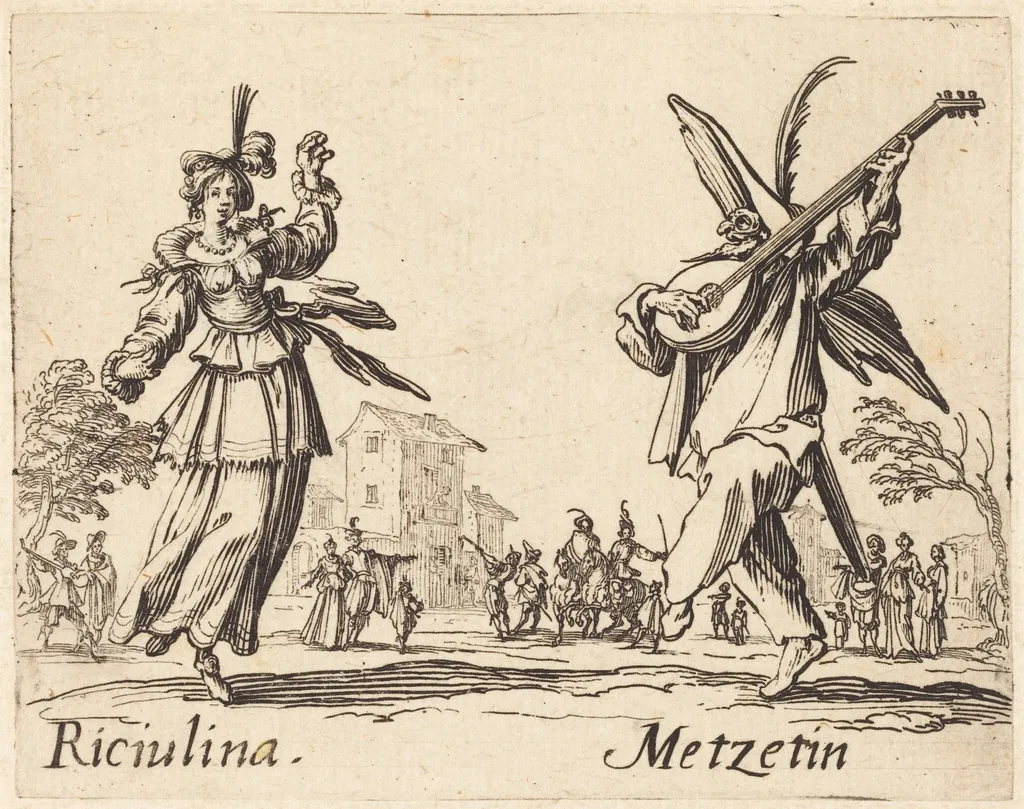
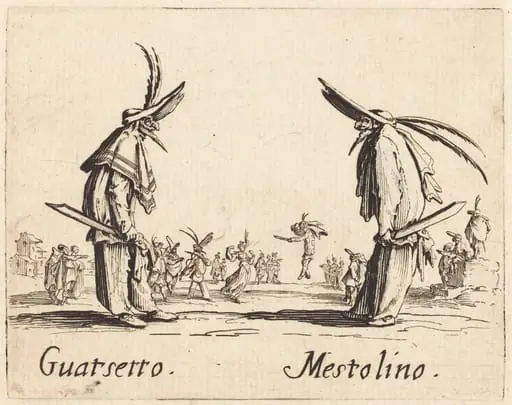
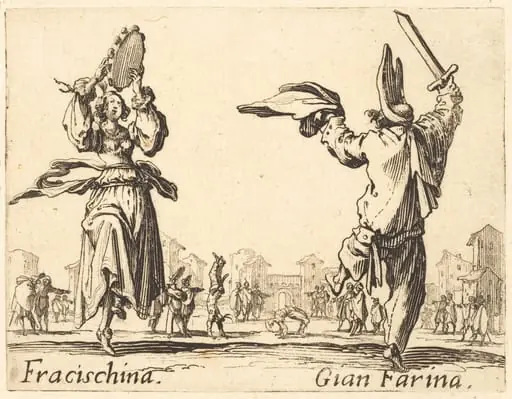
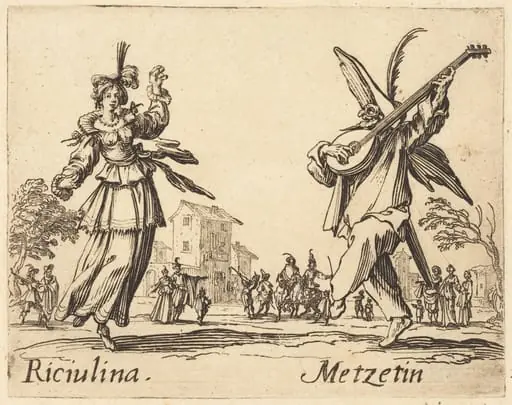
Riciulina and Metzetin is an ink print by the Baroque artist Jacques Callot. It dates from 1622 and is held in the collection of the National Gallery of Art.
About this work
Overview
The composition combines lively human activity with a surreal, mythic element, illustrating Callot’s interest in both everyday life and imaginative narrative.
Jacques Callot, a French printmaker active in the early 17th century, produced the etching *Riciulina and Metzetin* around 1622. Executed on laid paper, the work presents a crowded urban scene dominated by two oversized, fantastical figures hovering above the street. The composition combines lively human activity with a surreal, mythic element, illustrating Callot’s interest in both everyday life and imaginative narrative.
Subject & Meaning
The two central figures—one a richly dressed woman with feathered adornments, the other a winged man bearing a bow—are labeled Riciulina and Metzetin, names that do not correspond to known historical persons. Their exaggerated scale and placement suggest allegorical roles, perhaps embodying abstract concepts or satirical commentary, while the surrounding crowd of pedestrians and riders grounds the scene in a recognizable, bustling cityscape.
Technique & Style
Callot employed fine, incisive lines characteristic of his etching practice, allowing for intricate detail in both the figures and the surrounding architecture. The use of laid paper provides a subtle texture that enhances the contrast between the sharply rendered foreground and the more muted background, creating a sense of depth and kinetic energy typical of Baroque printmaking.
History & Provenance
Part of Callot’s extensive output of more than 1,400 etchings, *Riciulina and Metzetin* belongs to his series of genre scenes that document contemporary society. While specific ownership records are scarce, the print has been catalogued among his works that explore everyday subjects alongside religious and military themes, reflecting the breadth of his artistic interests.
Context
Created in the Duchy of Lorraine during a period of flourishing print culture, the work exemplifies the Baroque fascination with dramatic composition and the mingling of the ordinary with the fantastical. Callot’s prints were widely circulated, influencing later artists and contributing to the development of narrative engraving in Europe.
Artist & collection

Artist
Jacques Callot was a baroque printmaker and draftsman from the Duchy of Lorraine.

 Holy Family at supper
 Restoration of the Aqueduct at Pisa
 Restoration of the Aqueduct at Pisa
 Square in Paris with Many Figures
 Square in Paris with Many Figures
 Horsemen Attacked by Robbers
 HOW WILL A COVERED PART BE CORRECTED?HOW WIKA A COVERED HEART DEED CORRECTED?
![Christ Walking on the Water [second plate], by Jacques Callot](https://artifactworldgallery.com/img/jacques-callot--christ-walking-on-the-water-second-plate--2069f3bfe4cb2126-w320.webp) Christ Walking on the Water [second plate]
Christ Walking on the Water [second plate]