Artwork
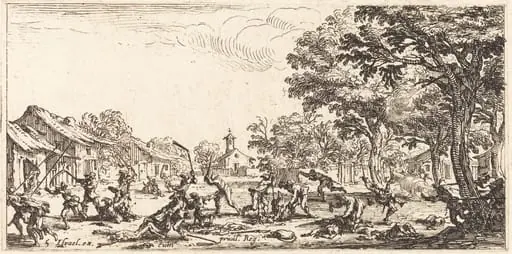
Soldiers Attacking Robbers
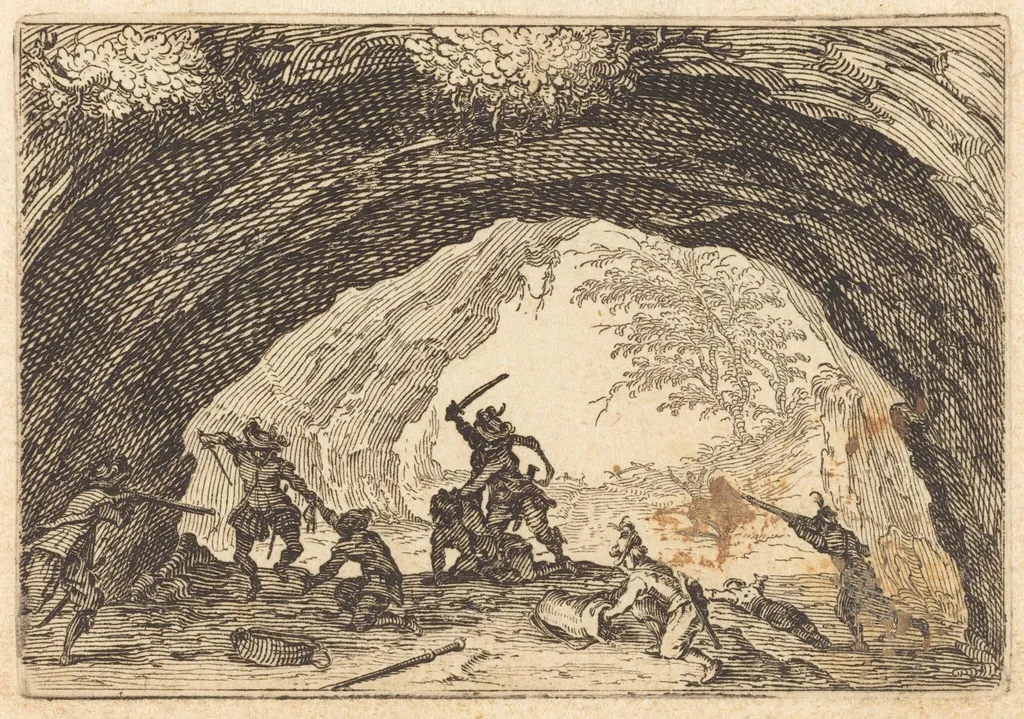
Soldiers Attacking Robbers is an ink print by the Baroque artist Jacques Callot. It dates from 1622 and is held in the collection of the National Gallery of Art.
About this work
He used a sharp needle to scratch lines into metal, then inked and pressed the plate onto paper—this is called etching.
This etching shows soldiers on horseback attacking a crowd of robbers and civilians. The weapons flash in the foreground.
Jacques Callot made this print around 1622. He used a sharp needle to scratch lines into metal, then inked and pressed the plate onto paper—this is called etching. The crowded scene feels chaotic, yet every detail stays sharp.
Take a closer look at how the light falls on the faces. Then check out more prints by Callot, Jacques.
Overview
Created around 1622, this etching by Jacques Callot captures a violent encounter between mounted soldiers and a group of robbers and civilians. Executed on laid paper using the etching technique, the work is part of a larger body of over 1,400 prints in which Callot recorded the turbulent realities of early 17th-century life. His precision in line and composition transforms a moment of chaos into a meticulously rendered scene.
Subject & Meaning
The scene depicts armed cavalry overwhelming a disorganized crowd, blending combatants and bystanders in a single frame. No clear moral stance is presented; instead, the image reflects the blurred lines between soldier, bandit, and civilian during a period of widespread military unrest. The inclusion of non-combatants suggests the broader societal impact of armed conflict, not merely its battlefield dimensions.
Technique & Style
Callot employed a fine-pointed needle to incise lines into a metal plate, which was then etched in acid and inked for printing. The resulting image retains sharp, intricate detail despite its crowded composition. Delicate gradations of light and shadow define facial expressions and armor, while overlapping figures create depth without sacrificing clarity—a hallmark of his technical mastery in etching.
History & Provenance
This print emerged during Callot’s most active period in Nancy and Florence, when he was documenting the social disruptions of the Thirty Years’ War. Though no specific commission is recorded, the work aligns with his broader project of chronicling military life. It circulated widely among collectors and artists, contributing to his reputation as a keen observer of contemporary violence and disorder.
Context
In the early 1620s, the Duchy of Lorraine and surrounding regions were frequently traversed by mercenary troops, whose presence brought plunder and instability. Callot’s prints, including this one, respond to the visible consequences of war on civilian populations. His images were not propaganda but records—detached, detailed, and unflinching—of the era’s pervasive unrest.
Legacy
Callot’s etchings influenced generations of artists through their narrative clarity and technical innovation. *Soldiers Attacking Robbers* exemplifies his ability to convey complex social dynamics in a single frame. While not widely exhibited today, the work remains a reference point in studies of early modern printmaking and the visual documentation of war.
Artist & collection
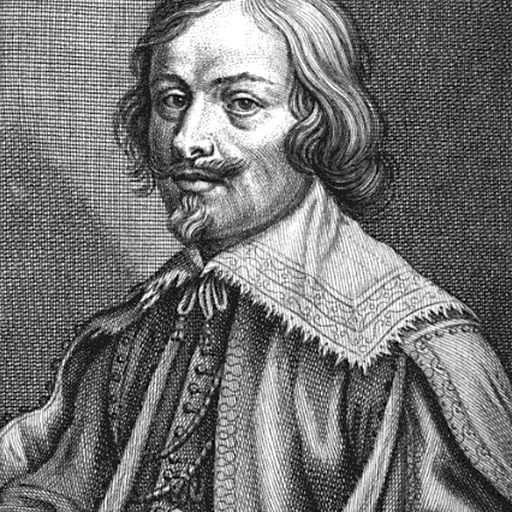
Artist
Jacques Callot was a baroque printmaker and draftsman from the Duchy of Lorraine.

 Holy Family at supper
 Restoration of the Aqueduct at Pisa
 Restoration of the Aqueduct at Pisa
 Square in Paris with Many Figures
 Square in Paris with Many Figures
 Horsemen Attacked by Robbers
 HOW WILL A COVERED PART BE CORRECTED?HOW WIKA A COVERED HEART DEED CORRECTED?
![Christ Walking on the Water [second plate], by Jacques Callot](https://artifactworldgallery.com/img/jacques-callot--christ-walking-on-the-water-second-plate--2069f3bfe4cb2126-w320.webp) Christ Walking on the Water [second plate]
Christ Walking on the Water [second plate]
 A Thick Forest
 Landscape with a Fallen Tree (Paysage à l'arbre cassé)
 The Peasants' Revenge
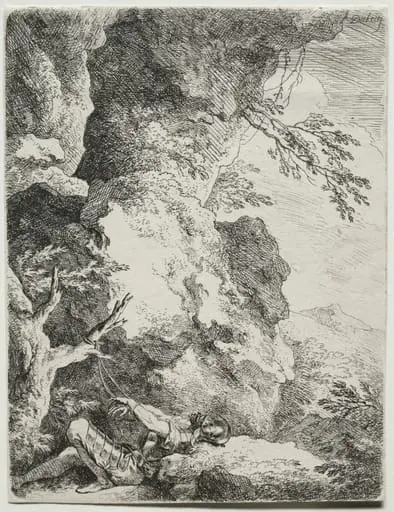 St. William, The Hermit Saint
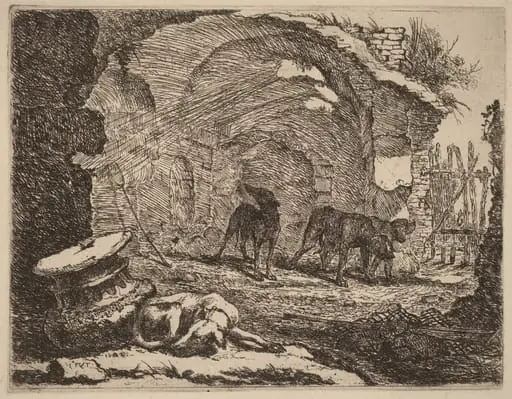 Four Dogs, One Sleeping beside a Capital
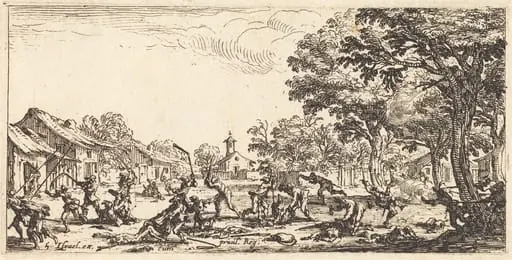 The Peasants' Revenge
 Six large upright landscapes with scenes from Ovid's Metamorphoses: Venus and Adonis
 The Path through the Rock
 Two Men Penitent in the Wilderness