Artwork
The Envoy of Tuscany Thanking the Queen
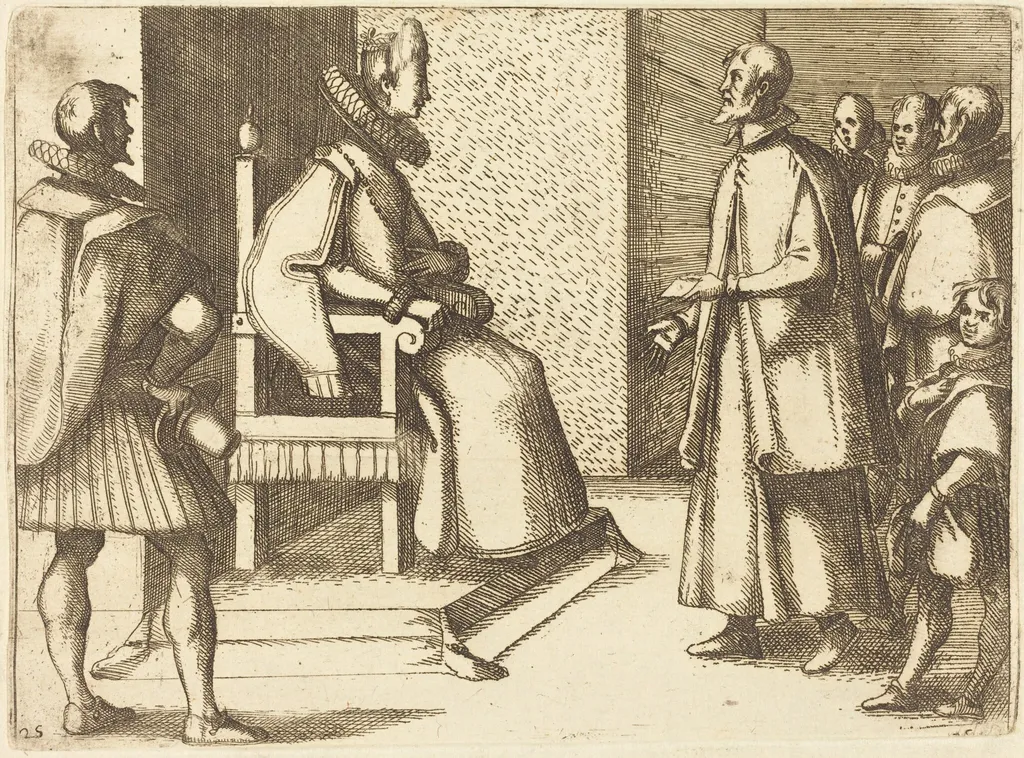
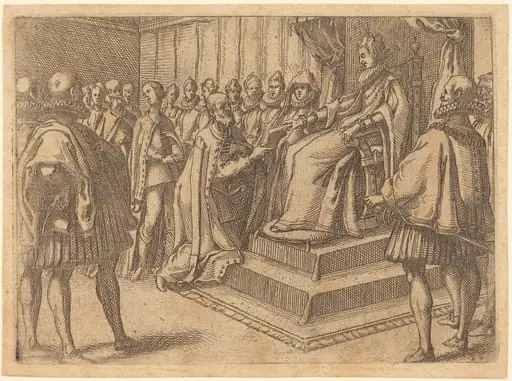
The Envoy of Tuscany Thanking the Queen is an ink print by the Baroque artist Jacques Callot. It dates from 1612 and is held in the collection of the National Gallery of Art.
About this work
Overview
This etching, produced by Jacques Callot in 1612, captures a formal court ceremony in which a Tuscan envoy expresses gratitude to a monarch.
This etching, produced by Jacques Callot in 1612, captures a formal court ceremony in which a Tuscan envoy expresses gratitude to a monarch. Created as a restrike on laid paper, it belongs to a body of work exceeding 1,400 prints by Callot, who specialized in documenting the rituals and social dynamics of early 17th-century European courts. The scene reflects his interest in precise observation of hierarchy and gesture.
Subject & Meaning
The image portrays a kneeling diplomat addressing a seated queen, her elaborate attire and crown signaling her status. Behind her, attendants stand in orderly silence, reinforcing the formality of the moment. The envoy’s posture conveys deference, while the queen’s stillness suggests authority. The exchange is not merely personal but symbolic of diplomatic relations between Tuscany and the French court, rendered with restrained solemnity.
Technique & Style
Callot employed fine, controlled lines typical of his etching method, achieving clarity in fabric folds, facial expressions, and architectural details. The background wall and doorway provide spatial depth without distraction, focusing attention on the central figures. His use of delicate cross-hatching and precise contouring reflects his mastery of the medium, balancing detail with compositional restraint.
History & Provenance
The original 1612 impression was later restriked, a common practice to meet demand after the artist’s death. While the exact provenance of this particular restrike is undocumented, it aligns with the circulation of Callot’s court scenes among collectors and institutions in the 17th and 18th centuries. His prints were widely reproduced, ensuring their presence in European print collections.
Context
Created during the early Baroque period, the work reflects the era’s emphasis on ceremonial display and political representation. Callot, though from Lorraine, worked extensively in France and documented its courtly culture. His prints served as visual records of diplomacy, military campaigns, and social rituals, offering insight into the visual language of power in early modern Europe.
Legacy
Callot’s etchings influenced generations of printmakers through their technical precision and observational depth. Though not widely exhibited as standalone works today, his depictions of court life remain valuable for understanding the visual culture of diplomacy. This print contributes to a broader archive of Baroque-era imagery that prioritizes documentation over idealization.
Artist & collection
Artist
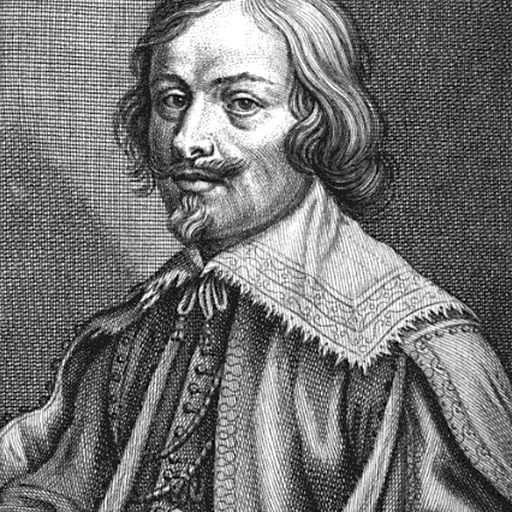
Jacques Callot was a baroque printmaker and draftsman from the Duchy of Lorraine.

 Holy Family at supper
 Restoration of the Aqueduct at Pisa
 Restoration of the Aqueduct at Pisa
 Square in Paris with Many Figures
 Square in Paris with Many Figures
 Horsemen Attacked by Robbers
 HOW WILL A COVERED PART BE CORRECTED?HOW WIKA A COVERED HEART DEED CORRECTED?
![Christ Walking on the Water [second plate], by Jacques Callot](https://artifactworldgallery.com/img/jacques-callot--christ-walking-on-the-water-second-plate--2069f3bfe4cb2126-w320.webp) Christ Walking on the Water [second plate]
Christ Walking on the Water [second plate]
 The Envoy of Tuscany thanking the Queen
![The Envoy of Tuscany thanking the Queen [verso], by Jacques Callot](https://artifactworldgallery.com/img/jacques-callot--the-envoy-of-tuscany-thanking-the-queen-verso--d1096c23bbbd576f-w320.webp) The Envoy of Tuscany thanking the Queen [verso]
The Envoy of Tuscany thanking the Queen [verso] Reception of the Envoy of Poland
 Reception of the Envoy of Poland
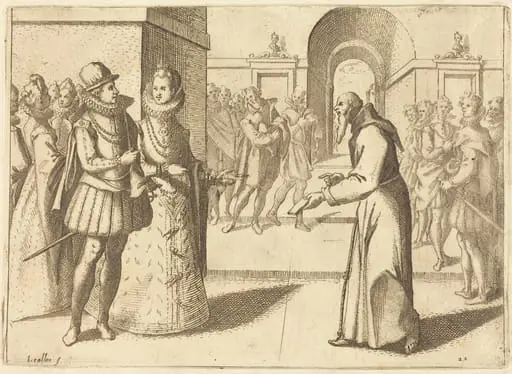 A Capucin Bringing Thanks of the King of Bavaria
![King and Queen in Consultation about the Turks [recto], by Jacques Callot](https://artifactworldgallery.com/img/jacques-callot--king-and-queen-in-consultation-about-the-turks-recto--5b03792b86815455-w320.webp) King and Queen in Consultation about the Turks [recto]
King and Queen in Consultation about the Turks [recto]![A Capucin bringing thanks of the King of Bavaria [recto], by Jacques Callot](https://artifactworldgallery.com/img/jacques-callot--a-capucin-bringing-thanks-of-the-king-of-bavaria-recto--39ed030c08b9b2a7-w320.webp) A Capucin bringing thanks of the King of Bavaria [recto]
A Capucin bringing thanks of the King of Bavaria [recto]![Reception of the Envoy of Poland [recto], by Jacques Callot](https://artifactworldgallery.com/img/jacques-callot--reception-of-the-envoy-of-poland-recto--b391a89639ee42f8-w320.webp) Reception of the Envoy of Poland [recto]
Reception of the Envoy of Poland [recto]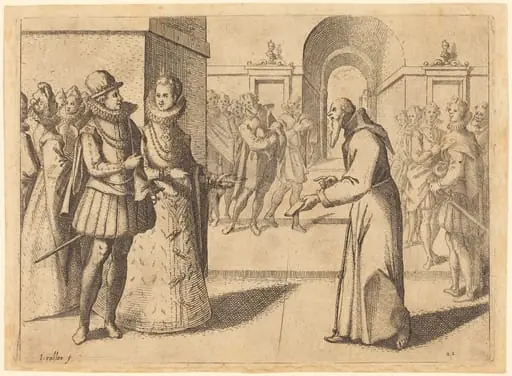 A Capucin bringing thanks of the King of Bavaria