Artwork
Mercury and the Three Graces
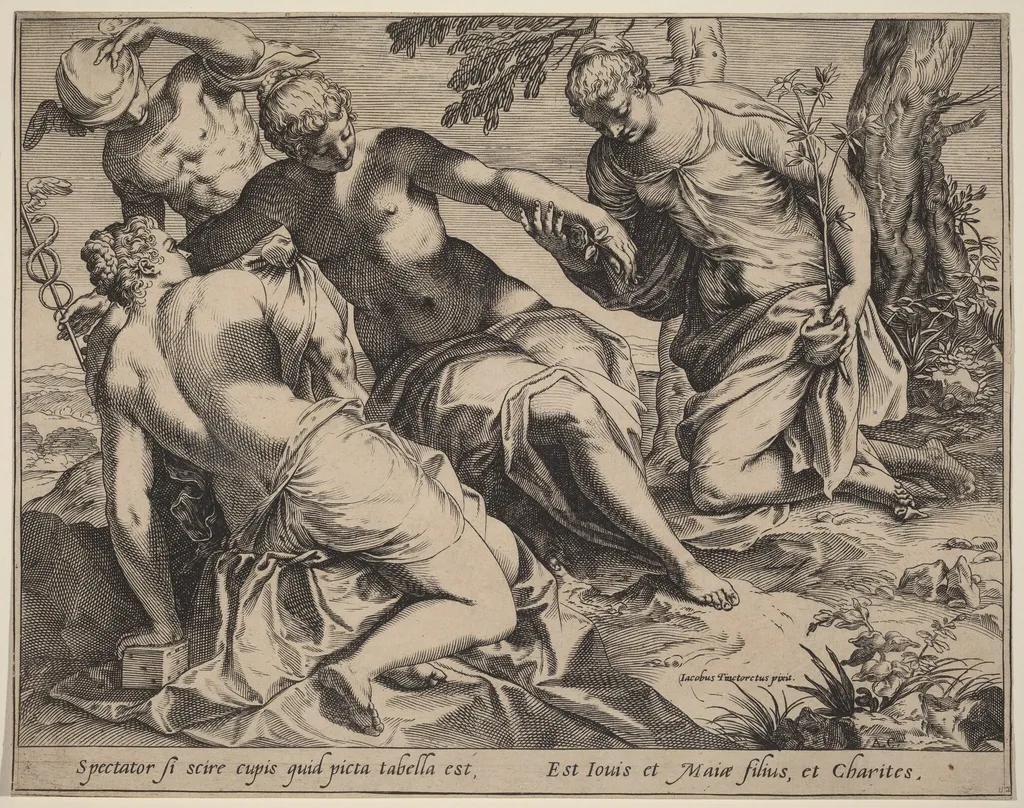
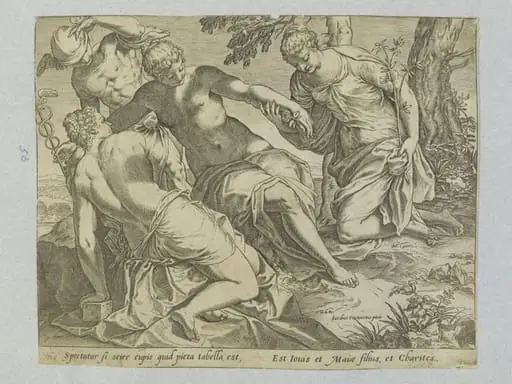
Mercury and the Three Graces is an ink print by the Renaissance artist Agostino Carracci. It dates from 1589 and is held in the collection of the National Gallery of Art.
About this work
Overview
As a co-founder of the Accademia degli Incamminati in Bologna, he sought to move beyond the artificiality of Mannerism by returning to naturalistic observation.
Agostino Carracci created this engraving in 1589 on laid paper, part of his broader engagement with printmaking alongside his painting and teaching. As a co-founder of the Accademia degli Incamminati in Bologna, he sought to move beyond the artificiality of Mannerism by returning to naturalistic observation. The work exemplifies his commitment to clarity, balance, and lifelike form, using the precision of engraving to convey both movement and stillness in a mythological scene.
Subject & Meaning
The scene portrays Mercury, messenger of the gods, accompanied by the Three Graces—goddesses of charm, beauty, and creativity. Mercury, identifiable by his winged sandals and caduceus, stands slightly apart, observing the trio seated in a tranquil woodland. Their relaxed postures suggest a moment of quiet communion rather than dramatic action. The inclusion of fruit in one Grace’s basket alludes to abundance and earthly pleasure, grounding the divine in a serene, humanized setting.
Technique & Style
Carracci employed fine, controlled lines to model form and depth, relying on cross-hatching to build tonal variation across skin, fabric, and foliage. The laid paper’s texture subtly enhances the print’s tactile quality. Figures are rendered with soft contours and minimal exaggeration, avoiding Mannerist distortions. The background trees and shrubs are meticulously detailed, creating a sense of enclosed space without overwhelming the central group. The overall effect is one of calm clarity, achieved through disciplined line work.
History & Provenance
Produced during Carracci’s early career in Bologna, the print emerged from a circle of artists committed to reforming Italian art through direct study of nature and classical models. It was likely made for a scholarly or collector’s audience familiar with mythological themes. Though few early impressions survive, its inclusion in later collections confirms its recognition among connoisseurs of the period as a refined example of northern Italian printmaking.
Context
In late 16th-century Italy, Mannerist art dominated with elongated forms and complex compositions. Carracci and his academy countered this by advocating for a return to the harmony and naturalism of Renaissance masters like Raphael. This engraving reflects that mission: mythological subjects are treated with restraint and psychological presence, aligning with humanist ideals. The choice of engraving—a medium often used for reproduction—signals an intention to disseminate this new aesthetic beyond painting.
Legacy
Carracci’s approach to figure and composition in this print influenced generations of artists who sought to reconcile classical themes with observed reality. His technical mastery in engraving demonstrated that line alone could convey volume, mood, and narrative subtlety. Though less celebrated than his paintings, this work helped establish printmaking as a legitimate vehicle for artistic innovation within the Bolognese school and beyond.
Artist & collection
Artist
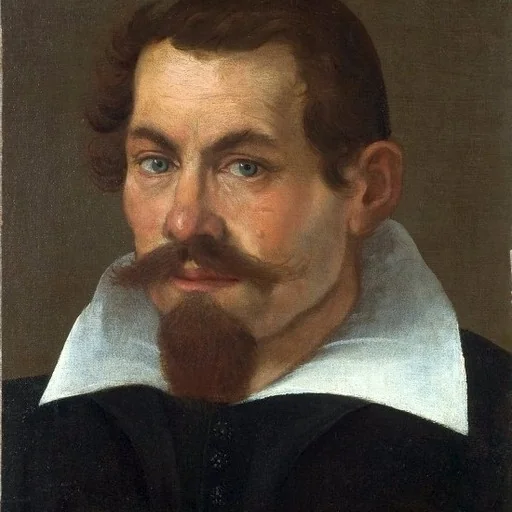
Agostino Carracci ( kə-RAH-chee, UK also kə-RATCH-ee, Italian: ; also Caracci; 16 August 1557 – 22 March 1602) was an Italian painter, printmaker, tapestry designer, and art teacher.

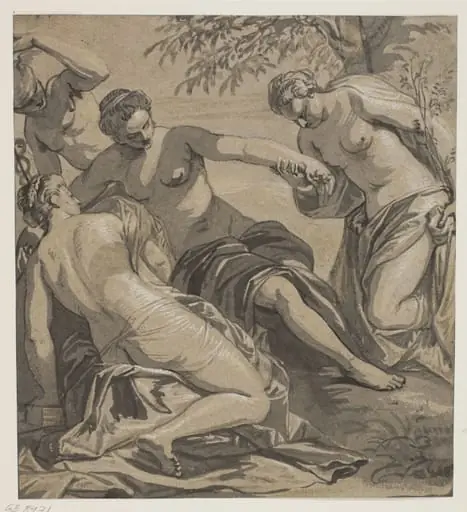 The three Graces and Mercury, after the painting in the Anticollegio, Palazzo Ducale, Venice
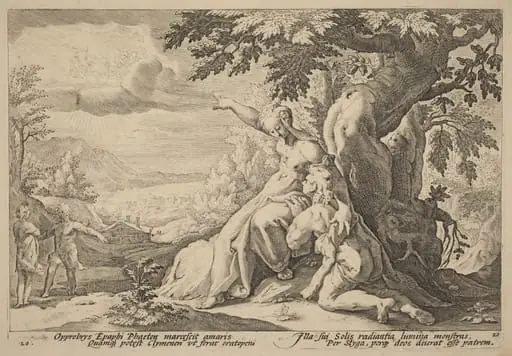 Clymene Urging Phaeton to Find Helios
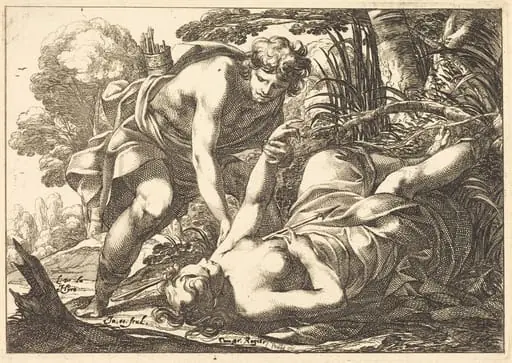 Cephalus and Procris
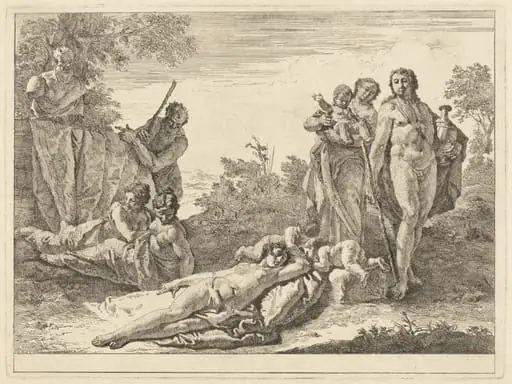 Nine Figures around a Herm of Pan
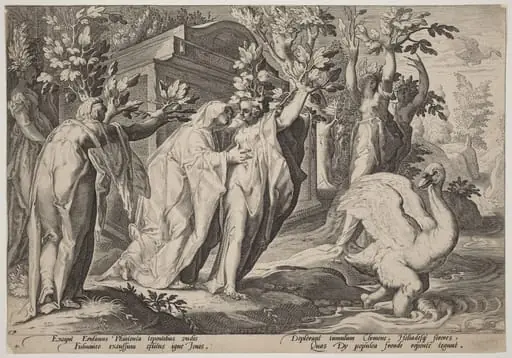 Phaeton's Sisters Changed into Poplars, and Cygnus into a Swan
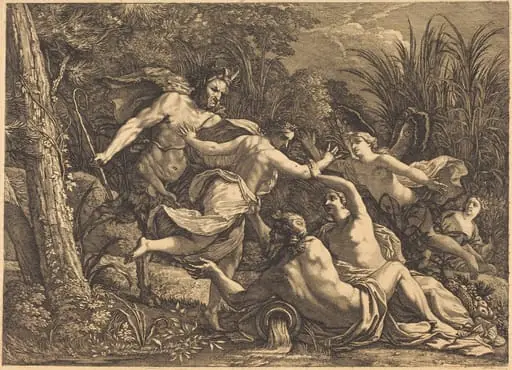 Pan and Syrinx
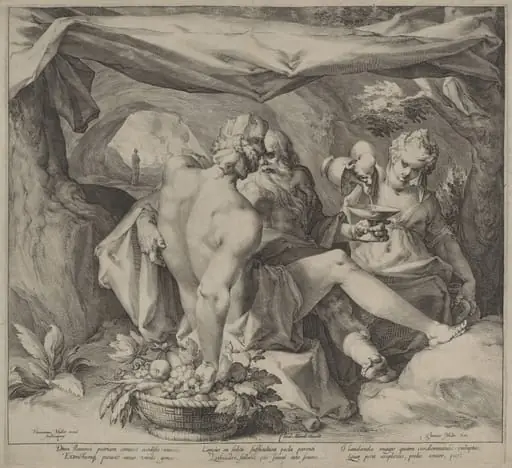 Lot and His Daughters
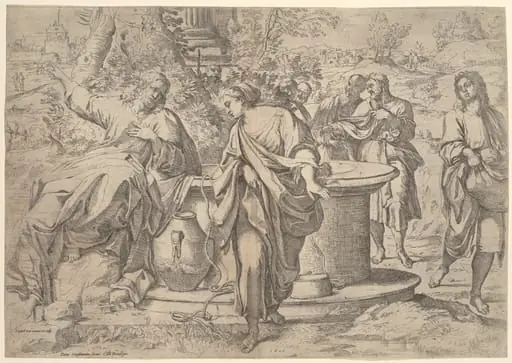 Christ and the Samaritan Woman
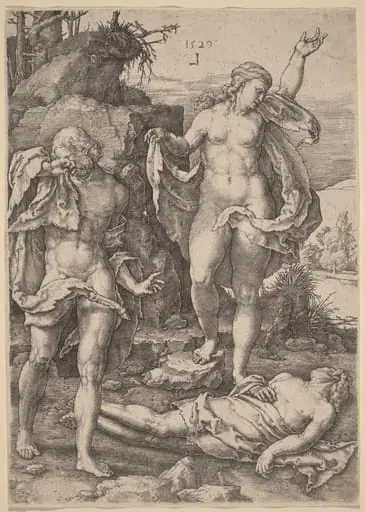 Adam and Eve Lamenting the Death of Abel
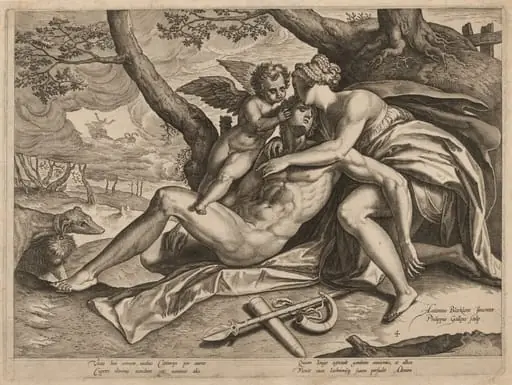 The Death of Adonis
 The Lamentation
 Mercury and the Graces