Artwork
Neubrandenburg in Flames
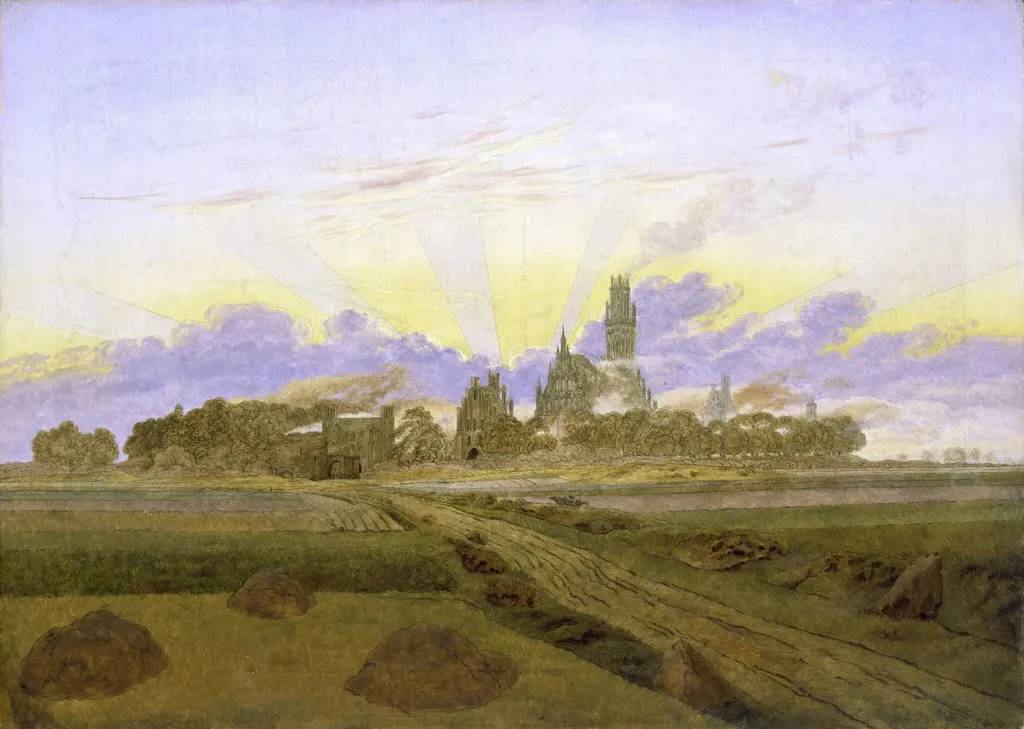
Neubrandenburg in Flames is an oil painting by the German Romanticist artist Caspar David Friedrich. It dates from 1835 and is held in the collection of the Hamburger Kunsthalle.
About this work
Neubrandenburg in Flames is a painting by Caspar David Friedrich. It's an oil paint work.
The painting is dated around 1835, but it's also noted that a similar description dates it to around 1834. This slight discrepancy in dating suggests that the painting's history is still being studied.
To learn more about the artist's style and techniques, look up the artist: Caspar David Friedrich.
Overview
Friedrich, whose parents were native to the town, returned to its imagery throughout his career, often imbuing it with personal and symbolic weight.
An oil painting attributed to Caspar David Friedrich, Neubrandenburg in Flames depicts the town of Neubrandenburg engulfed in fire. Created circa 1834–1835, the work is held in the collection of the Hamburg Kunsthalle. Though sometimes referred to by titles referencing sunrise or sunset, the scene conveys destruction rather than natural light. Friedrich, whose parents were native to the town, returned to its imagery throughout his career, often imbuing it with personal and symbolic weight.
Subject & Meaning
The painting portrays Neubrandenburg ablaze, with towering flames rising above the town’s rooftops and church spires. The sky is darkened by smoke, and the only light comes from the inferno below. Unlike typical Romantic landscapes that evoke awe through nature, this work conveys loss and ruin. It may reflect Friedrich’s mourning for his hometown’s decline or serve as a metaphor for the fragility of human settlements against forces beyond control.
Technique & Style
Friedrich employs a muted palette dominated by deep browns, blacks, and smoky grays, with accents of orange and red to suggest fire. The composition is tightly framed, drawing the viewer’s eye upward through the columns of flame toward a nearly obscured horizon. Brushwork is controlled yet expressive, blending precise architectural details with turbulent, almost abstract flames. The absence of human figures intensifies the sense of isolation and desolation.
History & Provenance
The painting entered the Hamburg Kunsthalle’s collection in the 19th century, though its early ownership is not fully documented. Dating has been debated between 1834 and 1835, reflecting uncertainty in Friedrich’s records from his later years. No preparatory sketches survive, and the work was not exhibited publicly during his lifetime. Its current attribution is based on stylistic analysis and provenance records from the museum’s archives.
Context
Friedrich painted this during a period of personal and political disillusionment following the failed revolutions of 1830. Neubrandenburg, once a thriving Hanseatic center, had lost economic prominence by the 1830s. The image may echo broader anxieties about urban decay and the erosion of cultural memory in post-Napoleonic Germany. It stands apart from his earlier spiritual landscapes, shifting focus from transcendence to ruin.
Legacy
Neubrandenburg in Flames is rarely exhibited due to its fragile condition and somber tone, yet it remains a key example of Friedrich’s late work. Scholars view it as a departure from his idealized nature scenes, revealing a darker, more introspective phase. Its emotional gravity influenced later German artists who explored trauma and memory through landscape, though it never achieved widespread public recognition in his lifetime.
Own this work as a print
Artist & collection
Artist
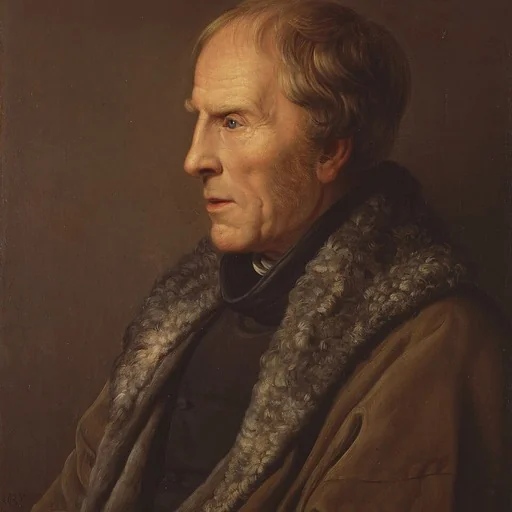
Caspar David Friedrich (German: ; 5 September 1774 – 7 May 1840) was a German Romantic landscape painter, generally considered the most important German artist of his generation, whose often symbolic, and anti-classical…

 After Sunset : North Wales
 Kirkstall Abbey, Yorkshire: Evening
 A View of Moulins
 Hilly landscape at sunset
 Gillingham on the Medway, Kent
 View of Engelholm at Præstø in Zealand
 Landscape
 Lancaster
 River scene with church in the background
 Hill and Ploughed Field near Dresden
 Meadows with a Distant View of Oxford
 Meadows near Greifswald