Artwork
A Satyr
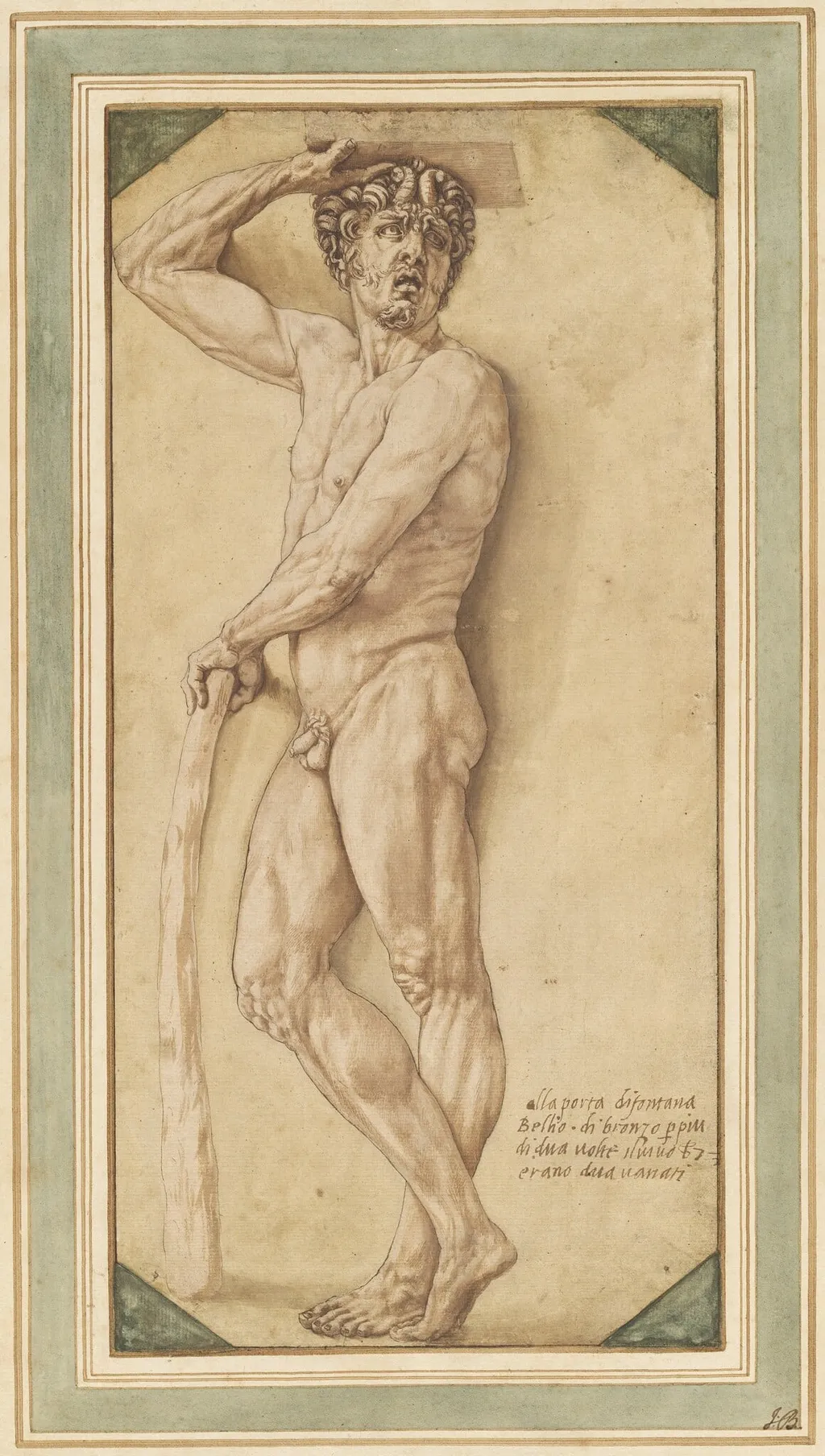
A Satyr is a chalk drawing by the Renaissance artist Benvenuto Cellini. It dates from 1544 and is held in the collection of the National Gallery of Art.
About this work
Overview
Created in 1544 by Benvenuto Cellini, this drawing is a study in pen and brown ink with wash over black chalk on laid paper. The figure is mounted on a support with a framing line in ink, suggesting it was preserved as a deliberate artistic record rather than a casual sketch. Its energetic, unfinished quality reflects its function as a working drawing, likely tied to a larger sculptural project.
Subject & Meaning
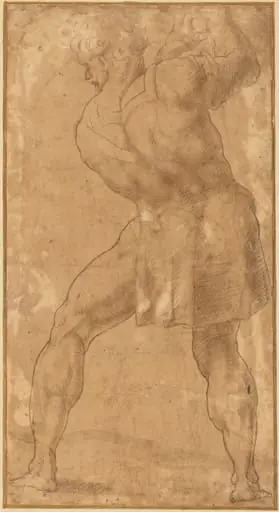
The figure depicts a satyr, a mythological creature associated with wildness and nature. Rendered mid-motion, the satyr raises one arm as if grasping an object, while the other clutches a club. The pose suggests movement and tension, evoking the creature’s untamed spirit. The drawing does not illustrate a specific myth but captures the essence of the satyr as a symbol of primal energy.
Technique & Style
The fur and musculature are rendered with loose, textured strokes, avoiding smooth finish in favor of dynamic immediacy.
Cellini employed rapid, expressive lines in pen and ink, layered with washes to suggest volume and shadow. The fur and musculature are rendered with loose, textured strokes, avoiding smooth finish in favor of dynamic immediacy. Notes in Italian, written along the edge, indicate the drawing was made as a reference, possibly for a bronze statue. The sketch’s spontaneity reveals the artist’s direct engagement with form.
History & Provenance
The drawing dates to Cellini’s time in France, where he worked for King Francis I. It likely served as preparatory material for a sculptural commission, though no corresponding finished statue has been definitively identified. The paper has been laid down and framed in ink, indicating early efforts to preserve the work. Its survival suggests it was valued by the artist or his circle as a record of creative process.
Context
During the 1540s, Cellini was immersed in the French court’s artistic milieu, where classical themes were revived through detailed studies of the human form. Drawings like this were essential tools for sculptors translating ideas into three dimensions. The satyr, a recurring motif in Renaissance art, reflected contemporary interest in antiquity and the human body’s expressive potential.
Legacy
This drawing exemplifies Cellini’s approach to preparatory work: vigorous, unpolished, and deeply observational. It stands as evidence of the sculptor’s process, bridging drawing and sculpture in the Mannerist tradition. Though not widely exhibited, it remains a key example of how Renaissance artists used sketching to explore movement, anatomy, and mythological character.
Artist & collection


![Nude Man Seen from Behind [verso], by Jacopo Palma il Giovane](https://artifactworldgallery.com/img/jacopo-palma-il-giovane--nude-man-seen-from-behind-verso--2de266ff199c839b-w320.webp)