Artwork
Study for Newlyn, Near Penzance, England
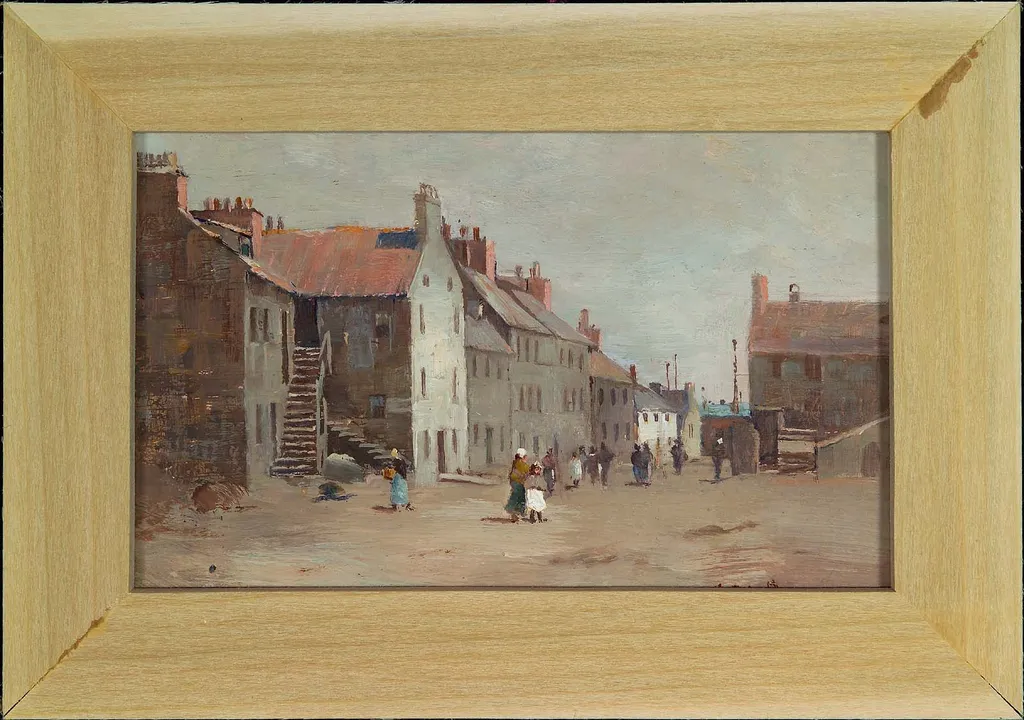
Study for Newlyn, Near Penzance, England is an unspecified painting by the Impressionist artist Charles Edwin Lewis Green. It dates from 1896 and is held in the collection of the Museum of Fine Arts Boston.
About this work
Overview
Painted in 1896 by Charles Edwin Lewis Green, this work is a preparatory study for a larger composition depicting a street in Newlyn, near Penzance, Cornwall.
Painted in 1896 by Charles Edwin Lewis Green, this work is a preparatory study for a larger composition depicting a street in Newlyn, near Penzance, Cornwall. Executed in oil, it captures a quiet moment in a coastal English village. The painting is part of the collection at the Museum of Fine Arts, Boston, where it serves as a record of Green’s observational approach to rural life in late 19th-century Britain.
Subject & Meaning
The scene presents a modest urban alleyway lined with weathered buildings, centered on a bright white structure that draws the eye. Figures move subtly through the foreground—passersby, likely locals—adding quiet human presence without narrative drama. The composition avoids idealization, instead emphasizing the ordinary rhythms of daily life in a fishing community, reflecting Green’s interest in authentic, unembellished environments.
Technique & Style
Green employed a restrained palette of earth tones—browns, grays, and ochres—to convey the texture of stone and plaster under a diffused sky. The white building acts as a tonal anchor, contrasting with the muted surroundings. Brushwork is deliberate but not overly detailed, suggesting form through value shifts rather than line. The shallow depth and horizontal alignment of structures create a calm, meditative rhythm.
History & Provenance
Created as a study for a larger work, this painting remained in the artist’s possession until acquired by the Museum of Fine Arts, Boston, in the early 20th century. Its status as a preparatory piece suggests Green valued it as a record of light and structure, rather than a finished exhibition piece. The museum’s records indicate it entered the collection through a private donation, likely from a patron familiar with Green’s Newlyn Circle connections.
Context
Green worked during the height of the Newlyn School’s influence, a group of artists drawn to Cornwall for its light and working-class subjects. While not a core member, his focus on everyday street life aligns with the movement’s realist ethos. Unlike some contemporaries who emphasized fishermen or harbor activity, Green turned his attention to the built environment and its inhabitants, offering a quieter counterpoint to the era’s more dramatic coastal scenes.
Legacy
Though less widely known than his Newlyn School peers, Green’s study contributes to the broader documentation of late Victorian British realism. Its preservation in a major American museum underscores its value as an example of transatlantic interest in regional English life. The work remains a quiet testament to the artistic attention given to ordinary spaces, influencing later generations interested in urban and rural topography as subject matter.
Artist & collection

 Street Scene, Near Paris
 Steyning, Sussex
 Deansgate, Blackpool
 Cowbridge market hall and High Street
 A Corner of the Artist´s Father's House
 Laitakaupunkia
 A Corner of the Artist´s Father's House
 Preparing for the Coronation, West Malling, May, 1937.
 Village by the Sea in Brittany
 The Grote Zavel (Grand Sablon), Brussels
 The Grote Zavel (Grand Sablon), Brussels
 De Pottenmakersstraat in Brugge