Artwork
The Little Cowherds
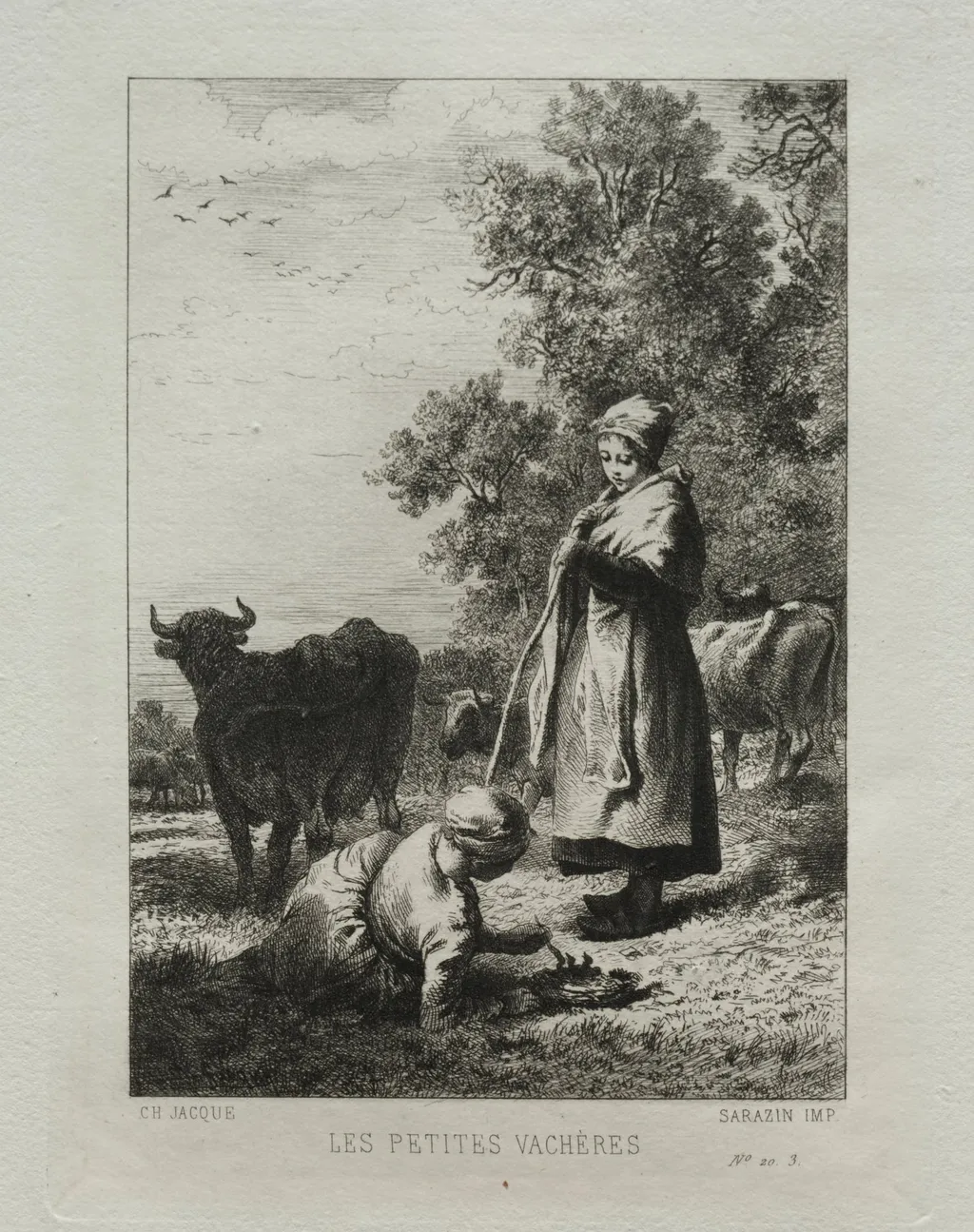
The Little Cowherds is a print by the Impressionist artist Charles Jacque. It dates from 1864 and is held in the collection of the Cleveland Museum of Art.
About this work
Overview
Jacque, linked to the Barbizon School, focused on agricultural life with technical precision shaped by his earlier work as a military map engraver.
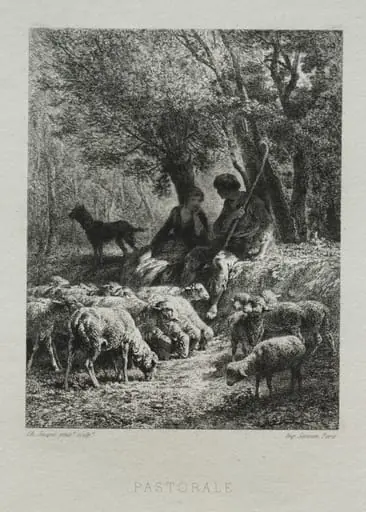
Created in 1864 by Charles-Émile Jacque, *The Little Cowherds* is a black-and-white print depicting rural laborers in a quiet, open landscape. Jacque, linked to the Barbizon School, focused on agricultural life with technical precision shaped by his earlier work as a military map engraver. The piece captures a moment of stillness rather than drama, aligning with the movement’s interest in unidealized rural existence.
Subject & Meaning
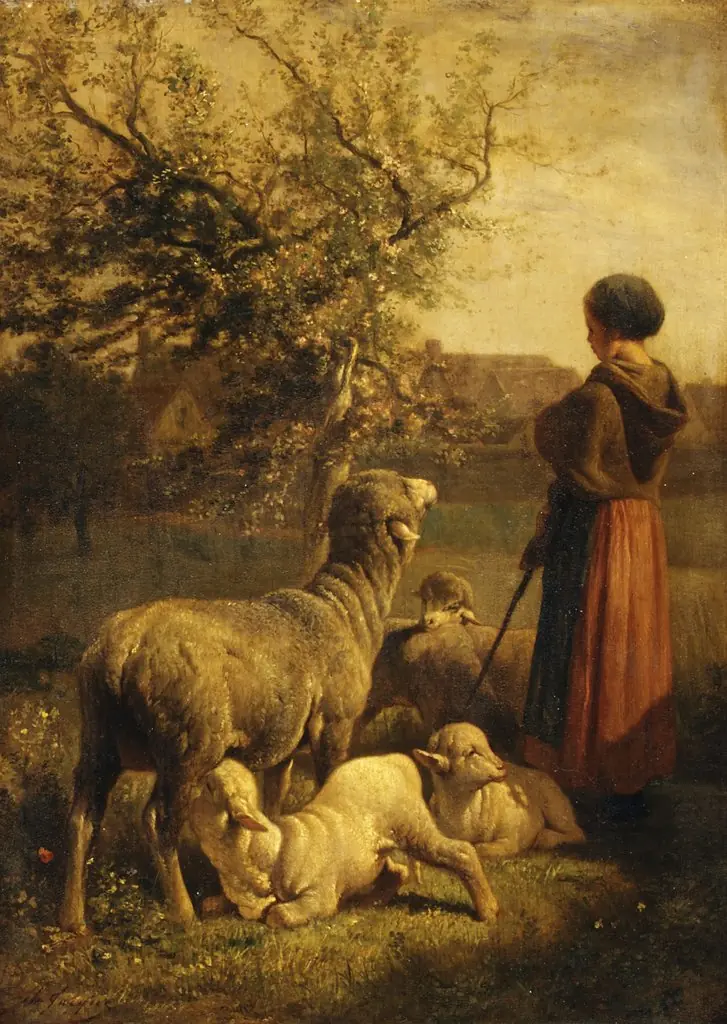
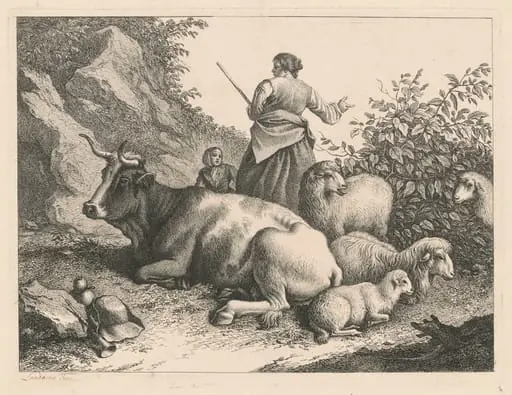
The scene shows a young girl in a headscarf and long dress, standing with a stick as she observes two cows and a sheep grazing nearby. The title, *Les Petites Vachères*, identifies her as one of several child herders common in 19th-century French countryside labor. The composition avoids sentimentality, presenting her role as ordinary and unremarkable, reflecting a broader cultural recognition of rural work as worthy of artistic attention.
Technique & Style
Jacque employed fine, controlled lines to model form and suggest light, drawing from his engraving background. The contrast between the girl’s solid silhouette and the softly rendered grass and distant hill creates depth without shading. Birds in flight and sparse tree outlines add subtle movement, while the absence of facial detail universalizes the figure, emphasizing her function over individual identity.
History & Provenance
Produced during Jacque’s active years in Barbizon, the print was likely made for a broader audience interested in rural themes. It circulated among collectors and artists aligned with Realism, though specific early ownership records are limited. Its survival reflects the period’s growing appreciation for prints as legitimate art forms, distinct from painting but equally expressive of social observation.
Context
In mid-19th-century France, industrialization reshaped rural life, prompting artists to document disappearing traditions. Jacque, alongside Millet and others, turned to the fields and pastures of Fontainebleau for subject matter. *The Little Cowherds* fits within this effort: a quiet record of children’s labor, unembellished and grounded in daily reality, countering academic idealism with observational honesty.
Legacy
The print contributed to the legitimization of rural subjects in printmaking and influenced later Realist artists who valued everyday scenes. While not widely exhibited today, it remains a representative example of how technical skill in engraving could convey emotional restraint and social awareness. Its endurance lies in its unadorned depiction of labor, a quiet testament to a vanishing way of life.
Artist & collection
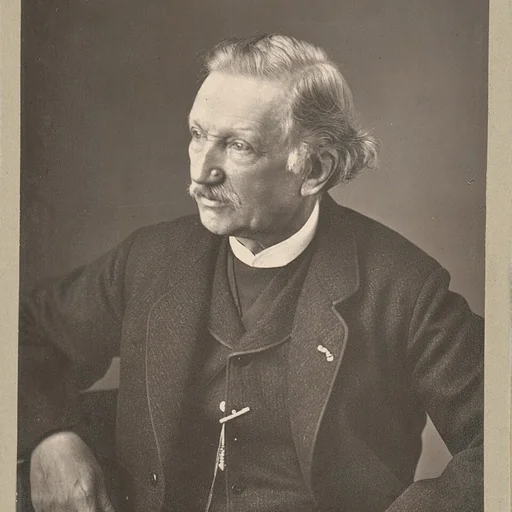
Artist
Charles-Émile Jacque (23 May 1813 – 7 May 1894) was a French painter of Pastoralism and engraver who was, with Jean-François Millet, part of the Barbizon School. He first learned to engrave maps when he spent seven years in the French Army.