Artwork
Agra
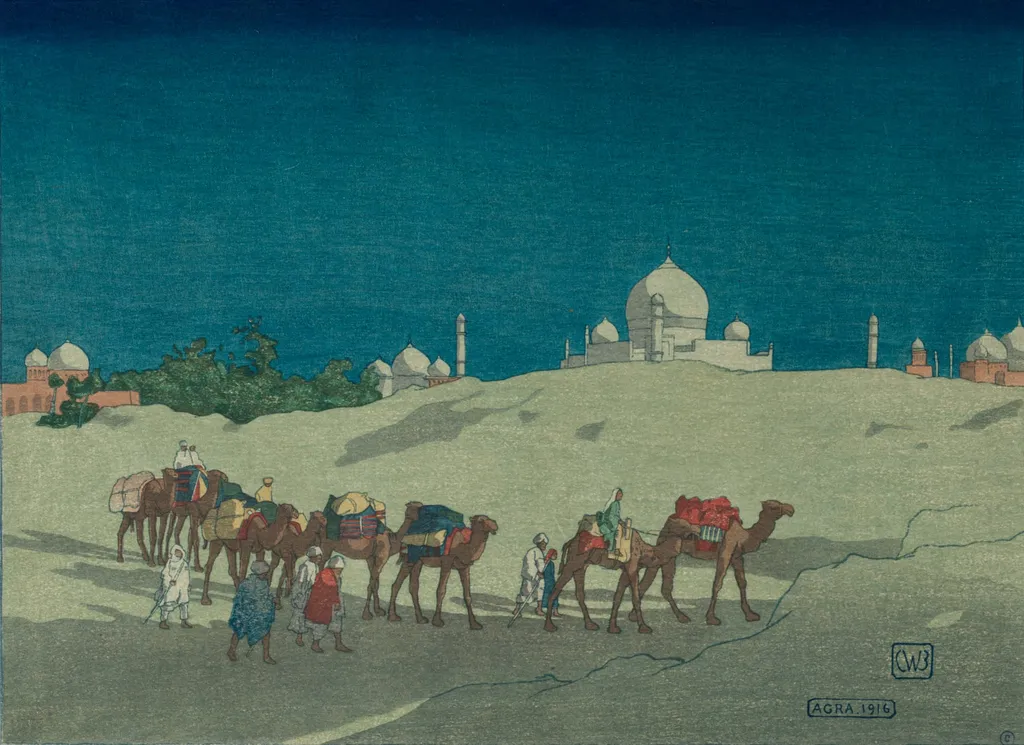
Agra is a print by Charles William Bartlett. It dates from 1916 and is held in the collection of the Cleveland Museum of Art.
About this work
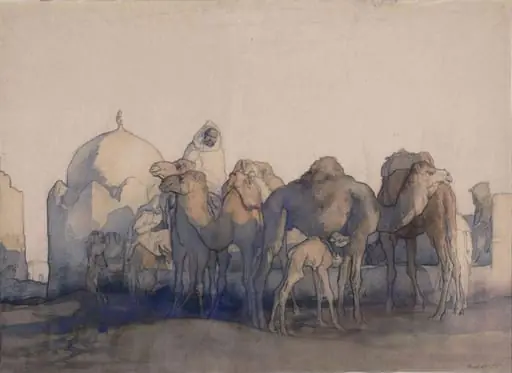
This painting shows a desert scene with a group of people and camels walking toward a domed building in the distance.
This painting shows a desert scene with a group of people and camels walking toward a domed building in the distance. The sky is a deep blue, and the sand is light greenish-brown. The camels carry colorful blankets and bags, and the people wear loose robes in different colors. The building in the background has white domes and tall minarets.
The artist signed it "C.W.B." and wrote "Agra, 1916" in the corner, which might hint at the location. The way the light hits the figures and buildings gives a soft, even glow.
Next, check out The Cleveland Museum of Art to see more works like this.
Overview
Agra, created in 1916 by Charles William Bartlett, is a watercolor print depicting a desert landscape in northern India. The work captures a caravan of figures and camels approaching a distant architectural complex. Bartlett signed the piece with his initials and dated it, affirming its connection to the city of Agra. The composition emphasizes quiet movement and atmospheric harmony, reflecting the artist’s interest in travel and regional scenery.
Subject & Meaning
The scene portrays a group of travelers and their camels moving toward a monumental structure with domes and minarets, likely the Taj Mahal. The figures, dressed in varied robes, suggest a pilgrimage or daily journey through the arid terrain. The absence of dramatic action conveys a sense of routine and endurance. The building, rendered with subtle detail, anchors the composition as a destination both physical and symbolic.
Technique & Style
Bartlett employed watercolor with a restrained palette of pale greens, soft browns, and deep blue skies. The light is diffused evenly, creating a calm luminosity across sand and stone. Brushwork is loose yet deliberate, suggesting form without sharp definition. The lack of harsh shadows enhances the serene mood, aligning with the artist’s preference for tonal harmony over contrast, typical of his Orientalist-inspired works.
History & Provenance
The work entered the collection of The Cleveland Museum of Art after being acquired from the artist’s estate or through a dealer. Bartlett, a British-born painter active in Asia during the early 20th century, produced numerous works during his travels in India and Japan. Agra is one of several pieces from this period that document his engagement with South Asian architecture and culture, preserved as part of the museum’s print holdings.
Context
Created during the British colonial period in India, the work reflects a Western artist’s perspective on Indian landscapes and architecture. While not overtly political, it aligns with a broader trend among European painters who sought to capture the exoticism of the subcontinent. Bartlett’s approach, however, avoids sensationalism, favoring quiet observation over romanticized spectacle, distinguishing his work from more theatrical Orientalist depictions.
Legacy
Agra remains a representative example of Bartlett’s mature style and his commitment to documenting travel through subtle, atmospheric rendering. Though not widely exhibited, it contributes to scholarly understanding of early 20th-century Western engagement with Indian visual culture. The piece endures as a quiet record of a moment in time, valued for its restraint and sensitivity rather than its scale or drama.
Own this work as a print
Artist & collection

Artist
Charles William Bartlett was an English painter and printmaker who settled in Hawaii.