Artwork
L'Allocution, 20 juillet, 1830
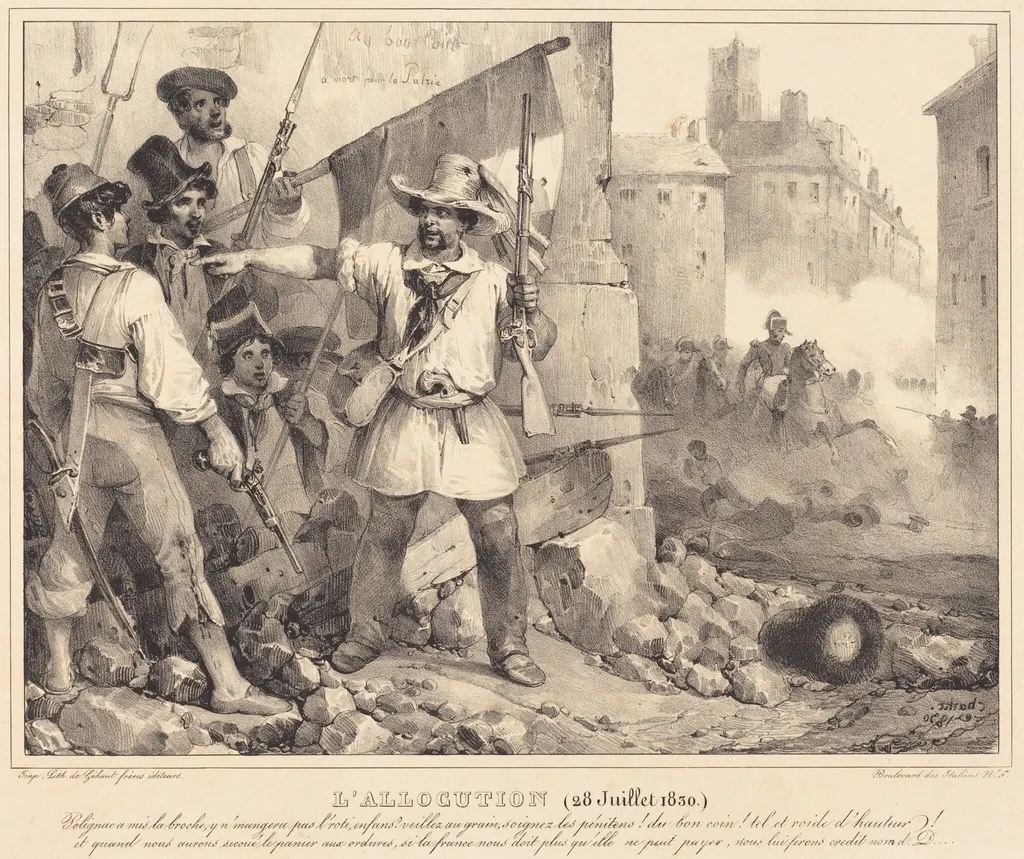
L'Allocution, 20 juillet, 1830 is an ink print by the Romanticist artist Nicolas Toussaint Charlet. It dates from 1830 and is held in the collection of the National Gallery of Art.
About this work
Overview
Created in 1830, *L'Allocution, 20 juillet, 1830* is a lithograph by Nicolas-Toussaint Charlet, capturing a moment of civic agitation during the July Revolution in France. Executed on wove paper, the work exemplifies Charlet’s engagement with contemporary political events through the accessible medium of printmaking, aligning his artistic practice with the turbulent spirit of the era.
Subject & Meaning
The image portrays a civilian or militia figure addressing a gathered crowd, rifle in hand and sash across his chest, as if delivering a call to action.
The image portrays a civilian or militia figure addressing a gathered crowd, rifle in hand and sash across his chest, as if delivering a call to action. His gesture and the attentive faces around him suggest a moment of mobilization. The presence of a national flag and urban architecture implies a localized uprising rooted in communal identity, reflecting the revolutionary fervor that swept Paris that summer.
Technique & Style
Charlet employed lithography to achieve sharp contrasts and dynamic line work, emphasizing the central figure through bold contours and dramatic chiaroscuro. The crowd is rendered with loose, energetic strokes, creating a sense of movement and urgency. The composition directs focus to the speaker while preserving the texture of everyday clothing and architecture, grounding the scene in realism.
History & Provenance
Produced shortly after the July Days of 1830, the print was likely circulated as a political commentary or propaganda piece. Charlet, known for his sympathetic portrayals of soldiers and common citizens, used lithography to reach a broad audience. The work’s immediate production suggests it was tied to the events it depicted, possibly distributed in the weeks following the king’s abdication.
Context
The print emerged during a pivotal moment in French history, when public dissent over Charles X’s authoritarian decrees erupted into street fighting. Charlet’s depiction of an ordinary man rallying others mirrors the decentralized nature of the revolution, where citizens, not just soldiers, assumed roles of leadership. Lithographs like this helped shape public perception of the uprising as a popular movement.
Legacy
*L'Allocution* stands as an early example of political lithography in France, demonstrating how printmaking could document and influence public sentiment. Charlet’s focus on the individual within collective action influenced later artists engaged with social themes. The work remains a tangible record of how visual culture intersected with revolutionary change in the 19th century.
Artist & collection

Artist
Nicolas-Toussaint Charlet was a French painter and printmaker, more especially of military subjects.