Artwork
Idyll
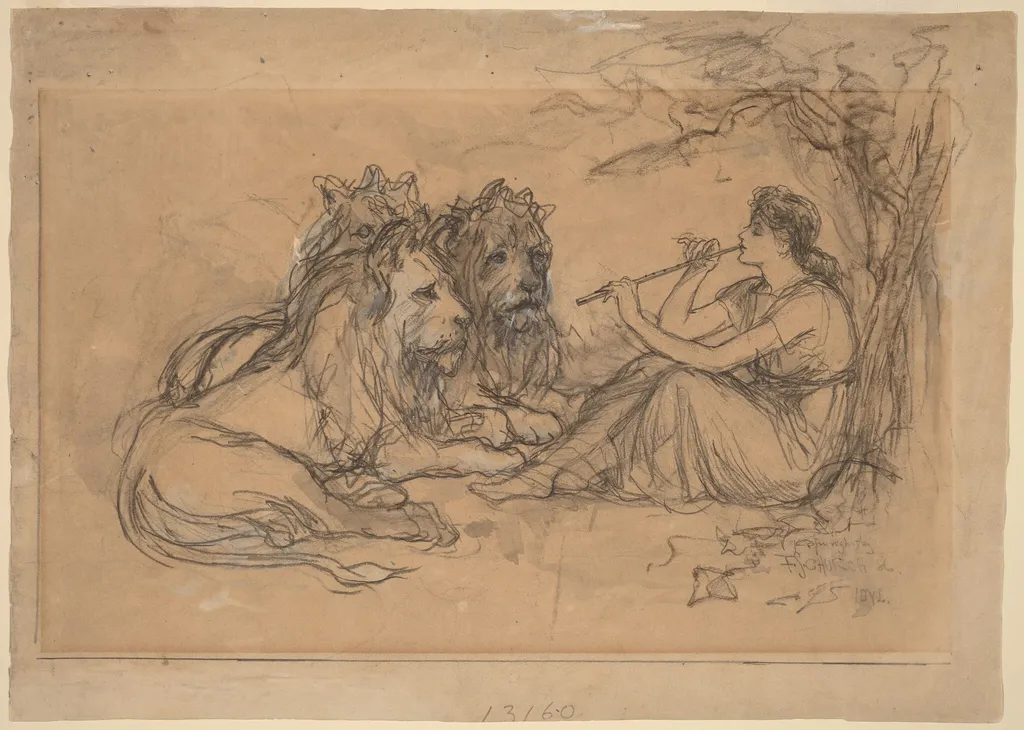
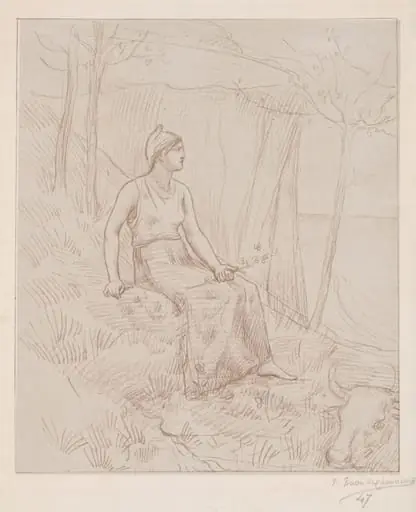
Idyll is a graphite drawing by the Impressionist artist Frederic Stuart Church. It dates from 1886 and is held in the collection of the National Gallery of Art.
About this work
Overview
Created in 1886 by Frederic Stuart Church, Idyll is a delicate drawing executed in graphite, gray wash, and white heightening on brown paper. The composition captures a quiet, dreamlike moment between a woman and a lion, rendered with minimal detail and a sense of atmospheric softness. The medium and handling suggest spontaneity, prioritizing mood over precision.
Subject & Meaning
The scene depicts a solitary woman playing a flute, accompanied by a serene lion at her side. Their calm coexistence evokes a mythic or allegorical tone, suggesting harmony between humanity and nature. The absence of narrative context invites interpretation, positioning the image as an idyllic fantasy rather than a documented event.
Technique & Style
Church employed loose, fluid lines and subtle gray washes to suggest form without definition. White highlights add luminosity to the woman’s dress and the lion’s flank, while the background dissolves into indistinct trees and hills. The effect is one of gentle ambiguity, with edges blurred to enhance the ethereal quality of the scene.
History & Provenance
Idyll was produced during Church’s later period, when he increasingly favored intimate, poetic subjects over grand historical themes. The drawing remained in private collections after its creation and was later acquired by a major American museum, where it is now preserved as an example of his lyrical draftsmanship.
Context
In the late 19th century, American artists often turned to allegory and nature to express emotional or spiritual ideals. Church’s work aligns with this trend, reflecting a broader interest in mythic harmony and the sublime. His use of wash and minimal line echoes contemporary European sketch traditions, particularly those emphasizing atmosphere over detail.
Legacy
Idyll endures as a quiet testament to Church’s ability to convey emotion through restraint. Though not widely exhibited, it is recognized in scholarly circles for its sensitive handling of light and form. The drawing exemplifies how understated techniques can evoke powerful, lingering impressions without overt narrative.
Artist & collection


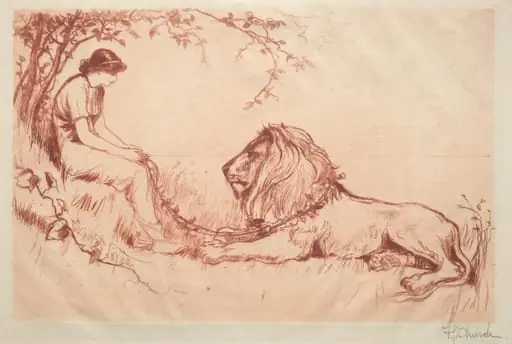 The Lion in Love
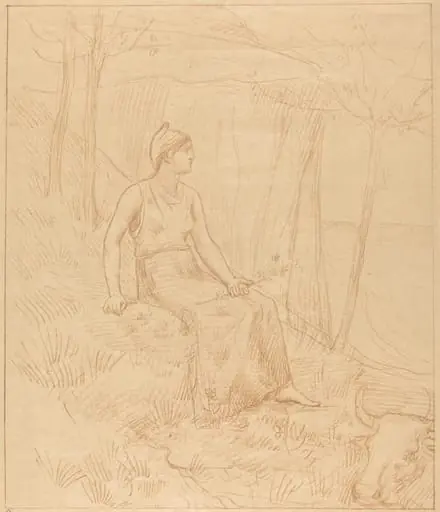 Normandie (Normandy)
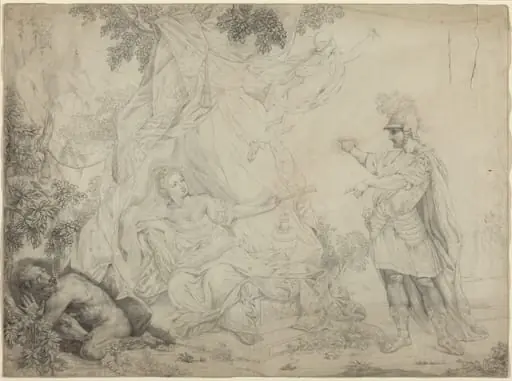 Circe and Ulysses
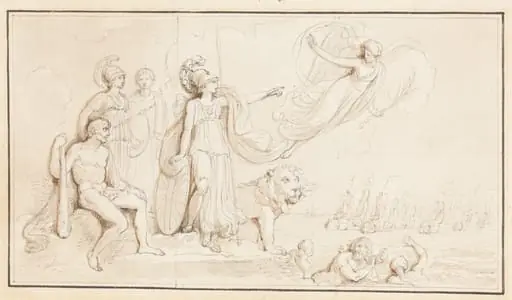 An Allegory of Britain's Naval Might
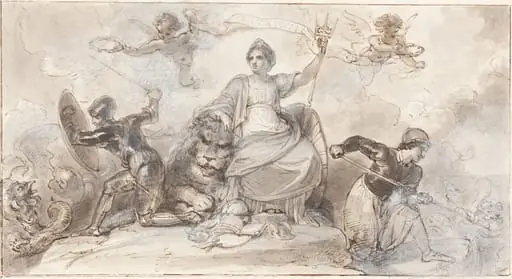 Patriotic Fund
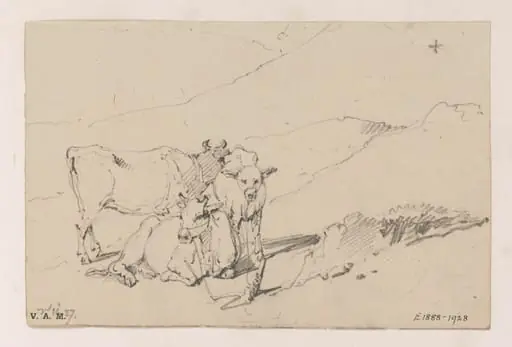 Three cows
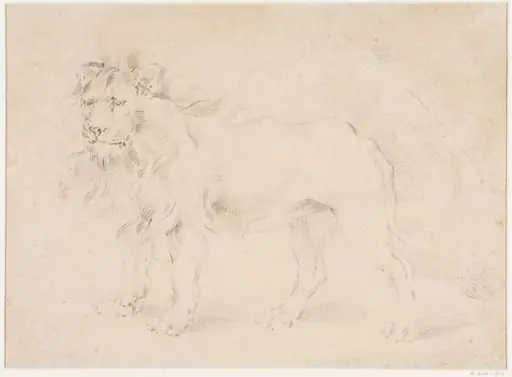 Study of a lion
![Contending Group after Nature [A Lion Fighting a Tiger and a Leopard], by Edwin, Sir Landseer](https://artifactworldgallery.com/img/edwin-sir-landseer--contending-group-after-nature-a-lion-fighting-a-tiger-and-a--3801d18d30f50081-w320.webp) Contending Group after Nature [A Lion Fighting a Tiger and a Leopard]
Contending Group after Nature [A Lion Fighting a Tiger and a Leopard]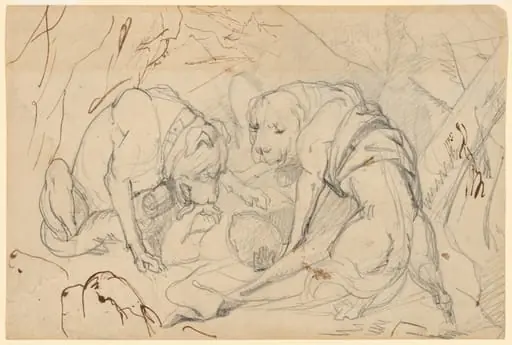 Study for "Alpine Mastiffs Reanimating a Distressed Traveler" (recto); Study for "Alpine Mastiffs Reanimating a Distressed Traveler" (verso)
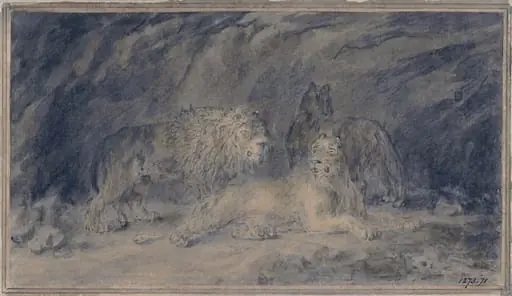 Lion and lionesses
 Normandy