Artwork
Contending Group after Nature [A Lion Fighting a Tiger and a Leopard]
![Contending Group after Nature [A Lion Fighting a Tiger and a Leopard], by Edwin, Sir Landseer, graphite, 1822](https://artifactworldgallery.com/img/edwin-sir-landseer--contending-group-after-nature-a-lion-fighting-a-tiger-and-a--3801d18d30f50081-w1024.webp)
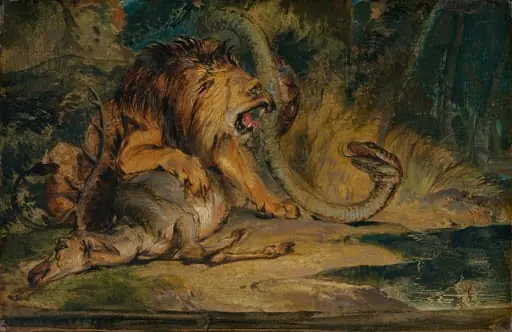
Contending Group after Nature [A Lion Fighting a Tiger and a Leopard] is a graphite drawing by the Romanticist artist Edwin, Sir Landseer. It dates from 1822 and is held in the collection of the National Gallery of Art. Created in 1822 by Sir Edwin Landseer, this drawing captures a violent encounter between three large felines.
About this work
Overview
Created in 1822 by Sir Edwin Landseer, this drawing captures a violent encounter between three large felines. Executed in pen and ink with washes over graphite on laid paper, the work is mounted and preserved in the National Gallery of Art, Washington. It reflects Landseer’s early fascination with animal anatomy and behavior, rendered with dynamic precision and emotional intensity.
Subject & Meaning
The scene portrays a lion, overwhelmed and on its back, fending off simultaneous attacks from a tiger and a leopard. Each animal is depicted with anatomical accuracy, their postures conveying struggle and survival. The composition suggests a naturalistic confrontation rather than a symbolic allegory, emphasizing raw physicality over narrative moralizing.
Technique & Style
Landseer employed bold, fluid pen lines to define musculature and motion, layered with gray and brown washes to model volume and shadow. The graphite underdrawing guides the forms, while the washes create atmospheric depth and texture in the surrounding foliage. Contrasts between dark contours and soft tonal transitions enhance the sense of movement and tension.
History & Provenance
The drawing was produced during Landseer’s formative years, shortly after his first public exhibition of animal subjects. It remained in the artist’s possession until his death, later entering the National Gallery of Art’s collection through established provenance. Its preservation reflects its significance as an early example of his observational approach to wildlife.
Context
In the early 19th century, European artists increasingly turned to direct observation of animals, influenced by scientific inquiry and colonial encounters with exotic species. Landseer’s work aligns with this trend, drawing from live specimens and anatomical studies rather than idealized traditions, marking a shift toward naturalism in British art.
Legacy
This drawing exemplifies Landseer’s lifelong commitment to depicting animals with psychological and physical realism. It influenced later generations of animal painters and contributed to the broader acceptance of wildlife as a serious subject in fine art, grounded in empirical study rather than romanticized convention.
Own this work as a print
Artist & collection