Artwork
Monument of the Lord Chancellor Bacon, Saint Michael's Church
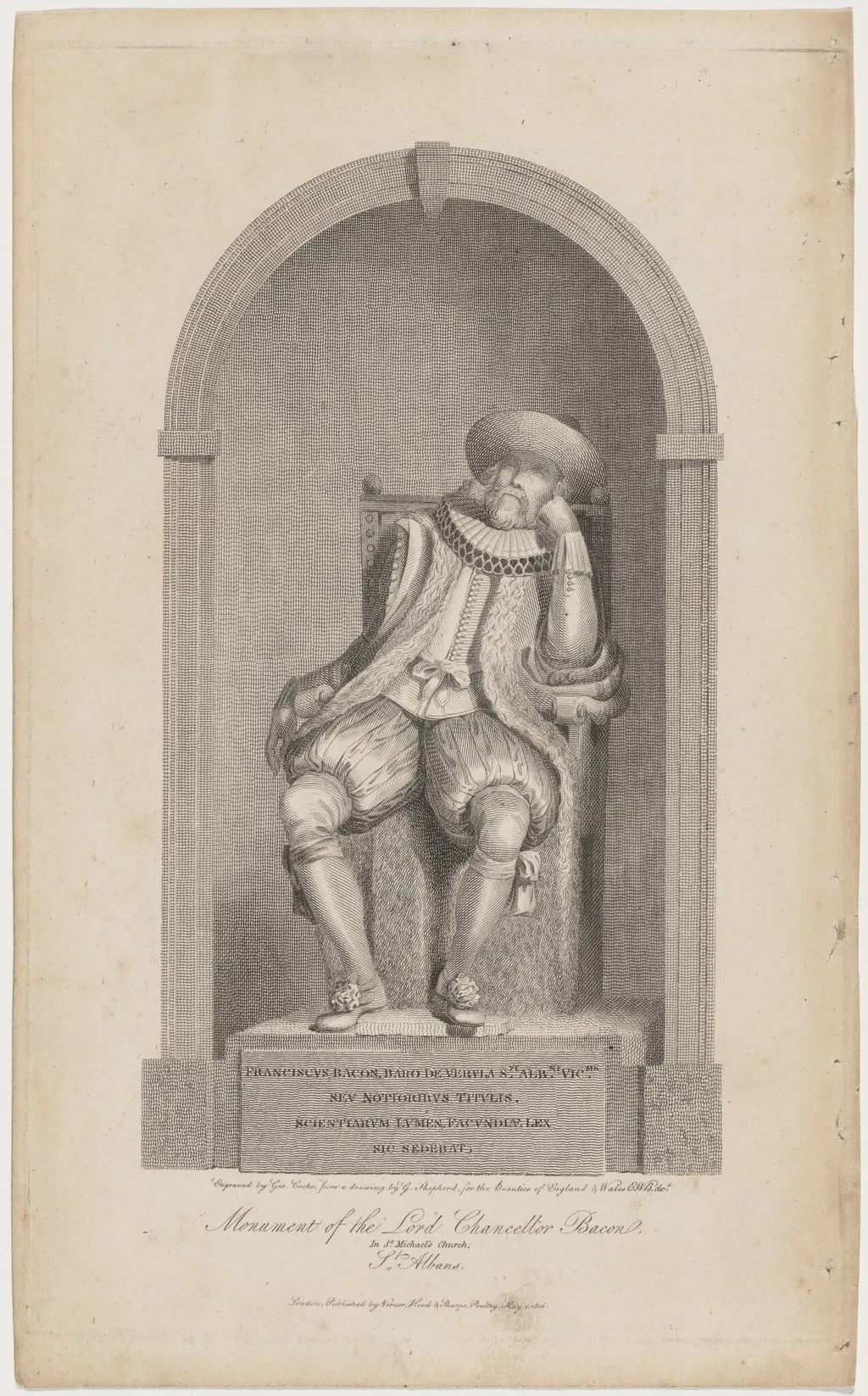
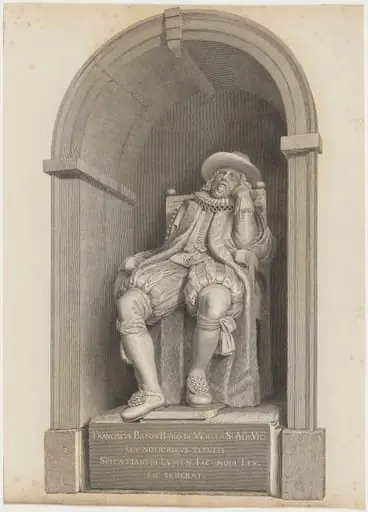
Monument of the Lord Chancellor Bacon, Saint Michael's Church is an ink print by the Romanticist artist George Cooke. It dates from 1808 and is held in the collection of the National Gallery of Art.
About this work
Overview
Rendered in fine line work, the print captures the effigy as it appears in situ, emphasizing architectural framing and the figure’s formal attire.
An 1808 engraving by George Cooke depicts the memorial monument of Francis Bacon, Lord Chancellor, located in Saint Michael’s Church. Rendered in fine line work, the print captures the effigy as it appears in situ, emphasizing architectural framing and the figure’s formal attire. The composition reflects the conventions of commemorative portraiture in early 19th-century Britain, prioritizing dignity and historical presence over naturalism.
Subject & Meaning
The figure represents Sir Francis Bacon, distinguished statesman and philosopher, commemorated in his ecclesiastical tomb. His posture—hand resting on the chin—suggests contemplation, aligning with his reputation as a thinker. The archway and pedestal frame him as a figure of enduring intellectual and institutional authority, reinforcing the monument’s function as a tribute to legacy rather than mere likeness.
Technique & Style
Cooke employs precise cross-hatching to model form and texture, particularly in the fabric of the collar and voluminous breeches. The engraving’s tonal gradations create depth without color, relying on line density to suggest shadow and volume. The architectural backdrop is rendered with geometric clarity, enhancing the monument’s solemnity and structural permanence.
History & Provenance
The engraving was produced as part of a broader effort to document historic church monuments in England during the early 1800s. Cooke, known for topographical prints, likely worked from direct observation or preparatory sketches made at the church. The print was circulated among antiquarians and scholars, serving as a record before modern conservation practices.
Context
In the early 19th century, there was growing interest in preserving and documenting England’s ecclesiastical heritage. Engravings like this one functioned as both historical records and cultural artifacts, reflecting a period when visual documentation was vital for understanding pre-industrial monuments. Bacon’s memorial, though centuries old, was reinterpreted through contemporary aesthetic and scholarly lenses.
Legacy
Cooke’s engraving remains a key visual source for studying the appearance of Bacon’s tomb prior to potential alterations or deterioration. It exemplifies the role of printmaking in early antiquarian scholarship, offering insight into how historical figures were visually memorialized in the age before photography. The work contributes to the archive of British commemorative art.
Artist & collection