Artwork
Badeanstalt (Bathing Place)
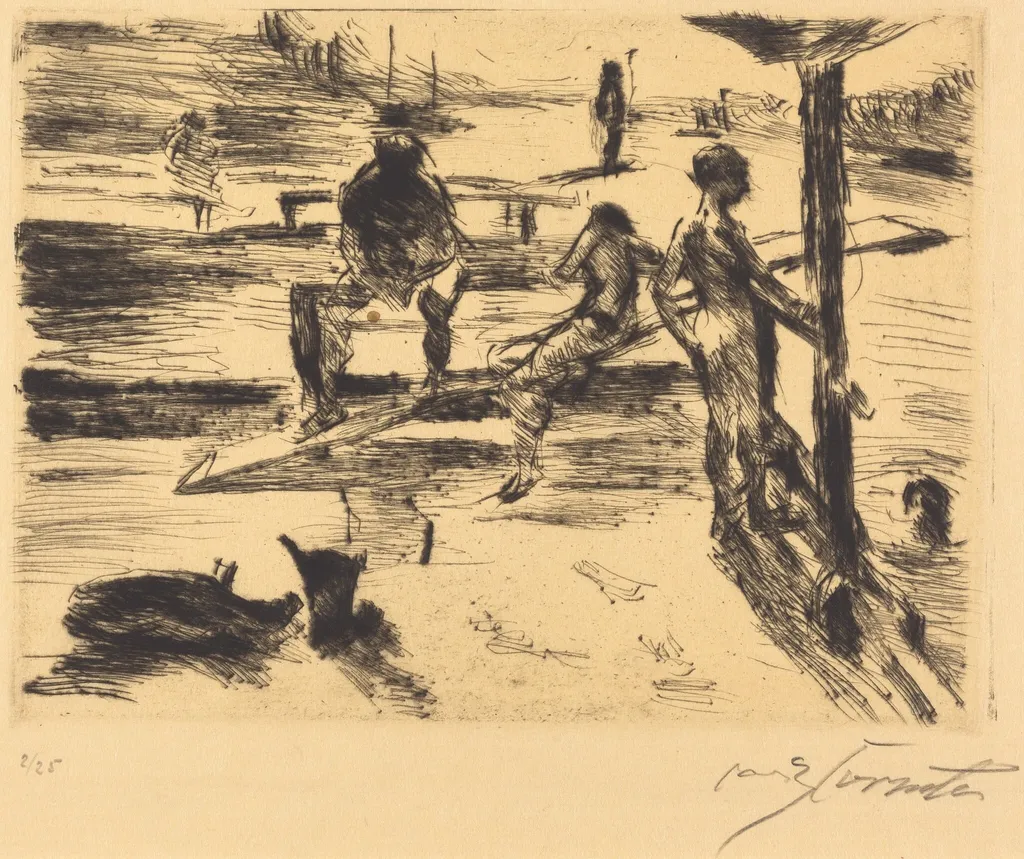
Badeanstalt (Bathing Place) is an ink print by Lovis Corinth. It dates from 1919 and is held in the collection of the National Gallery of Art.
About this work
Overview
Unlike his earlier academic style, this work embraces spontaneity and tactile surface variation, characteristic of his mature approach to printmaking.
Lovis Corinth produced Badeanstalt in 1919 as a drypoint print on wove paper, part of his late graphic work following a stroke in 1911. The piece belongs to a series of bathhouse scenes he explored during this period, reflecting a shift toward expressive, gestural mark-making. Unlike his earlier academic style, this work embraces spontaneity and tactile surface variation, characteristic of his mature approach to printmaking.
Subject & Meaning
The scene portrays a group of bathers in a public bathing facility, some seated on a bench, others standing or moving casually. There is no narrative drama—only quiet, unidealized moments of daily life. The figures are rendered without sentimentality, suggesting Corinth’s interest in human presence rather than moral or aesthetic idealization. The setting implies a communal, ordinary ritual, grounded in observation rather than symbolism.
Technique & Style
Corinth used drypoint to create dense, scratchy lines that build form through texture rather than outline. The black ink on wove paper enhances contrast and depth, with areas of heavy burr suggesting shadow and volume. His brushwork in drawing translates into a rough, energetic line quality, revealing the physical act of mark-making. This technique aligns with expressionist tendencies, prioritizing emotional resonance over precise detail.
History & Provenance
Created in 1919, the print emerged during Corinth’s post-stroke period in Berlin, when he increasingly turned to printmaking as a means of artistic renewal. He had been active in the Berlin Secession since 1909, and this work reflects his continued engagement with modernist currents. While specific early ownership records are not widely documented, the piece is held in major institutional collections today, reflecting its significance in his graphic oeuvre.
Context
In postwar Germany, artists like Corinth turned to intimate, everyday subjects as a response to societal upheaval. Public bathing places were common urban spaces, often depicted in late 19th- and early 20th-century art as sites of naturalism. Corinth’s treatment diverges from idealized nudes of the past, instead presenting the body in unadorned, unheroic poses, aligning with broader trends toward psychological realism in Weimar-era art.
Legacy
Badeanstalt exemplifies Corinth’s transformation into a more visceral, emotionally direct artist after his illness. His drypoints from this period influenced later generations of German printmakers who valued expressive line and raw observation. Though less celebrated than his paintings, these prints remain vital for understanding his evolution and the broader shift toward expressionist modes in early 20th-century German art.
Artist & collection

Artist
Lovis Corinth was a German artist and writer whose mature work as a painter and printmaker realized a synthesis of impressionism and expressionism.

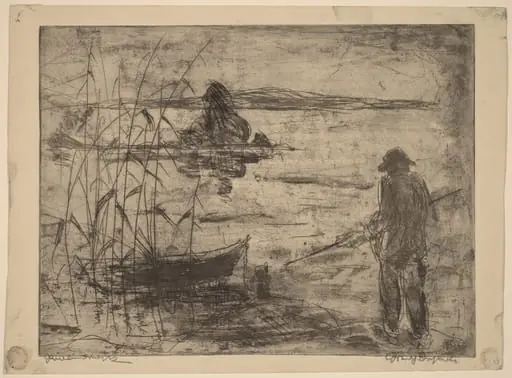 Fishing on the Havel River
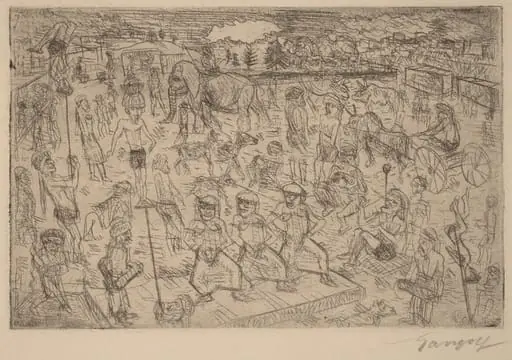 Hindu Village (Das Hindudorf)
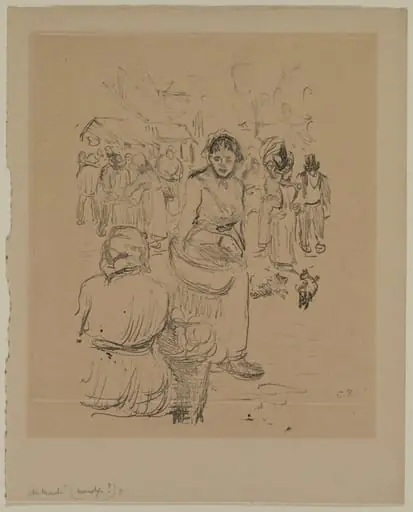 At the Market
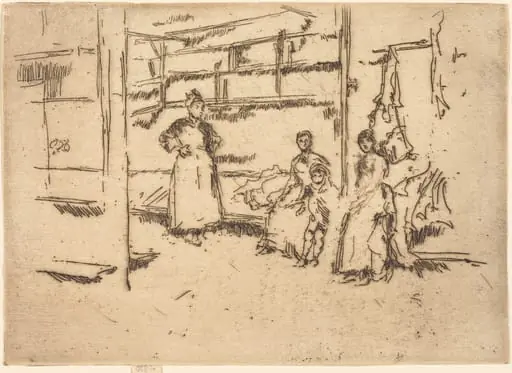 After the Sale, Hounsditch
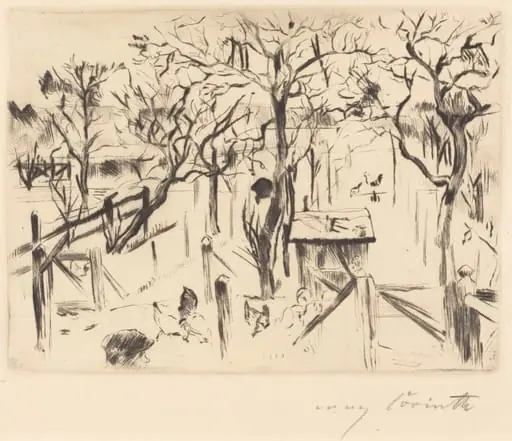 Obstgarten im Herbst (Fruit Garden in Autumn)
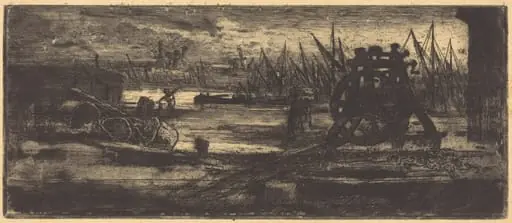 Un Vieux Chantier à Rochester (The Old Dock-yard at Rochester)
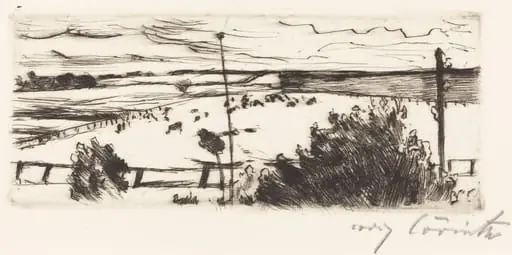 Küste (Seascape)
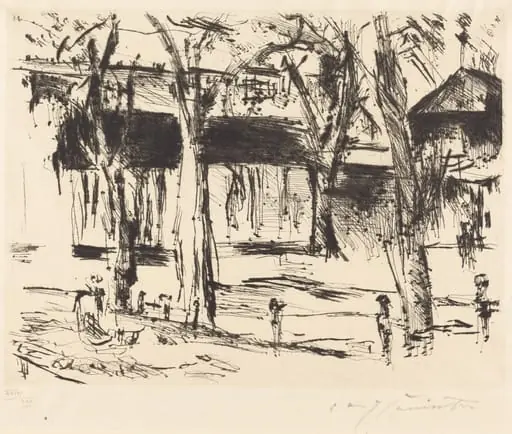 Bahnhof Tiergarten (Court with Trees)
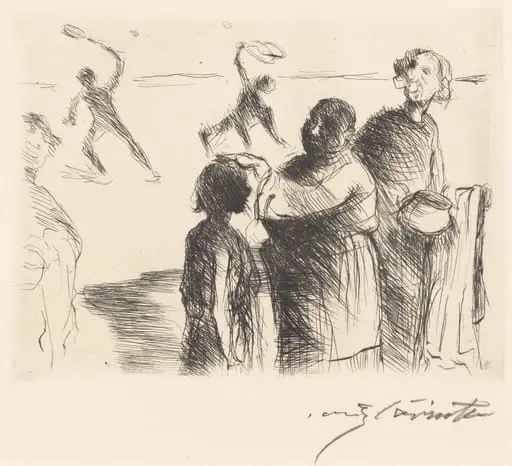 Das Gastmahl des Trimalchio: pl. II (The Banquet of Trimalchio: pl. II)
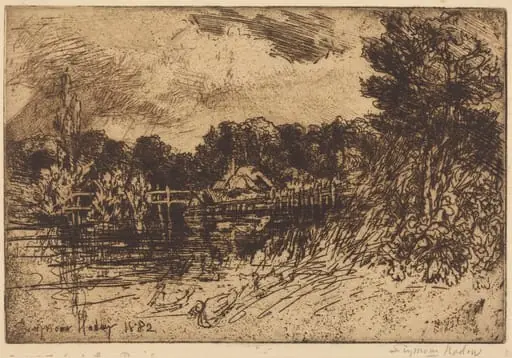 The Test at Longparish
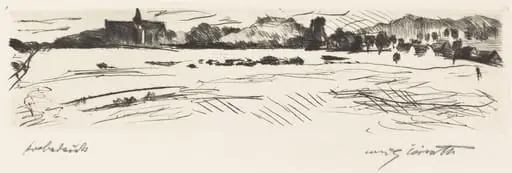 Dünenlandschaft (Landscape with Dunes)
 Tramp with Bundle (Le chemineau a la besace)