Artwork
Untitled
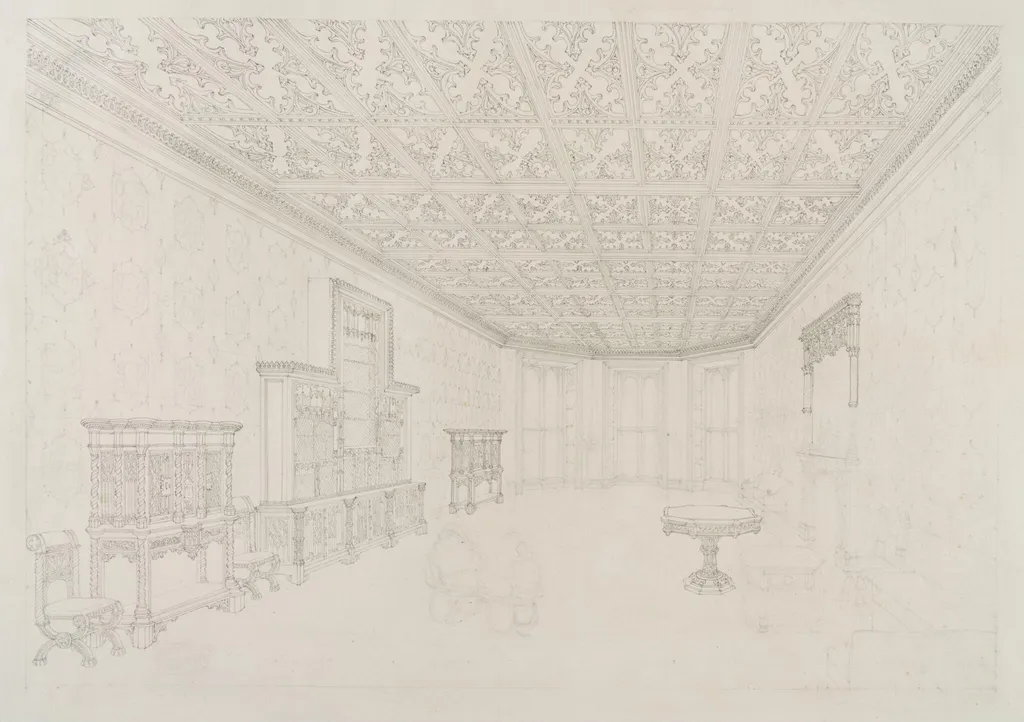
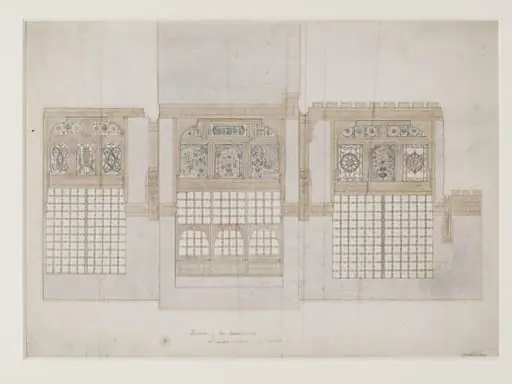
Untitled is a drawing by the Romanticist artist Lewis Nockalls Cottingham. It dates from 1842 and is held in the collection of the Victoria and Albert Museum.
About this work
Overview
The work serves as a functional blueprint rather than a decorative rendering, emphasizing spatial arrangement and structural detail over ornamentation.
This 1842 drawing by Lewis Nockalls Cottingham was prepared as a design proposal for the drawing room at Snelston Hall. It presents a carefully composed interior with bespoke furniture, reflecting Cottingham’s role as both architect and interior designer. The work serves as a functional blueprint rather than a decorative rendering, emphasizing spatial arrangement and structural detail over ornamentation.
Subject & Meaning
The composition depicts an unoccupied room intended for quiet contemplation, furnished with a central bookcase, two small tables, and a few chairs. The absence of people and the restrained palette suggest an environment designed for intellectual or private use. The arrangement implies order and serenity, aligning with 19th-century ideals of domestic refinement and scholarly leisure.
Technique & Style
Cottingham employed precise linear draftsmanship to model form and volume, using dense cross-hatching to define shadows and the solidity of furniture. The ceiling’s geometric pattern is rendered with delicate, measured strokes, contrasting with the plain walls. Light is implied through subtle tonal gradations rather than explicit highlights, reinforcing the drawing’s functional, architectural purpose.
History & Provenance
Commissioned by John Harrison, the drawing relates to the Gothic Revival house at Snelston Hall, which Cottingham designed between 1827 and 1828. The house was demolished in 1951, leaving this drawing as a key surviving record of its interior design. The work likely remained in Harrison’s possession or within Cottingham’s professional archive before entering institutional collections.
Context
In the early 1840s, British country houses increasingly emphasized interior coherence, with architects overseeing both structure and furnishings. Cottingham’s involvement in every aspect of Snelston Hall’s design reflects this trend. The drawing exemplifies the shift toward integrated design, where furniture was tailored to architectural space rather than selected from existing stock.
Legacy
As one of the few surviving interior design drawings from Cottingham’s practice, it offers insight into the transition from decorative excess to restrained, purpose-driven interiors in the Gothic Revival movement. Its preservation underscores the value placed on architectural documentation during a period when many country houses and their contents were lost to demolition or neglect.
Artist & collection
Artist
Lewis Cottingham spent his life fixing up old churches, squinting at crumbling stone arches until he could sketch the exact curve of a Gothic window.

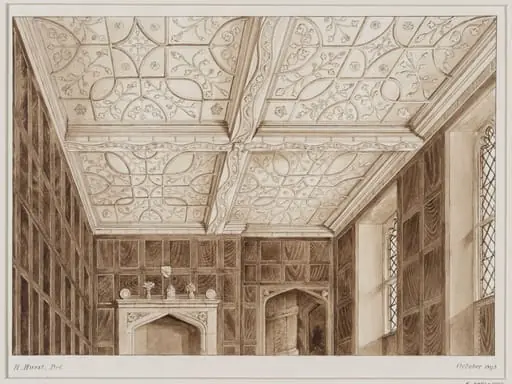 Untitled
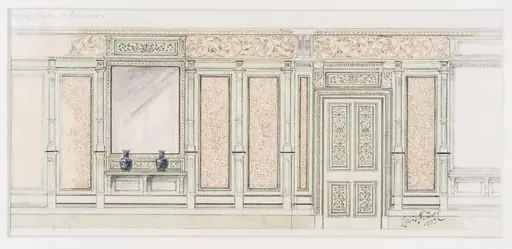 Untitled
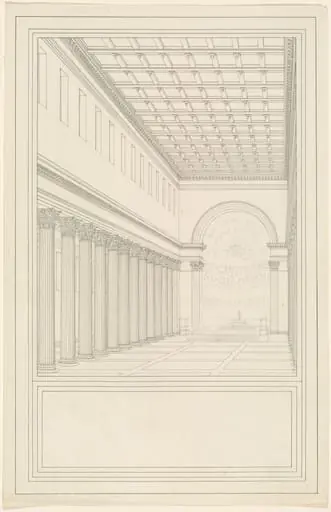 The Nave and Apse, without a Transept, of a Cathedral for Berlin
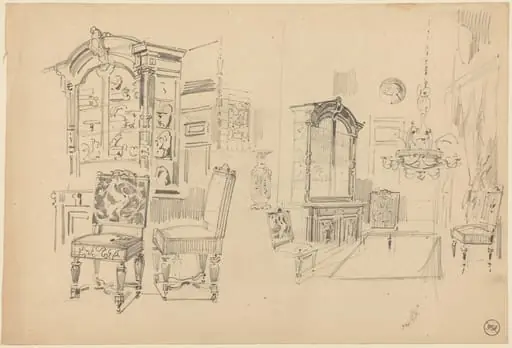 Two Studies of an Interior with Furniture
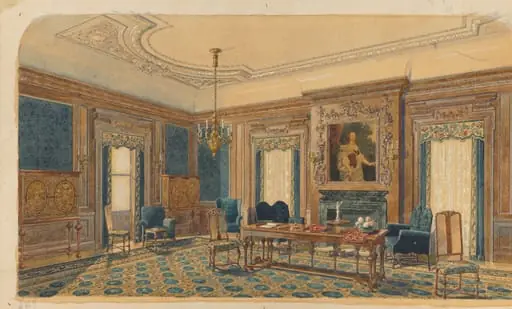 Sketch of Interior Design
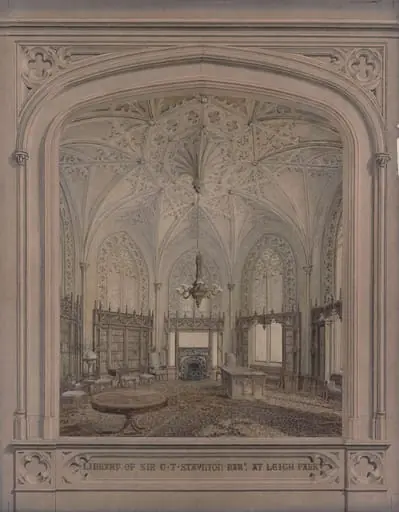 Library of Sir George Thomas Staunton, Bart, at Leigh Park
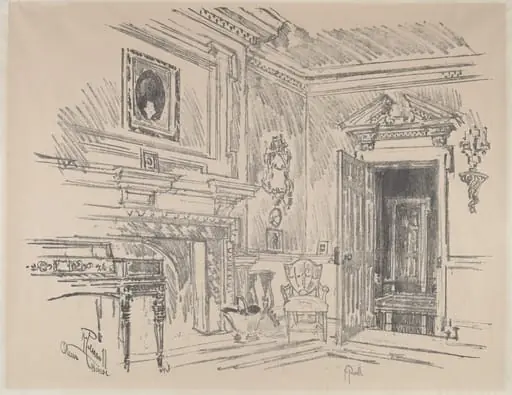 Drawing Room at Cliveden
 Cleopatra
 Perugino's Udienza del Cambio in the Collegio del Cambio, Perugia
 A panelled passage-way, Geffrye's Museum, Shoreditch
 Mendurah in my House in Cairo
 Drawing showing the interior decoration of houses in Cairo