Artwork
H Beard Print Collection
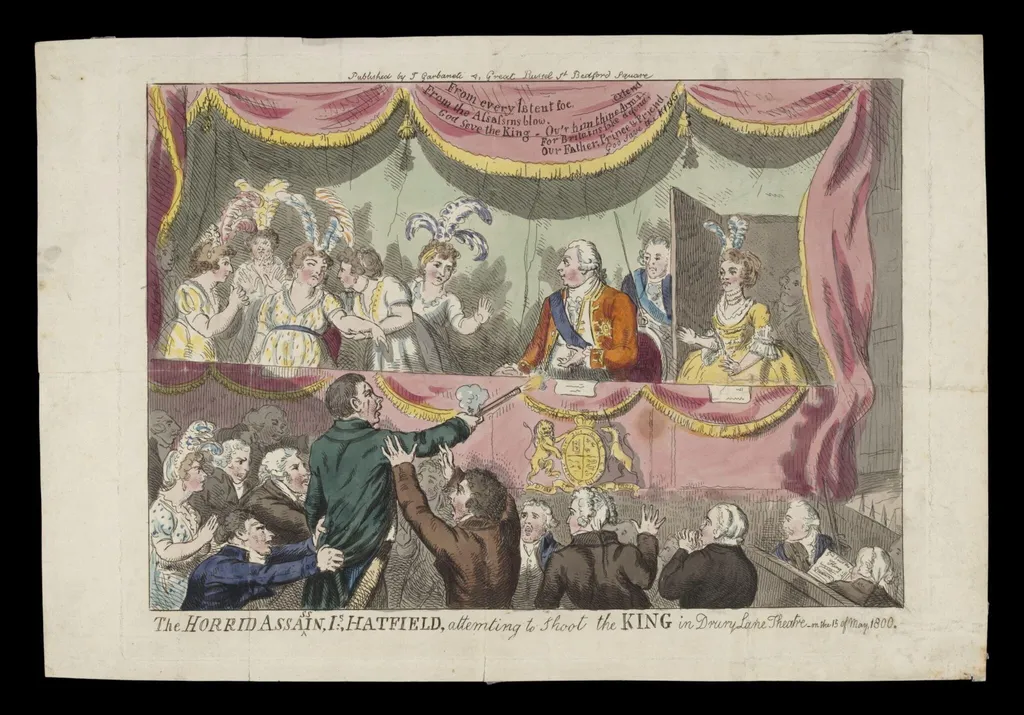
H Beard Print Collection is a print by the Romanticist artist Isaac Cruikshank. It dates from 1800 and is held in the collection of the Victoria and Albert Museum. This print captures the attempted assassination of King George III at the Drury Lane Theatre on May 15, 1800.
About this work
Overview
This print captures the attempted assassination of King George III at the Drury Lane Theatre on May 15, 1800. Produced in London by J. Garbaneti, it translates a real political crisis into a dramatic visual narrative, typical of early 19th-century broadsheet imagery aimed at a public eager for news rendered in spectacle.
Subject & Meaning
The scene depicts James Hadfield, a mentally unstable man, firing a pistol toward the king during a performance. Though the king was unharmed, the incident triggered national anxiety and intensified debates over security and mental competency in public life. The print frames the moment as both crime and theater, blurring the line between political act and public spectacle.
Technique & Style
Executed in the tradition of journalistic engraving, the print employs sharp lines and dense detail to convey motion and chaos. Figures are arranged for clarity rather than naturalism, with exaggerated gestures and theatrical lighting to heighten emotional impact. The style aligns with contemporaneous political prints, influenced by artists like George Cruikshank.
History & Provenance
Published shortly after the event, the print was part of a wave of rapid-response imagery circulating in London. It likely served as both news and moral caution, reinforcing state authority amid fears of regicide. Its attribution to Garbaneti, a known publisher of topical prints, situates it within a commercial print culture that thrived on current events.
Context
The attempt occurred during a period of heightened political tension following the French Revolution. British authorities responded with repressive legislation, including the Treasonable Practices Act. This print reflects public anxiety and the state’s effort to portray the monarchy as vulnerable yet resilient, using visual media to shape collective memory.
Legacy
Though not attributed to a major artist, the print exemplifies how mass-produced imagery shaped public understanding of political violence in Regency England. It contributed to a visual lexicon of regicide attempts that persisted in print culture, influencing later depictions of political danger and the role of the monarchy in national identity.
Artist & collection