Artwork
Achat d'un tableau horloge
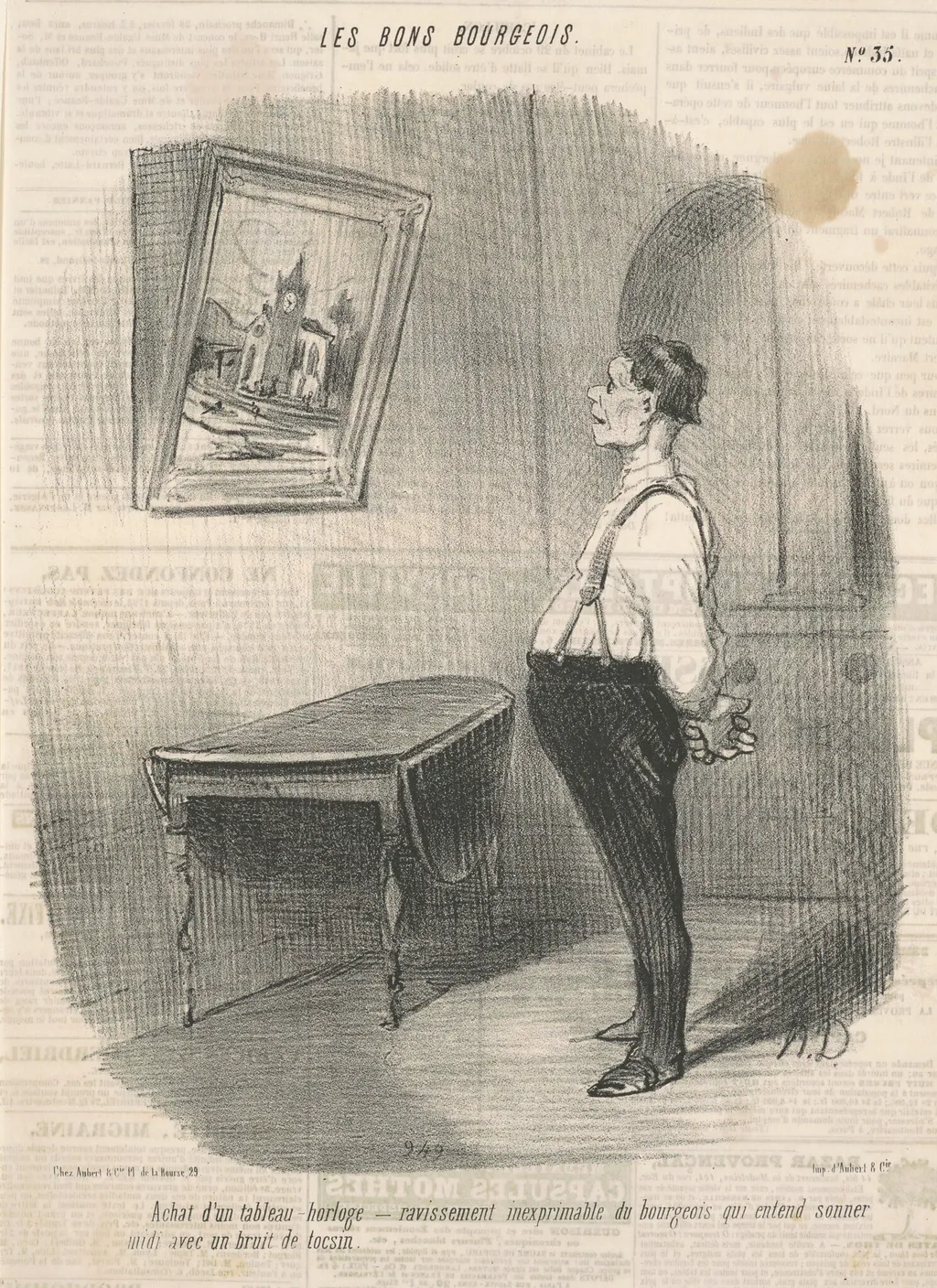
Achat d'un tableau horloge is an ink print by the Romanticist artist Honoré Daumier. It dates from 1847 and is held in the collection of the National Gallery of Art.
About this work
Overview
Honoré Daumier created this 1847 lithograph as part of his series critiquing bourgeois culture. The work depicts a single figure in profile, standing before a small religious painting, with no other elements to distract from the interaction between man and image. Rendered in the medium of lithography, it reflects Daumier’s skill in producing sharp, accessible prints for periodicals.
Subject & Meaning
The man, with exaggerated facial features, appears absorbed in contemplation before a serene church scene.
The man, with exaggerated facial features, appears absorbed in contemplation before a serene church scene. His posture and expression suggest a pretense of cultural refinement, while the contrast between his rugged visage and the tranquil painting underscores a disconnect between appearance and understanding. Daumier uses this juxtaposition to satirize middle-class pretensions toward art ownership.
Technique & Style
Daumier employed lithography to achieve bold, linear contrasts and expressive caricature. His use of heavy shading and simplified forms heightens the comedic tension between the figure and the painting. The composition is deliberately sparse, focusing attention on the psychological gap between the buyer and the artwork he admires, a hallmark of his graphic satire.
History & Provenance
Produced in 1847, the print was likely published in a French journal, as was common for Daumier’s work during this period. It belongs to a broader body of lithographs he created for Le Charivari, where he regularly lampooned social pretensions. No specific early ownership records are widely documented, but the image circulated widely among urban readers.
Context
In mid-19th century France, the rising middle class increasingly sought to display cultural capital through art acquisition, often without genuine appreciation. Daumier’s prints responded to this trend, highlighting the absurdity of purchasing art as status symbol. His work aligned with broader critiques of materialism and social climbing in post-revolutionary Paris.
Legacy
This lithograph exemplifies Daumier’s enduring influence on social satire in visual art. His ability to distill complex social behaviors into single, resonant images paved the way for later cartoonists and realist commentators. Though modest in scale, the work remains a precise example of how graphic art could challenge societal norms with wit and economy.
Artist & collection

Artist
Honoré-Victorin Daumier was a French painter, sculptor, and printmaker, whose many works offer commentary on the social and political life in France, from the Revolution of 1830 to the fall of the Second French Empire in 1870.









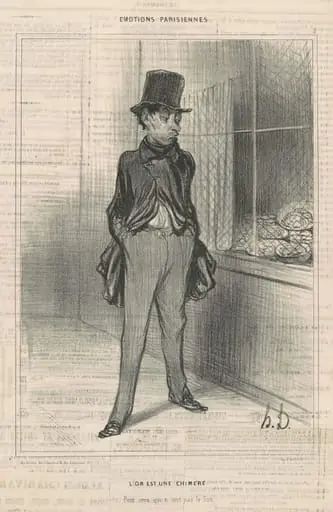 L'or est une chimère
![Aux Champs-Elysées, Ratapoil. Par suite d'une délibération philantropique [sic] du Comité du dix Décembre...à deux sous à club...deux sous..., by Honoré Daumier](https://artifactworldgallery.com/img/honore-daumier--aux-champs-elysees-ratapoil-par-suite-d-une-deliberation-phi--62ca0cc774af3945-w320.webp) Aux Champs-Elysées, Ratapoil. Par suite d'une délibération philantropique [sic] du Comité du dix Décembre...à deux sous à club...deux sous...
Aux Champs-Elysées, Ratapoil. Par suite d'une délibération philantropique [sic] du Comité du dix Décembre...à deux sous à club...deux sous...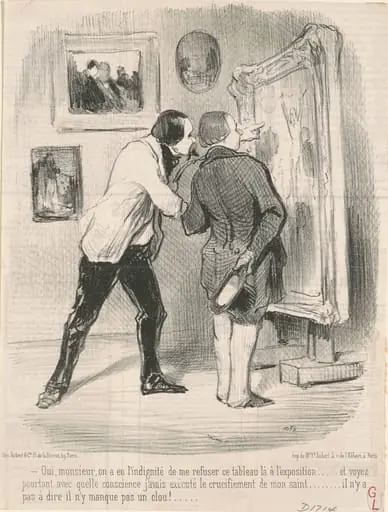 Oui ... on a eu l'indignité de me refuser ce tableau ...
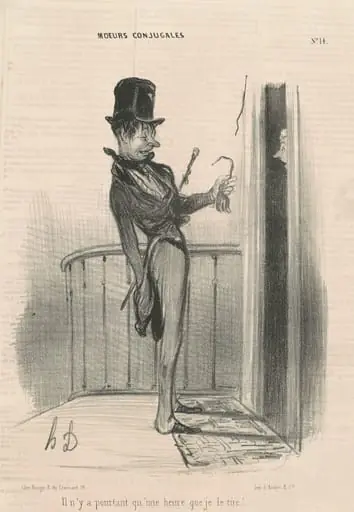 Il n'ya pas pourtant qu'une heure que je tire!
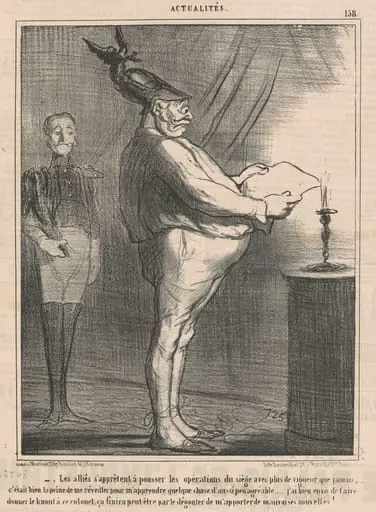 Les alliés s'appretent a pousser les opérations ...
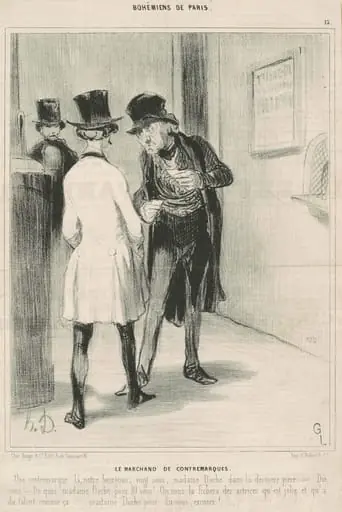 Le marchand de contremarques
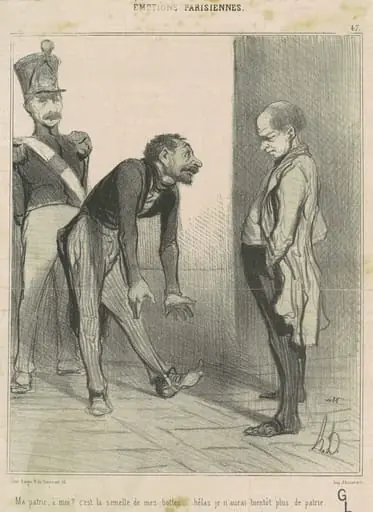 Ma patrie, a moi?...