Artwork
Allons bon ... c'est encore mon chien ...
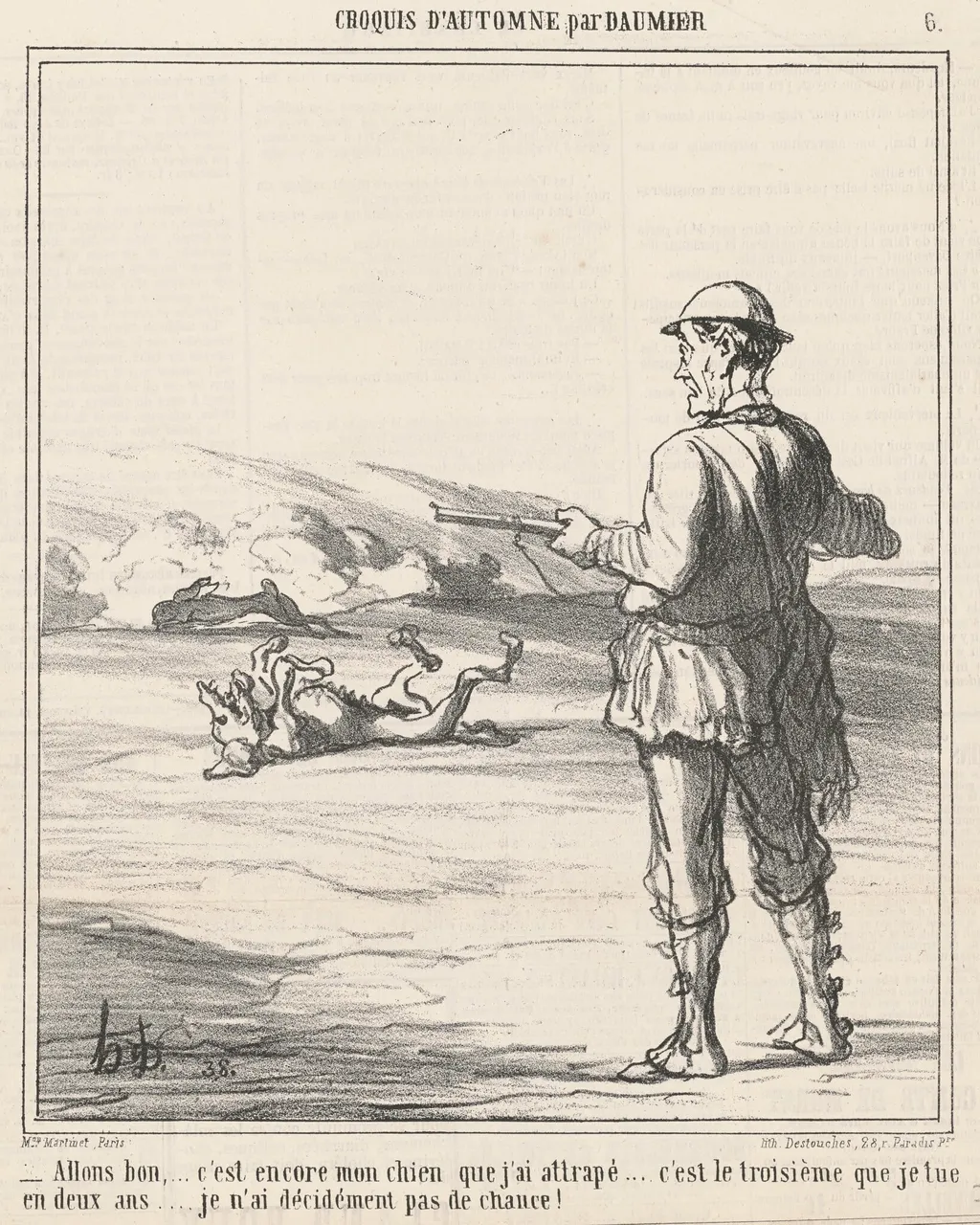
Allons bon ... c'est encore mon chien ... is an ink print by the Impressionist artist Honoré Daumier. It dates from 1865 and is held in the collection of the National Gallery of Art.
About this work
Overview
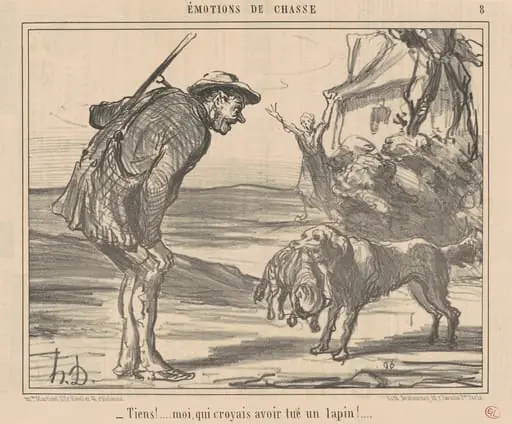
Created in 1865, this lithograph by Honoré Daumier depicts a rural hunter confronting his deceased dog, which lies on its back with legs splayed. Rendered in ink on stone, the image captures a fleeting, almost absurd moment of human-animal interaction. Daumier’s technique allows for rapid, expressive lines that convey both motion and emotion, characteristic of his approach to everyday scenes.
Subject & Meaning
The scene portrays a hunter’s quiet confrontation with the loss of a loyal, if comically inept, companion. The dog’s limp, exposed posture suggests both vulnerability and absurdity, while the man’s expression hovers between exasperation and tenderness. Daumier avoids melodrama, instead presenting a mundane tragedy with dry wit, reflecting his interest in the unspoken emotions of ordinary life.
Technique & Style
The contrast between the hunter’s detailed, textured clothing and the dog’s simplified, almost cartoonish silhouette heightens the emotional tension.
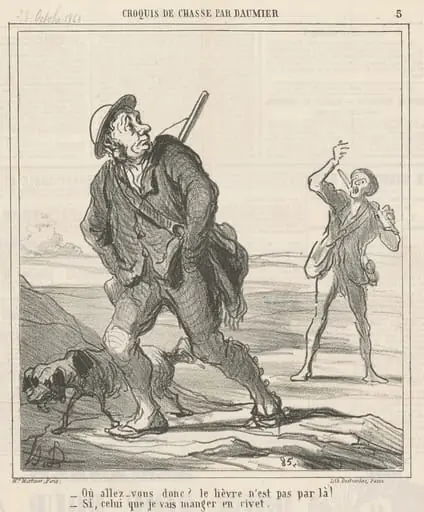
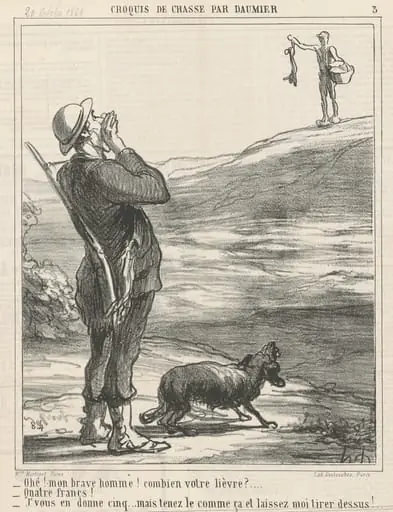
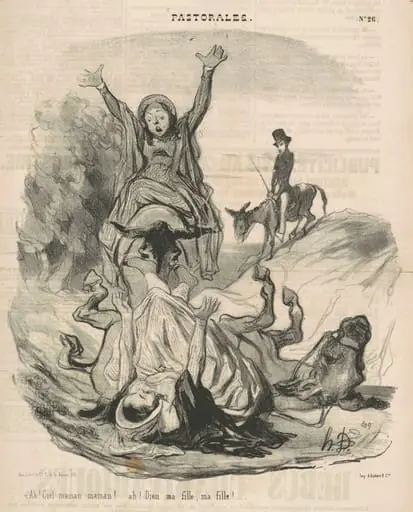
Daumier employed lithography to achieve a sketch-like immediacy, using fluid, economical lines to define form and mood. The contrast between the hunter’s detailed, textured clothing and the dog’s simplified, almost cartoonish silhouette heightens the emotional tension. The medium’s capacity for tonal variation allows subtle shading to suggest weight and stillness, reinforcing the scene’s quiet gravity.
History & Provenance
Produced during Daumier’s later years, this print emerged from his prolific output of social commentary in illustrated journals. Though unsigned and undated in many impressions, it was likely published in a periodical, circulating among Parisian middle-class audiences. Its survival in multiple institutional collections indicates its recognition as a representative work of his graphic oeuvre.
Context
In mid-19th century France, hunting was a common rural pastime, and dogs were valued working companions. Daumier, long attuned to class and domestic life, often depicted such relationships with irony and empathy. This image aligns with his broader practice of elevating overlooked moments, resisting idealization in favor of unvarnished, human truth.
Legacy
The lithograph endures as an example of Daumier’s ability to fuse humor with pathos in a single image. Its influence can be traced in later cartoonists and illustrators who adopted his visual economy and emotional nuance. Though not widely exhibited as a standalone work, it remains a touchstone in studies of 19th-century printmaking and social observation.
Artist & collection
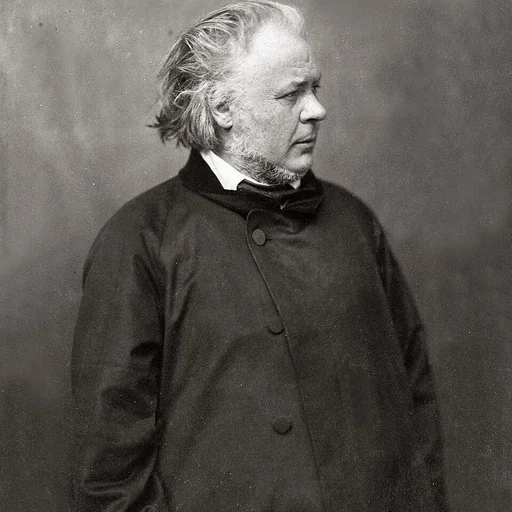
Artist
Honoré-Victorin Daumier was a French painter, sculptor, and printmaker, whose many works offer commentary on the social and political life in France, from the Revolution of 1830 to the fall of the Second French Empire in 1870.