Artwork
Bertrand et Raton
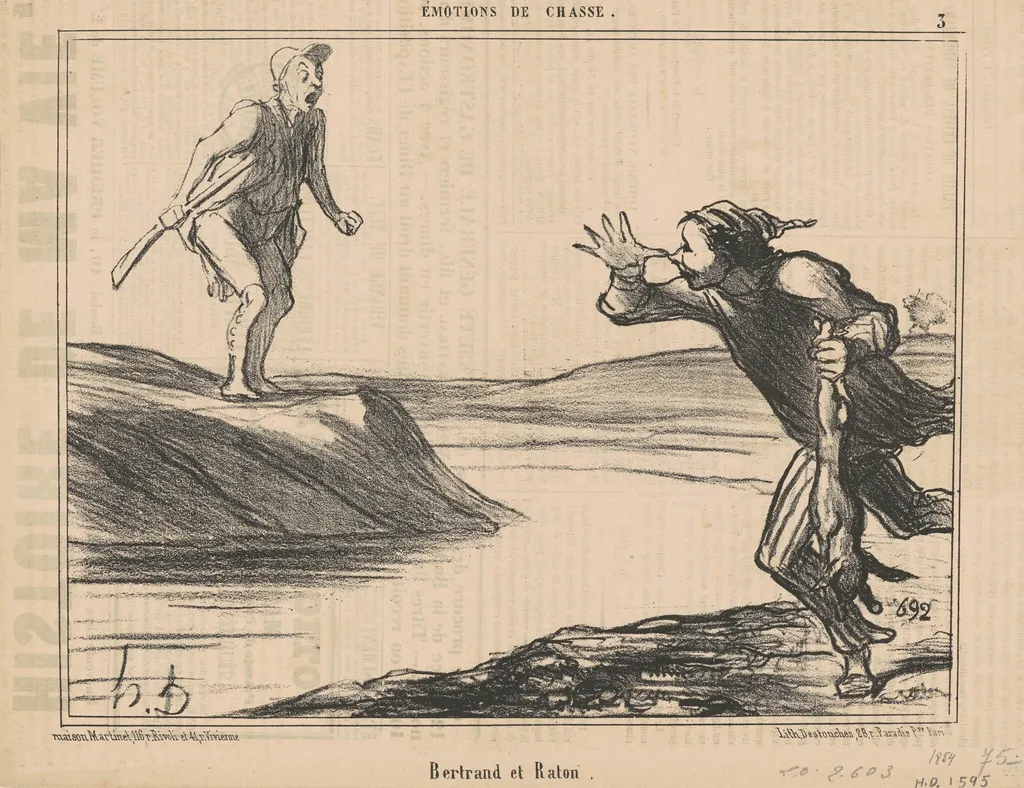
Bertrand et Raton is an ink print by the Impressionist artist Honoré Daumier. It dates from 1854 and is held in the collection of the National Gallery of Art.
About this work
Overview
Honoré Daumier’s 1854 lithograph titled “Bertrand et Raton” presents a compact, narrative scene set on a riverbank. The image captures two men locked in a moment of heightened agitation, their gestures and expressions suggesting an abrupt confrontation.
Subject & Meaning
One figure, clutching a club‑shaped implement, appears startled and poised for action, while the other raises his voice and holds a freshly killed animal. The juxtaposition of weapon and carcass amplifies the sense of urgency and conflict between the two characters.
Technique & Style
Executed in the lithographic medium, Daumier employs bold line work and stark contrasts to delineate the figures and their surroundings. The limited tonal range emphasizes the tension, while the rapid, gestural strokes convey movement and emotional intensity.
History & Provenance
Created in the mid‑nineteenth century, the print belongs to Daumier’s series of socially charged works that comment on everyday encounters. Its original publication context remains linked to the artist’s broader engagement with contemporary French life.
Context
The scene reflects the realist tendency of the period to depict ordinary, often gritty moments rather than idealized subjects. Daumier’s focus on a fleeting, possibly violent encounter aligns with his reputation for capturing the raw undercurrents of urban and rural society.
Artist & collection

Artist
Honoré-Victorin Daumier was a French painter, sculptor, and printmaker, whose many works offer commentary on the social and political life in France, from the Revolution of 1830 to the fall of the Second French Empire in 1870.