Artwork
Comme je vous ai dit vertement votre fait!
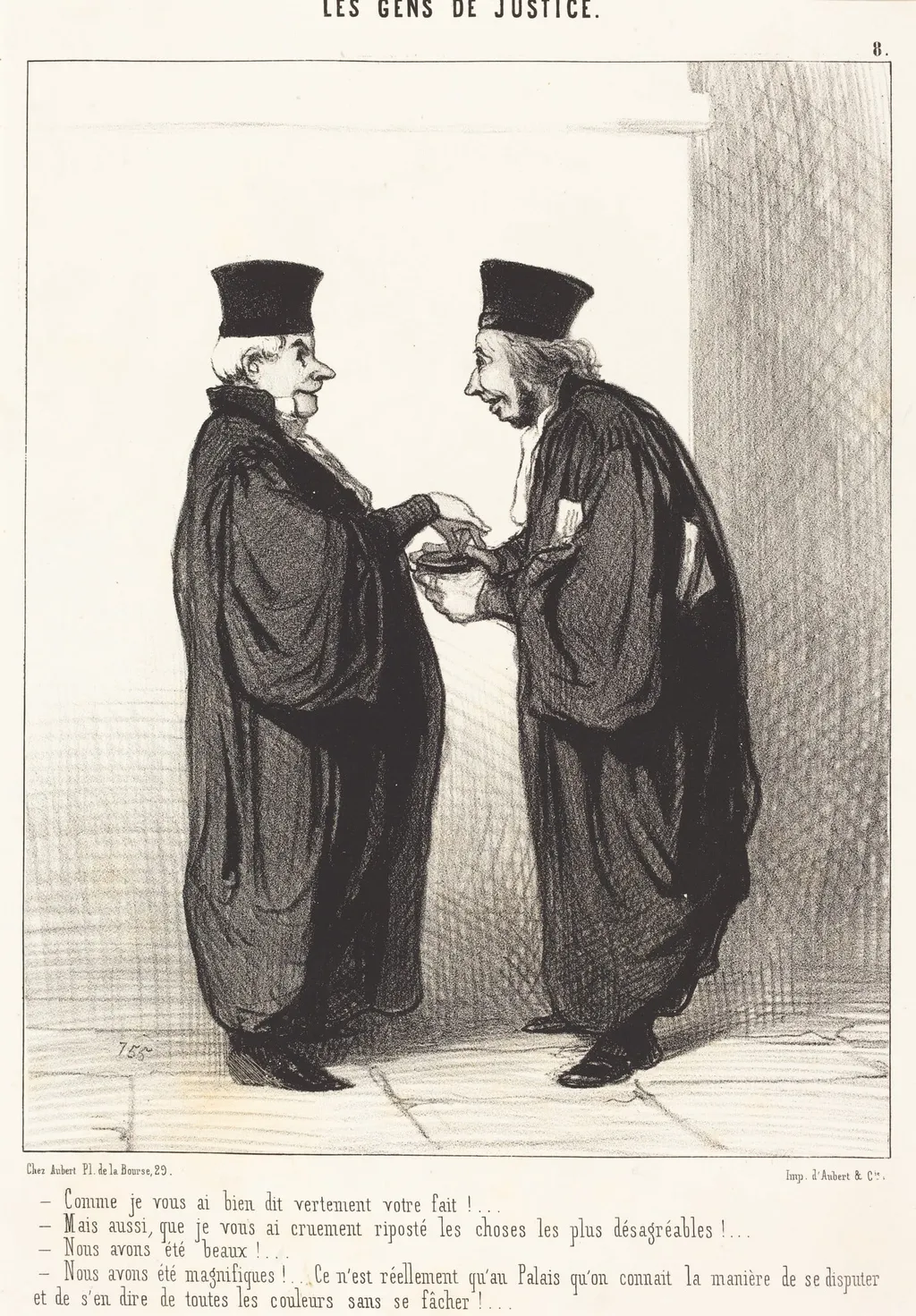
Comme je vous ai dit vertement votre fait! is an ink print by the Romanticist artist Honoré Daumier. It dates from 1845 and is held in the collection of the National Gallery of Art.
About this work
Overview
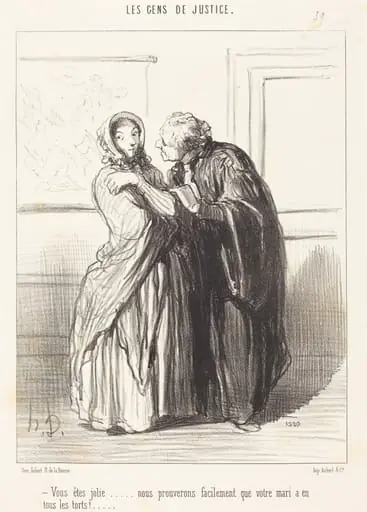
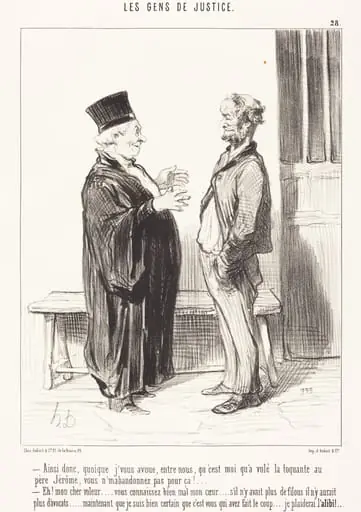
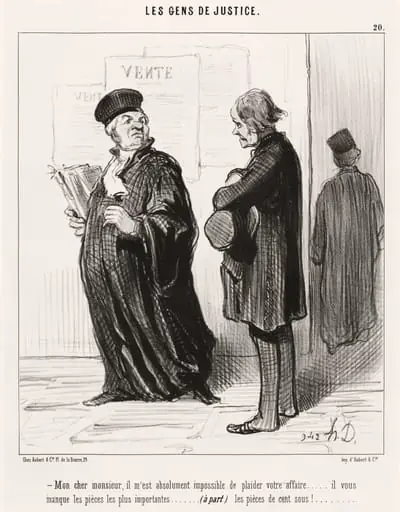
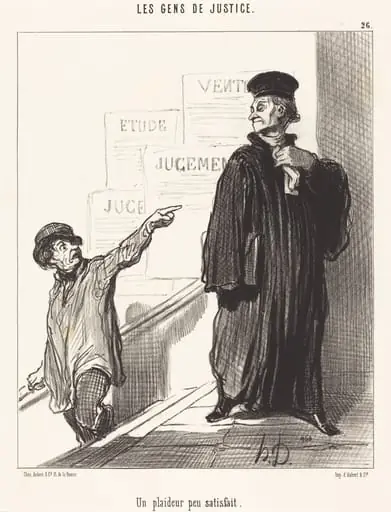
This 1845 lithograph by Honoré Daumier captures a tense exchange between two men in formal attire, rendered with sharp line work and minimal background detail.
This 1845 lithograph by Honoré Daumier captures a tense exchange between two men in formal attire, rendered with sharp line work and minimal background detail. As part of his prolific output for satirical journals, Daumier used lithography to critique French institutions. The title, translating to 'As I told you bluntly your business!', signals a confrontation, likely targeting legal or bureaucratic authority through understated drama rather than overt caricature.
Subject & Meaning
The two figures, dressed in long robes and hats, appear to be legal or judicial officials engaged in a heated exchange. One holds a small object—possibly a document or seal—while the other scrutinizes it. The scene suggests a moment of accountability or reprimand, reflecting Daumier’s recurring theme: the abuse of power within France’s legal and administrative systems. The lack of ornamentation focuses attention on the psychological tension between the men.
Technique & Style
Daumier employed lithography to achieve rapid, expressive lines and tonal contrasts, characteristic of his journalistic approach. The flat, unadorned setting and simplified forms emphasize the psychological weight of the interaction. His use of ink washes and controlled hatching creates depth without realism, prioritizing emotional clarity over detail. This method allowed for mass reproduction, aligning with his goal of reaching a broad, politically aware public.
History & Provenance
Created during Daumier’s most active period for *Le Charivari*, the print emerged amid heightened censorship under King Louis-Philippe’s regime. Though often prosecuted for his political satire, Daumier navigated legal boundaries by targeting institutional behavior rather than individuals. This work was likely published as a single-sheet print, circulated among urban readers who recognized its critique of judicial hypocrisy and bureaucratic rigidity.
Context
In mid-19th century France, lithographic satire flourished as a tool for dissent, especially after the 1830 July Revolution. Daumier’s prints responded to the gap between republican ideals and the realities of a conservative state. His work stood apart from Romantic grandeur, favoring everyday scenes of power dynamics. This piece reflects a broader cultural moment in which visual media became a vital medium for political commentary among the literate middle class.
Legacy
Daumier’s lithographs, including this one, influenced later generations of social realists and political cartoonists. His ability to distill complex social tensions into single, resonant images set a precedent for visual journalism. Though largely overlooked during his lifetime, his prints gained recognition in the 20th century as foundational to modern graphic satire, valued for their psychological insight and formal economy.
Artist & collection

Artist
Honoré-Victorin Daumier was a French painter, sculptor, and printmaker, whose many works offer commentary on the social and political life in France, from the Revolution of 1830 to the fall of the Second French Empire in 1870.