Artwork
Domino!!
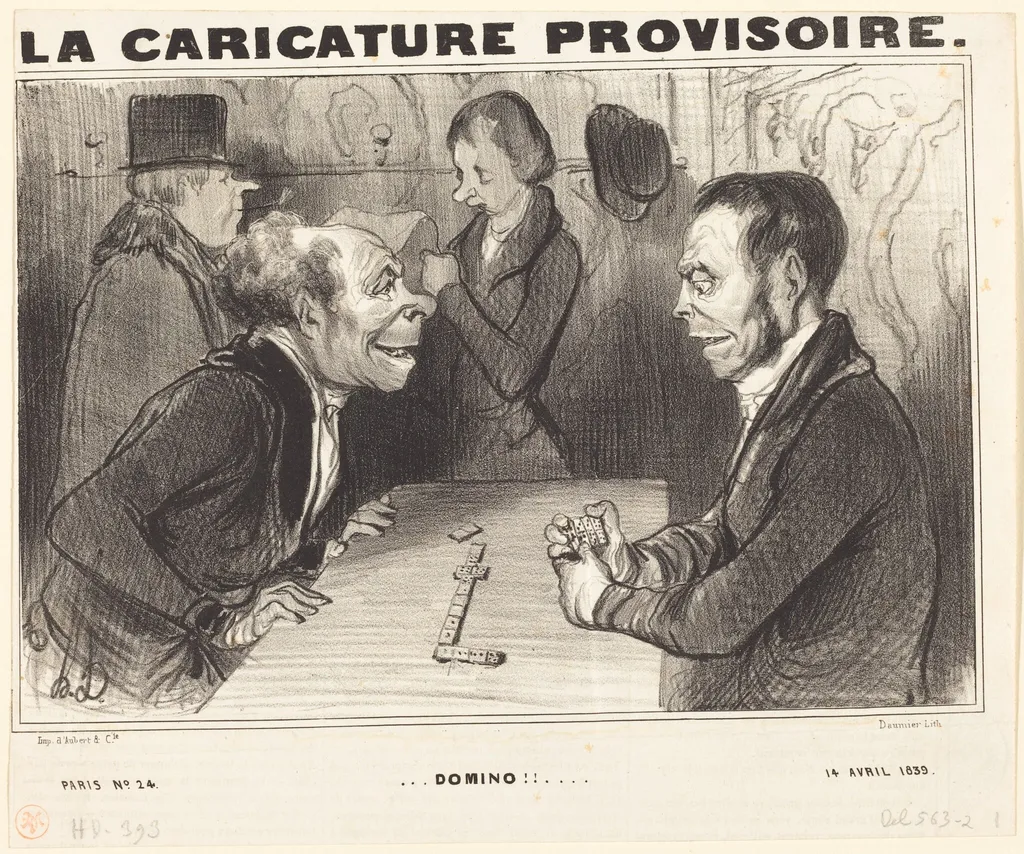
Domino!! is an ink print by the Romanticist artist Honoré Daumier. It dates from 1839 and is held in the collection of the National Gallery of Art.
About this work
Overview
Its informal format and topical subject align with Daumier’s role as a visual critic of contemporary society.
Honoré Daumier produced *Domino!!* in 1839 as a lithograph printed on newsprint, part of his prolific output for satirical journals. Created rapidly using direct stone drawing, the work exemplifies the immediacy and accessibility of lithographic technique in mid-19th-century French periodicals. Its informal format and topical subject align with Daumier’s role as a visual critic of contemporary society.
Subject & Meaning
The scene depicts three men engaged in a game of dominoes, their postures and expressions suggesting social dynamics rather than mere recreation. One figure grins with exaggerated delight, another appears disengaged, and a third, distinguished by a top hat, looms in the background—possibly a figure of authority. The title, *Domino!!*, and the publication name *La Caricature Provisoire* hint at irony, framing the game as a metaphor for political maneuvering among the elite.
Technique & Style
Daumier drew directly onto the lithographic stone with a greasy medium, enabling swift, spontaneous lines that mirrored the urgency of journalistic satire. The rough, energetic strokes and distorted facial features emphasize emotional states over realism. Printed on inexpensive newsprint, the image was designed for mass circulation, prioritizing impact and legibility over fine detail, a hallmark of his approach to printmaking.
History & Provenance
Created for *La Caricature*, a short-lived but influential journal known for its republican critique of King Louis-Philippe’s regime, *Domino!!* was one of many works that led to Daumier’s imprisonment in 1832. Though the journal ceased publication by 1835, Daumier continued contributing to *Le Charivari*, where his satirical prints remained widely distributed. The survival of this print reflects its role in a broader network of political visual culture.
Context
In late 1830s France, censorship targeted political caricature, yet lithography offered a loophole due to its speed and low cost. Daumier’s imagery tapped into public discontent, using everyday scenes to veil sharper critiques of power. The domino game, a common pastime among the lower and middle classes, became a coded reference to the calculated, turn-based nature of political influence under the July Monarchy.
Legacy
Daumier’s use of lithography to capture social tension influenced generations of illustrators and cartoonists. *Domino!!* exemplifies how art could function as public discourse under repression, blending humor with incisive observation. Though produced for ephemeral consumption, such works later gained recognition as vital documents of political and cultural life in 19th-century France.
Own this work as a print
Artist & collection
Artist
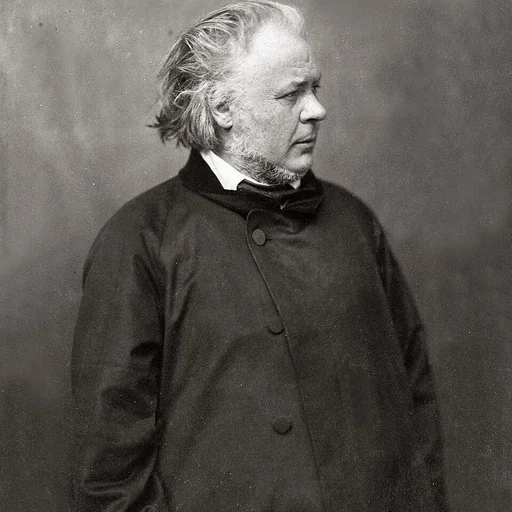
Honoré-Victorin Daumier was a French painter, sculptor, and printmaker, whose many works offer commentary on the social and political life in France, from the Revolution of 1830 to the fall of the Second French Empire in 1870.

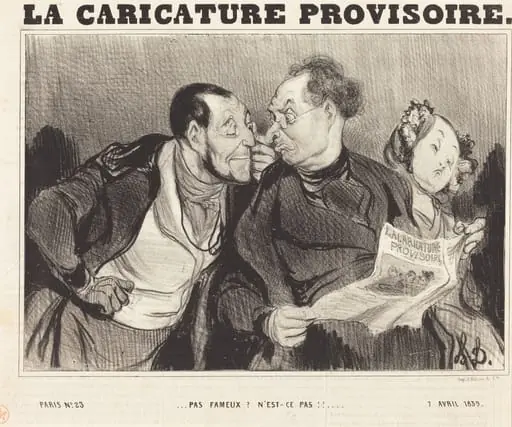 Pas fameux? N'est-ce pas!!...
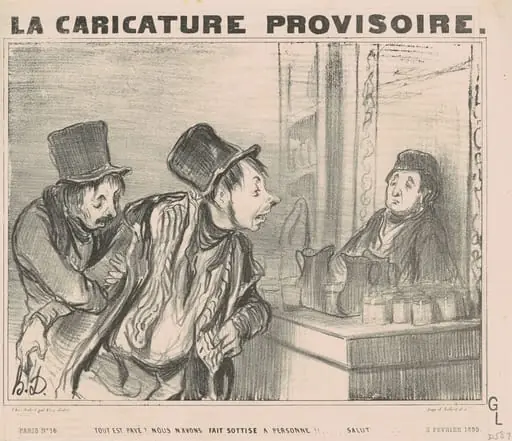 Tout est payé? Nous n'avons fait...salut
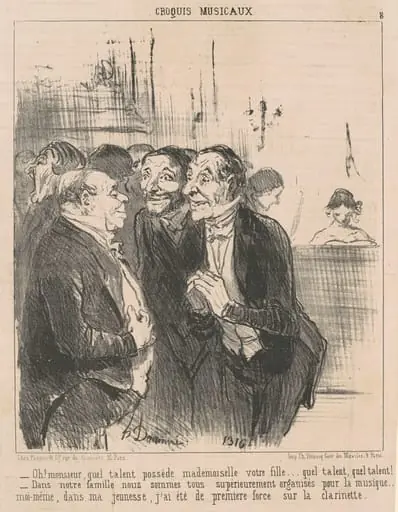 Oh! Monsieur, quel talent possède ...
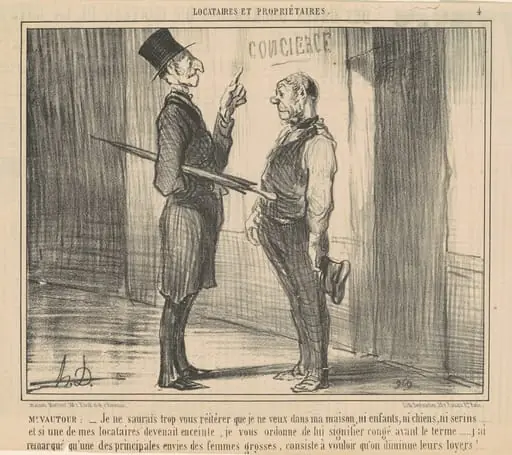 M. Vautour: Je ne saurais trop ...
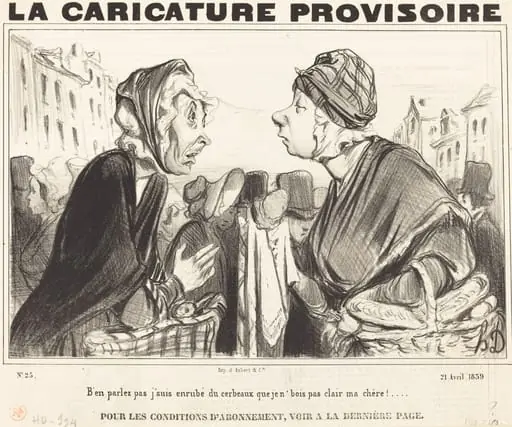 B'en parlez pas j'suis enrubé du cerbeaux...
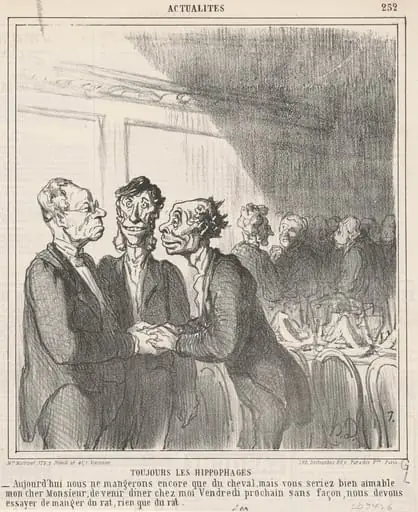 Toujours les Hippophages
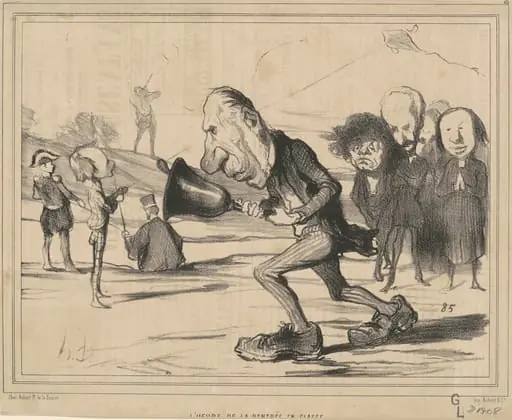 L'heure de la rentrée en classe
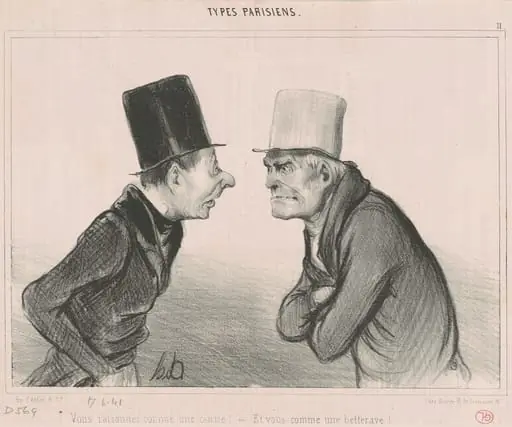 Vous raisonnez comme une canne!
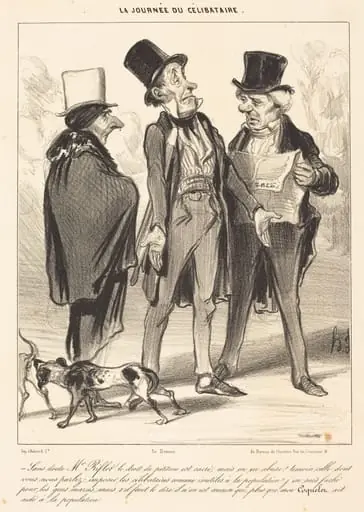 Sans doute M. Riflot le droit...
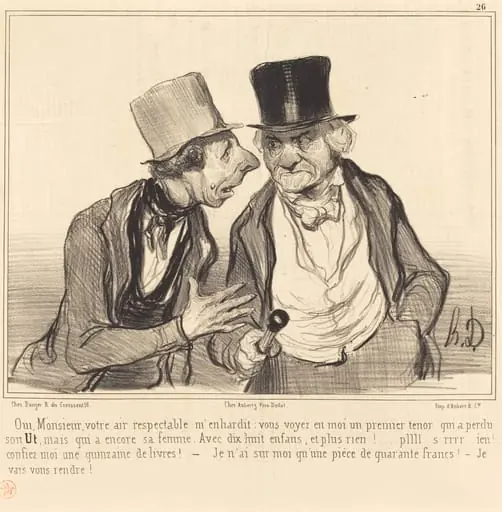 Oui, Monsieur, votre air respectable m'enhardit...
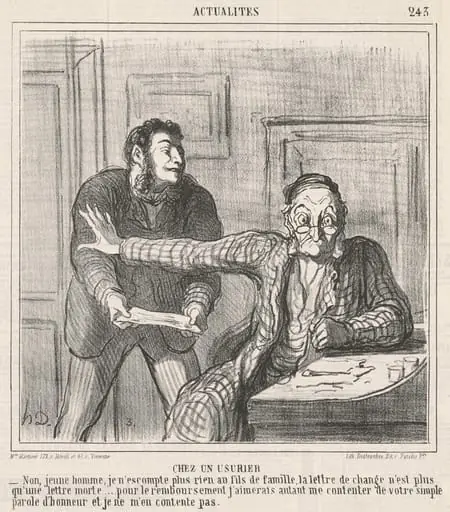 Chez un usurier
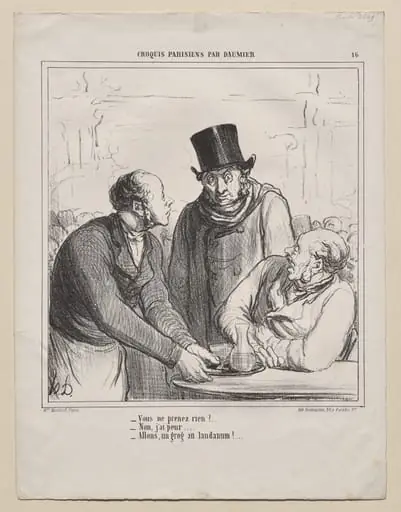 Are you not ordering anything?...