Artwork
Hier le fusil a aiguille, eux demain ...
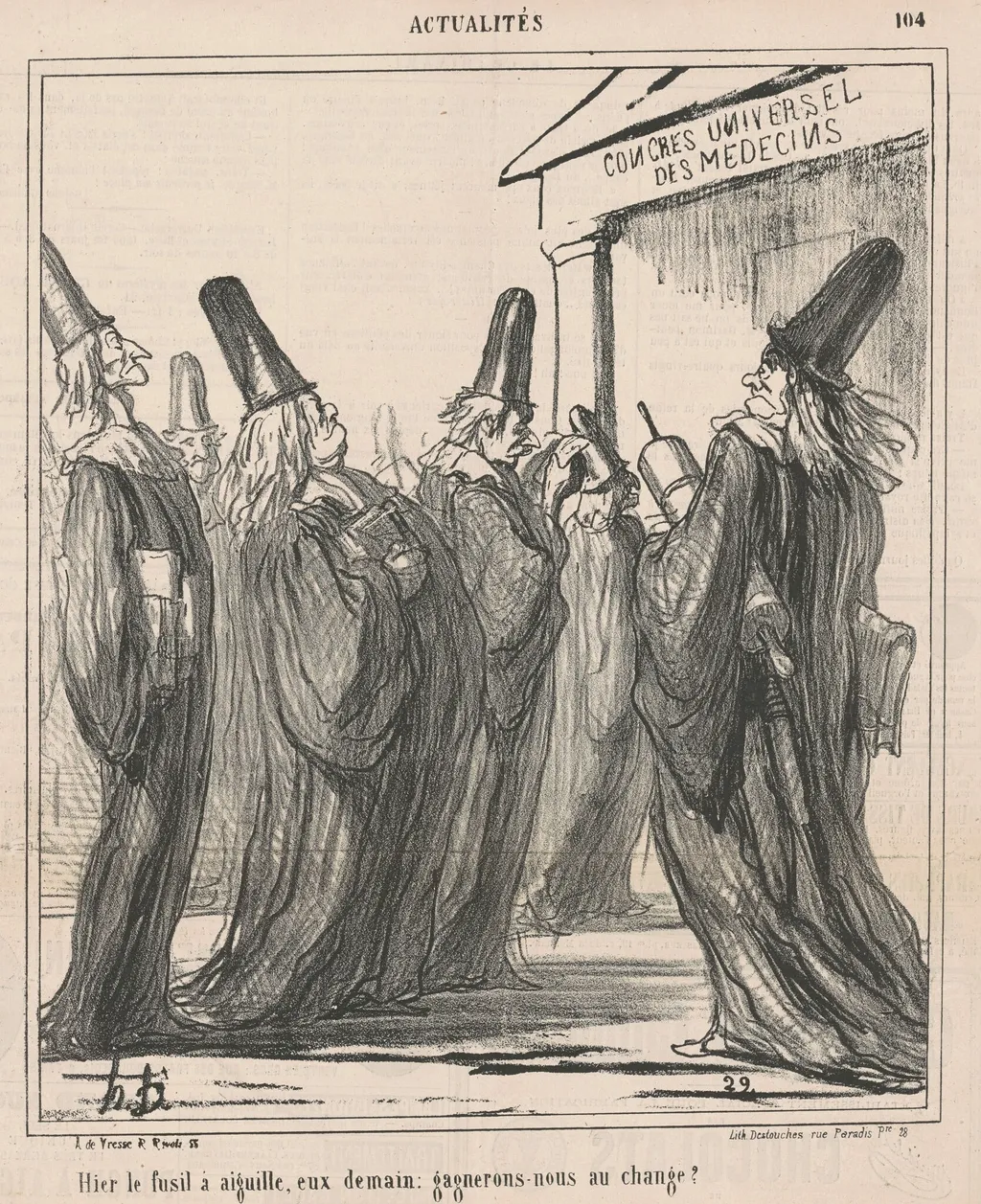
Hier le fusil a aiguille, eux demain ... is an ink print by the Impressionist artist Honoré Daumier. It dates from 1867 and is held in the collection of the National Gallery of Art.
About this work
This lithograph shows men in long robes and tall hats marching toward a building marked "Congrès Universel des Médecins.
This lithograph shows men in long robes and tall hats marching toward a building marked "Congrès Universel des Médecins." Their faces are stretched long, noses extra pointy. Daumier draws them with sharp lines, making them look silly despite their serious clothes.
He printed this in 1867. It mocks doctors who took themselves too seriously. The long faces and stiff poses make the scene funny, not scary.
Look at how Daumier uses lithography to build these bold shadows.
Overview
Created in 1867, this lithograph by Honoré Daumier depicts a procession of men in academic attire advancing toward a building inscribed with 'Congrès Universel des Médecins.' Rendered in bold, linear strokes, the image uses the lithographic medium to emphasize contrast and movement, capturing a moment of institutional solemnity undercut by visual irony.
Subject & Meaning
The figures represent physicians gathered for a professional congress, their exaggerated physiognomies—elongated faces and pointed noses—mocking their self-importance. Daumier contrasts their formal robes and rigid postures with grotesque facial features, suggesting a disconnect between their claimed authority and their absurdity, critiquing the pretensions of medical elites in mid-19th-century France.
Technique & Style
Daumier employed lithography to achieve sharp, expressive lines and dramatic tonal contrasts. His use of dense shadows and simplified forms heightens the caricatured effect, reducing individuality to typified silhouettes. The technique allows for rapid, incisive rendering, aligning with his journalistic approach and reinforcing the satirical tone through visual immediacy.
History & Provenance
Produced during a period of growing public scrutiny of professional institutions, the print was likely distributed in periodicals or as a standalone sheet. It reflects Daumier’s longstanding engagement with social satire through print media, though specific exhibition or ownership history prior to institutional acquisition remains undocumented.
Context
In 1867, France was undergoing medical professionalization, with new associations and congresses formalizing medical authority. Daumier’s image responds to this trend, reflecting public skepticism toward emerging elites who adopted scholarly trappings without visible merit. His work often targeted such institutional pretensions, positioning him as a chronicler of bourgeois hypocrisy.
Legacy
The lithograph endures as an example of Daumier’s capacity to distill social critique into visually potent caricature. While not widely exhibited in his lifetime, it contributes to a broader corpus of 19th-century satirical prints that influenced later generations of illustrators and political cartoonists seeking to challenge authority through humor.
Artist & collection

Artist
Honoré-Victorin Daumier was a French painter, sculptor, and printmaker, whose many works offer commentary on the social and political life in France, from the Revolution of 1830 to the fall of the Second French Empire in 1870.









 Vous avez perdu votre procès c'est vrai...
 Vous m'avez injurié dans votre plaidoirie...
 Trois Pauvres aveugles
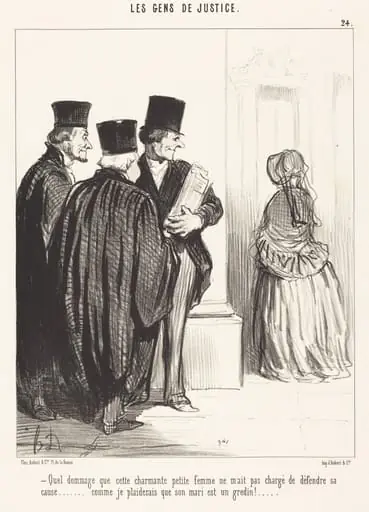 Quel dommage que cette charmante... femme...
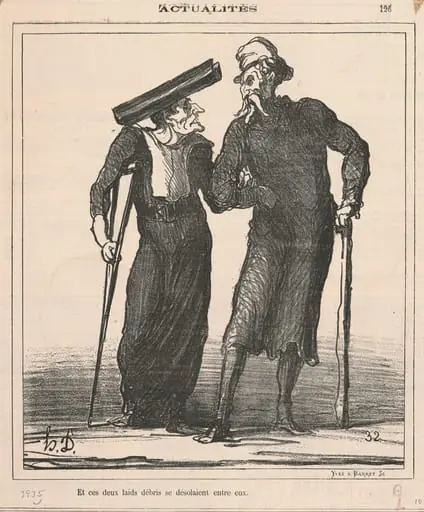 Et ces deux laids débris se désolaient entre eux
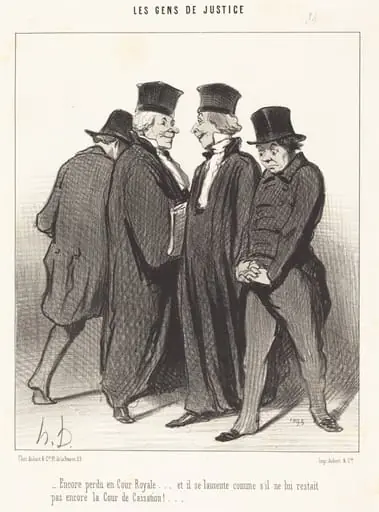 Encore perdu en Cour Royale... et il se lamente...
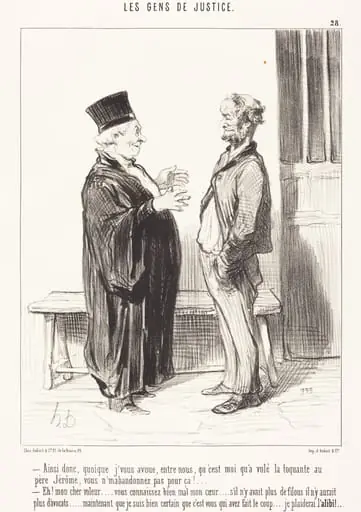 Ainsi donc, quoique j'vous avoue...
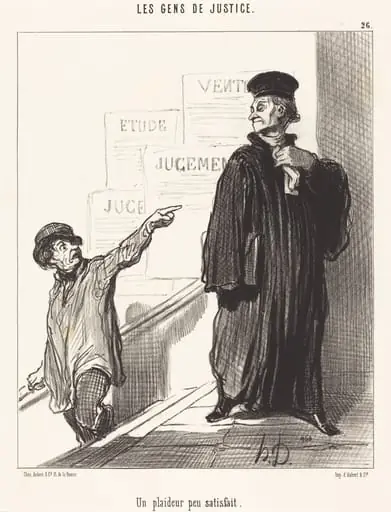 Un Plaideur peu satisfait
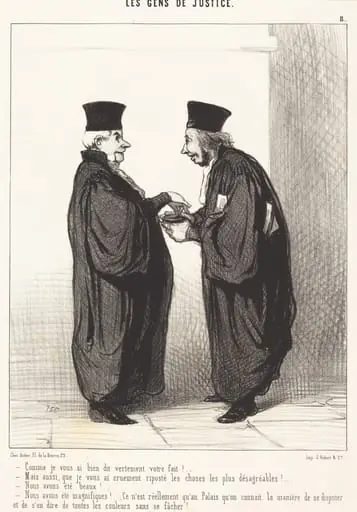 Comme je vous ai dit vertement votre fait!
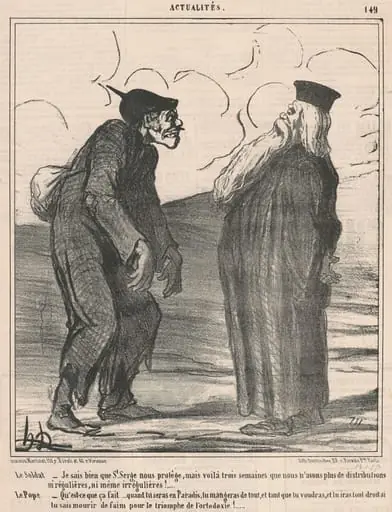 Le soldat...Je sais...