Artwork
Hippolyte lardé par Cupidon
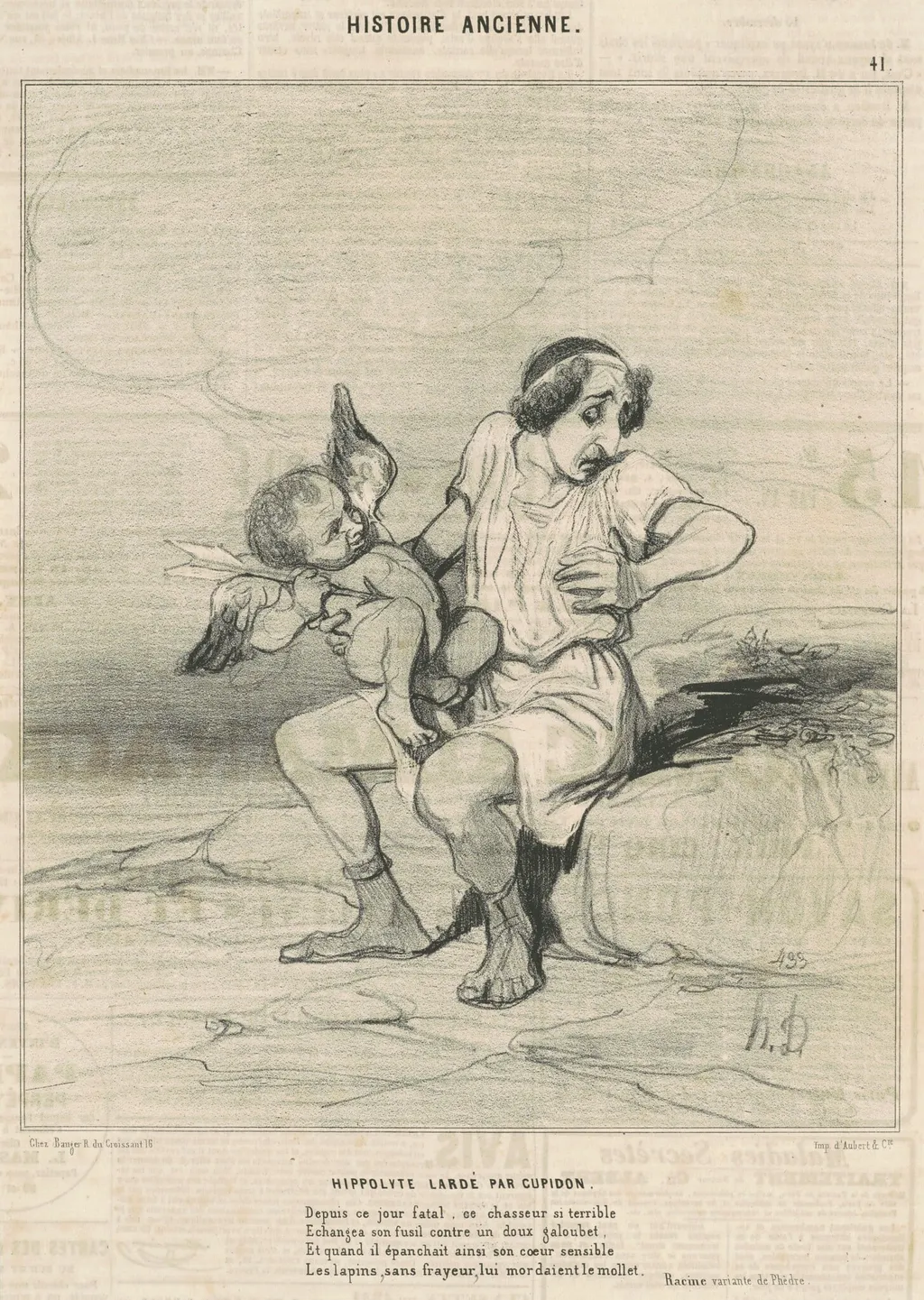
Hippolyte lardé par Cupidon is an ink print by the Romanticist artist Honoré Daumier. It dates from 1842 and is held in the collection of the National Gallery of Art.
About this work
Overview
This lithograph by Honoré Daumier presents a compact, satirical moment between a cherubic Cupid and a seated adult man. Executed in ink on paper, the work belongs to a series of prints that critique social behaviors through exaggerated human reactions. The composition is minimal, with little background detail, directing attention to the interaction between the two figures.
Subject & Meaning
The man’s wide-eyed, startled expression suggests surprise or discomfort, evoking the idea of love as an unexpected, even unwelcome, intrusion.
The scene depicts Cupid, depicted as a plump, mischievous child, seemingly inflicting a sudden sting upon the man below. The man’s wide-eyed, startled expression suggests surprise or discomfort, evoking the idea of love as an unexpected, even unwelcome, intrusion. Daumier uses this moment to humorously question the traditional idealization of romantic love, framing it as a disruptive, physical nuisance.
Technique & Style
Daumier employed rapid, expressive linework typical of his lithographic practice, using loose strokes to define forms rather than precise contours. The background is reduced to a few suggestive marks, emphasizing the figures’ emotional exchange. The contrast between the smooth, rounded form of Cupid and the angular, tense posture of the man heightens the visual tension, reinforcing the print’s ironic tone.
History & Provenance
Created in the mid-19th century, this print was likely produced for inclusion in a periodical or album of satirical images. Daumier regularly contributed to publications like La Caricature and Le Charivari, where such works reached a broad urban audience. While the exact publication context of this piece is unconfirmed, its style aligns with his prolific output during this period of political and social satire.
Context
Daumier’s work emerged amid France’s shifting cultural landscape, where the bourgeoisie’s romantic ideals were frequently scrutinized. His prints often targeted pretensions of love, marriage, and social decorum. This image fits within a broader tradition of French caricature that used humor to expose human folly, reflecting a public appetite for art that challenged conventional norms.
Legacy
Daumier’s lithographs, including this one, influenced later generations of illustrators and cartoonists through their economy of line and psychological insight. Though not widely exhibited in his lifetime as fine art, these prints gained recognition in the 20th century for their incisive commentary and expressive power, securing his place in the history of modern graphic satire.
Artist & collection

Artist
Honoré-Victorin Daumier was a French painter, sculptor, and printmaker, whose many works offer commentary on the social and political life in France, from the Revolution of 1830 to the fall of the Second French Empire in 1870.