Artwork
Inconvénient d'un parapluie a ressorts trop compliqués
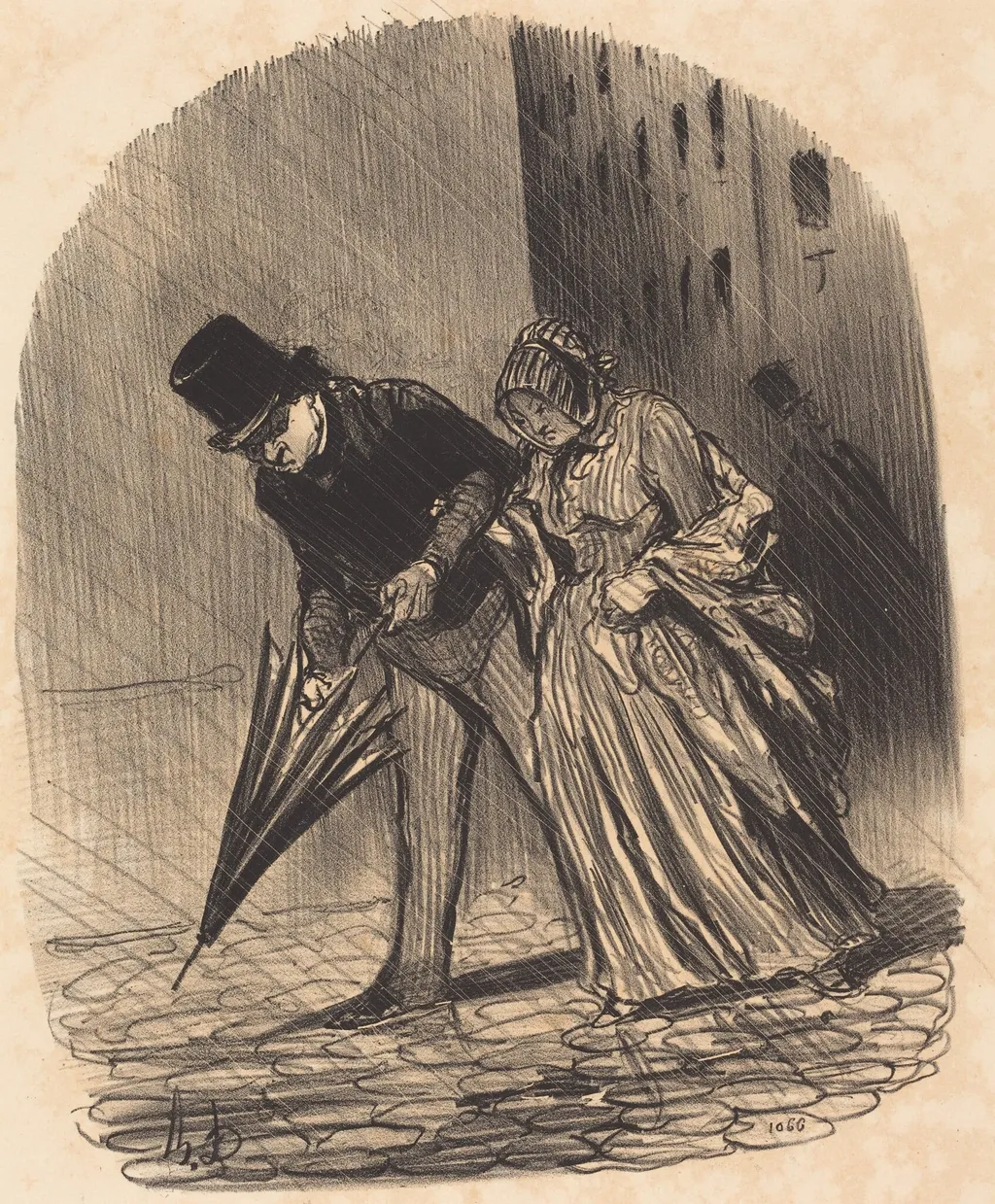
Inconvénient d'un parapluie a ressorts trop compliqués is an ink print by the Romanticist artist Honoré Daumier. It dates from 1847 and is held in the collection of the National Gallery of Art.
About this work
Overview
As part of his prolific output for satirical newspapers, Daumier used the accessibility of lithography to reach a broad audience.
Created in 1847, this lithograph by Honoré Daumier captures a moment of domestic frustration with mechanical overreach. As part of his prolific output for satirical newspapers, Daumier used the accessibility of lithography to reach a broad audience. The work belongs to a series targeting the absurdities of middle-class life under France’s July Monarchy and early Second Republic, blending humor with social observation.
Subject & Meaning
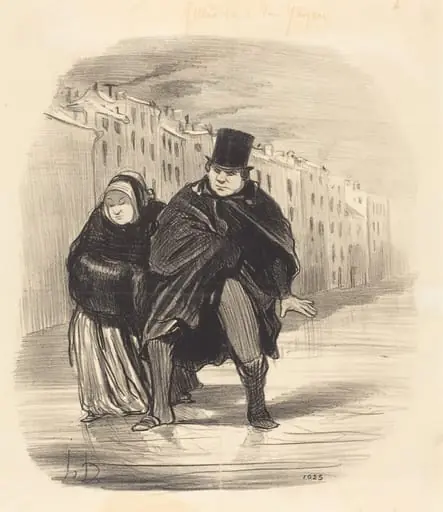
The image portrays a man in formal attire wrestling with a spring-loaded umbrella that has inverted violently, its ribs splayed like broken limbs. The absurdity of the situation underscores a broader critique: the bourgeoisie’s obsession with new, overly complex inventions that promise convenience but deliver chaos. The man’s dignified attire contrasts with his helpless struggle, highlighting the gap between social pretension and practical reality.
Technique & Style
Daumier employed rapid, expressive linework characteristic of lithographic drawing on stone. His brushwork conveys motion and tension—fabric ripples, limbs twist, metal springs contort—without elaborate detail. The contrast between the man’s rigid posture and the umbrella’s chaotic form enhances the comedic effect. The medium allowed for quick reproduction, making the image ideal for newspaper publication and widespread circulation.
History & Provenance
The print was published in *Le Charivari*, a Parisian satirical journal where Daumier regularly contributed. It emerged during a period of political instability and rising consumer culture, when mechanical gadgets became status symbols. Though initially ephemeral, such prints were later collected as cultural documents. No known original stone survives, but multiple impressions were distributed, ensuring its reach beyond elite circles.
Context
Mid-19th century Paris saw rapid industrialization and a surge in patented inventions, many marketed to the middle class. Daumier’s satire tapped into public skepticism about these gadgets, which often failed under daily use. His work resonated because it mirrored common frustrations, positioning technology not as progress but as a source of daily humiliation. The umbrella became a metaphor for the era’s misplaced faith in innovation.
Legacy
Daumier’s lithographs, including this one, helped define visual satire in modern print media. His ability to distill social critique into a single, vivid image influenced later cartoonists and illustrators. Though not widely exhibited in his lifetime, these works gained recognition in the 20th century as early examples of visual commentary on technology and class. Today, they remain key to understanding 19th-century French urban life.
Artist & collection
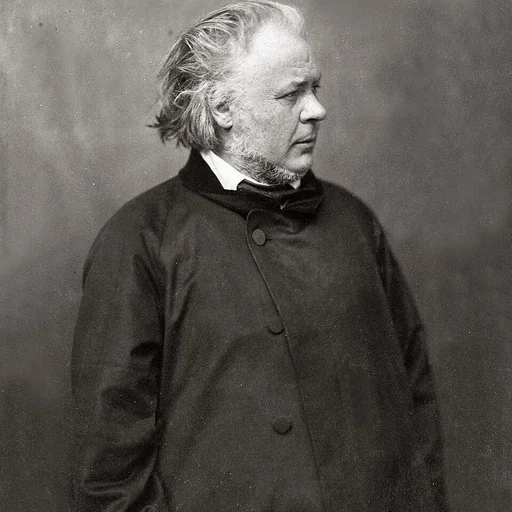
Artist
Honoré-Victorin Daumier was a French painter, sculptor, and printmaker, whose many works offer commentary on the social and political life in France, from the Revolution of 1830 to the fall of the Second French Empire in 1870.

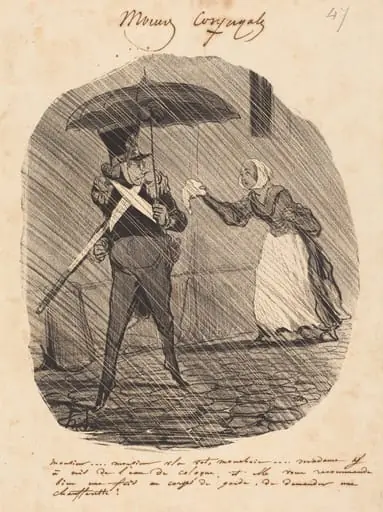 Monsieur... Monsieur, v'la vot' mouchoir
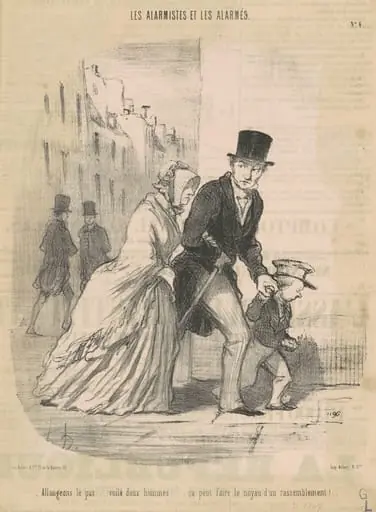 Allongeons le pas ... voila ceux hommes ...
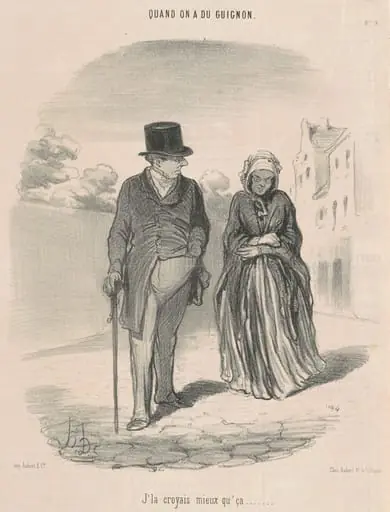 J'la croyais mieux qu'ça ...
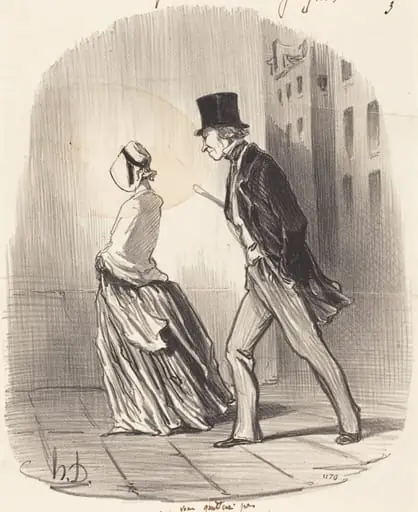 Non, madame, je ne vous quitterai pas...
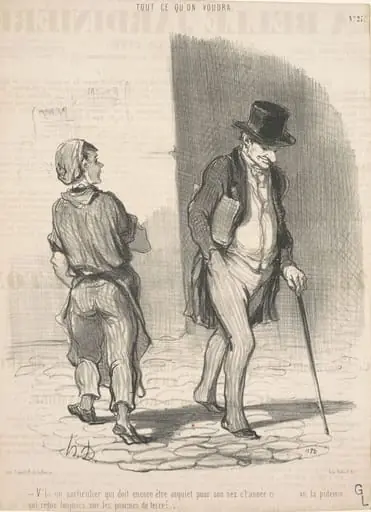 V'la un particulier qui doit ...être inquiet ...
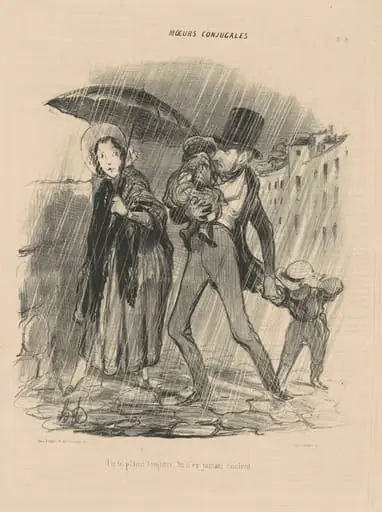 Tu te plains toujours, tu n'es jamais content.
 Tu m'reprendras encore... a aller souhaiter...
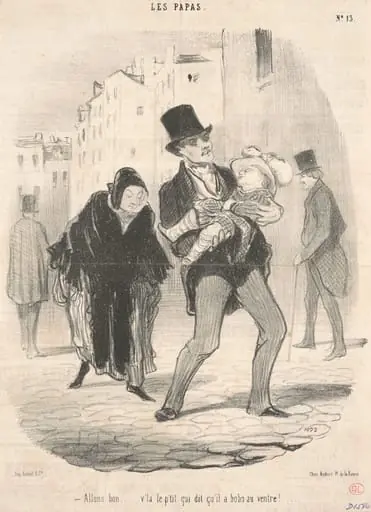 Allons bon ... v'la p'tit qui dit ...
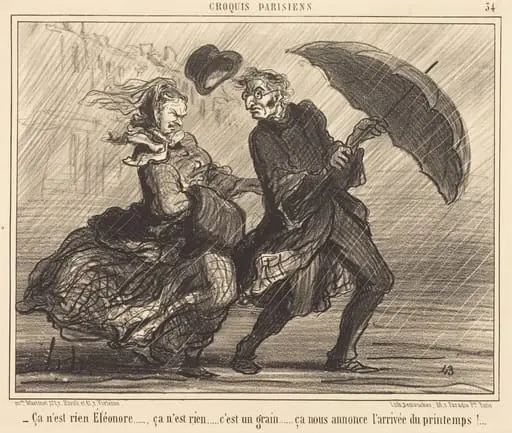 ça n'est rien Éléonore...ca n'est rien...
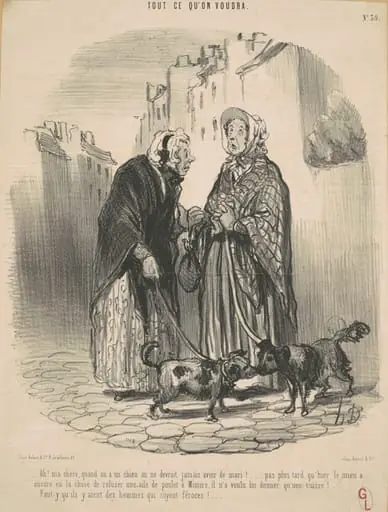 Ah! Ma chère, quand on a un chien ...