Artwork
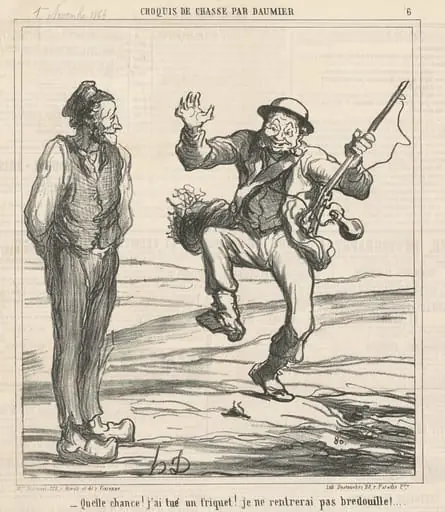
J'ai donc tué un perdreau!
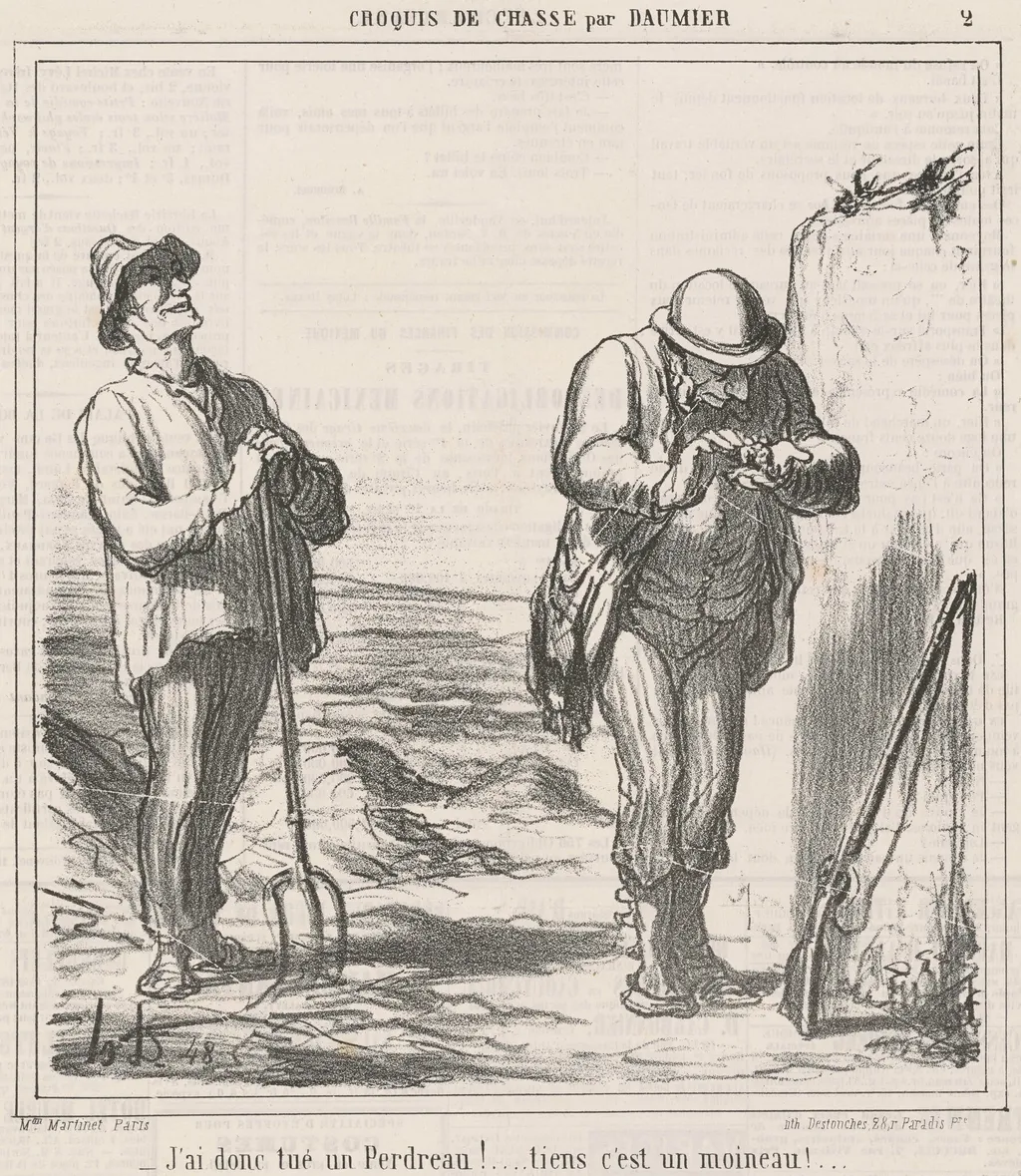
J'ai donc tué un perdreau! is an ink print by the Impressionist artist Honoré Daumier. It dates from 1866 and is held in the collection of the National Gallery of Art.
About this work
Overview
Two men stand in a sparse, uneven landscape—one upright and smirking, the other crouched in quiet concentration.
This lithograph by Honoré Daumier captures a quiet, ironic moment in rural life. Two men stand in a sparse, uneven landscape—one upright and smirking, the other crouched in quiet concentration. The title, translating to 'So I killed a partridge!', underscores the absurdity of claiming triumph over a small, insignificant kill. Daumier uses minimal detail to amplify the psychological contrast between the figures.
Subject & Meaning
The scene portrays a hunting incident, but the focus is not on the act itself—it’s on the differing reactions. The standing man exudes performative pride, while the crouching figure engages with the dead bird with solemnity, perhaps even regret. Daumier critiques the performative masculinity of rural elites, suggesting that such small victories are inflated into matters of personal honor, revealing deeper social pretensions.
Technique & Style
Daumier employs bold, fluid lines and stark tonal contrasts typical of his lithographic work. The figures are rendered with expressive economy—facial expressions and posture convey narrative without elaborate detail. The landscape is suggested rather than defined, drawing attention to the human interaction. The rough texture of the ground and the loose handling of clothing enhance the sense of immediacy and informal observation.
History & Provenance
Created in the mid-19th century, this print was likely part of Daumier’s broader series of social satires published in periodicals like Le Charivari. Though exact provenance details are sparse, it aligns with his output during a period when he increasingly turned to rural and working-class subjects. The work circulated widely among French urban audiences, offering a critical lens on provincial life.
Context
In post-revolutionary France, hunting was both a leisure activity of the bourgeoisie and a symbol of inherited privilege. Daumier, himself from a modest background, frequently depicted such scenes to expose the gap between social aspiration and reality. This image reflects a broader cultural moment where rural traditions were being reinterpreted through urban, critical eyes.
Legacy
Daumier’s lithographs, including this one, helped redefine printmaking as a vehicle for social commentary rather than mere illustration. His ability to distill complex human behavior into a single, quiet moment influenced later generations of caricaturists and realist artists. The work remains a subtle, enduring example of how humor can carry moral weight.
Own this work as a print
Artist & collection

Artist
Honoré-Victorin Daumier was a French painter, sculptor, and printmaker, whose many works offer commentary on the social and political life in France, from the Revolution of 1830 to the fall of the Second French Empire in 1870.