Artwork
Le triomphe de la loi du 31 Mai
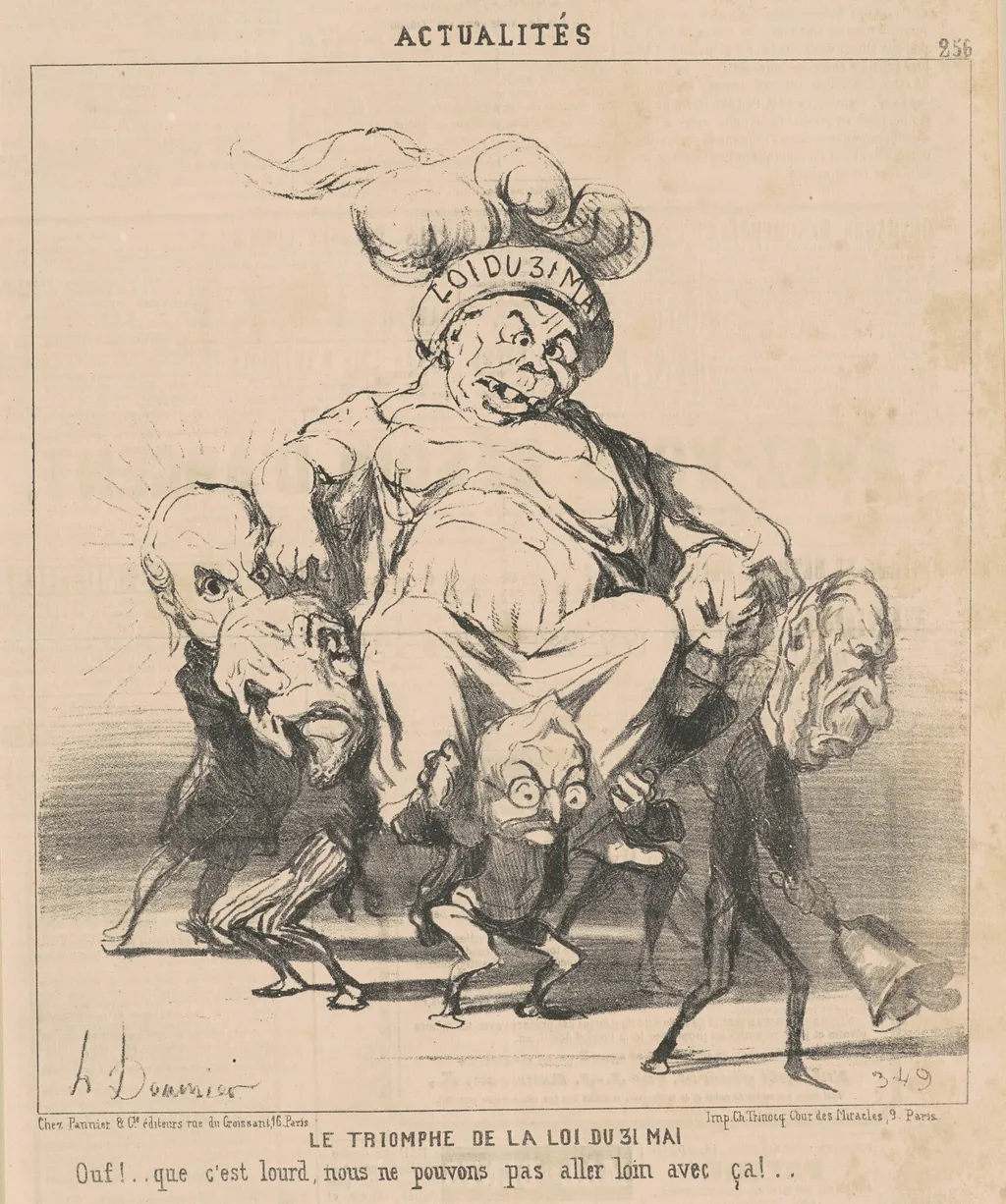
Le triomphe de la loi du 31 Mai is an ink print by the Impressionist artist Honoré Daumier. It dates from 1851 and is held in the collection of the National Gallery of Art.
About this work
This lithograph shows a group of men straining under the weight of a giant, frowning figure labeled “LOI DU 31 MAI 1850.
This lithograph shows a group of men straining under the weight of a giant, frowning figure labeled “LOI DU 31 MAI 1850.” The tiny workers look exhausted while the huge law looms over them. Daumier makes the rule itself seem like a heavy burden.
The law in question restricted voting rights after the 1851 coup. Daumier used satire to show how ordinary people felt crushed by political decisions.
Try looking up Daumier, Honoré next.
Overview
Honoré Daumier’s lithograph *Le triomphe de la loi du 31 Mai* presents a satirical scene in which a group of laboring figures struggle to bear a massive, frowning form marked with the inscription “LOI DU 31 MAI 1850.” The composition emphasizes the oppressive weight of the law as a literal burden carried by ordinary men.
Subject & Meaning
The central, oversized figure represents the law enacted on 31 May 1850, a decree that curtailed voting rights following the 1851 coup. By rendering the statute as a disgruntled, towering body, Daumier visualizes the perception that the legislation oppressed and exhausted the populace.
Technique & Style
Executed as a lithograph, the work relies on bold line work and stark contrasts to accentuate the strain on the carriers. Daumier’s characteristic caricature—exaggerated facial expressions and distorted proportions—serves both comedic and critical purposes, highlighting the absurdity of the political imposition.
History & Provenance
Created in the early 1850s, the print was part of Daumier’s prolific series of politically charged illustrations that responded to contemporary French events. It circulated among the artist’s satirical publications, reaching a readership familiar with the contentious reforms of the Second Republic.
Context
The 31 May law emerged during a period of reactionary governance after Louis‑Napoléon’s 1851 coup d’état, when the regime sought to limit suffrage and consolidate power. Daumier’s image reflects the broader climate of dissent among journalists, artists, and citizens who viewed such measures as an affront to democratic ideals.
Legacy
While not as widely reproduced as some of Daumier’s later works, this lithograph exemplifies his commitment to political commentary through visual satire. It remains a reference point for scholars studying the interplay between art and 19th‑century French political discourse.
Own this work as a print
Artist & collection

Artist
Honoré-Victorin Daumier was a French painter, sculptor, and printmaker, whose many works offer commentary on the social and political life in France, from the Revolution of 1830 to the fall of the Second French Empire in 1870.