Artwork
Lolo qu'aimes-tu mieux de ton papa ou de ta maman...
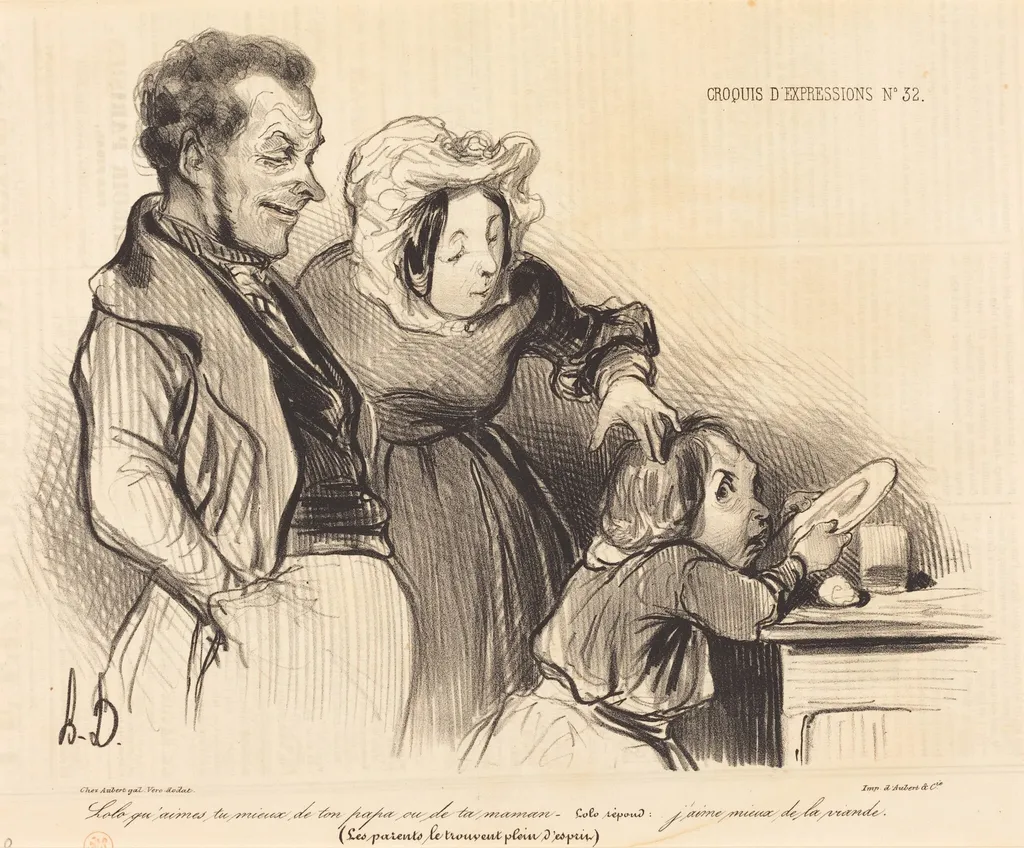
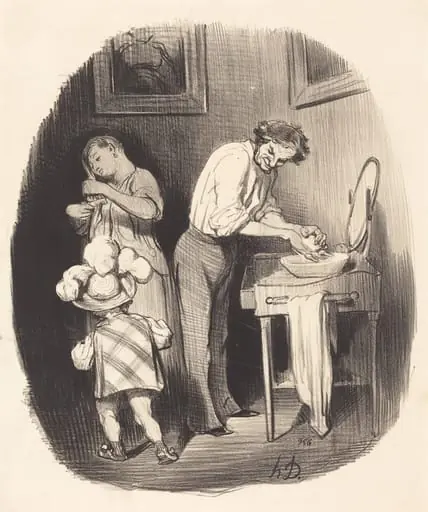
Lolo qu'aimes-tu mieux de ton papa ou de ta maman... is an ink print by the Romanticist artist Honoré Daumier. It dates from 1838 and is held in the collection of the National Gallery of Art.
About this work
Overview
Its simple materials and mass-reproducible format align with his commitment to reaching a broad audience through the press.
Created in 1838, this lithograph on newsprint by Honoré Daumier captures a quiet domestic moment with subtle irony. Produced during a period of intense political satire in France, the work appeared in a popular periodical, reflecting Daumier’s role as a visual critic of middle-class life. Its simple materials and mass-reproducible format align with his commitment to reaching a broad audience through the press.
Subject & Meaning
The scene portrays a child seated at a table, head resting on an arm, while two adults stand on either side—likely parents—engaged in an unspoken question. The title, phrased as a child’s dilemma, mocks the artificial tension imposed on young minds by adult expectations. Daumier uses the domestic setting to critique the performative nature of bourgeois family life, where emotional authenticity is overshadowed by social performance.
Technique & Style
Daumier employed lithography on newsprint to achieve rapid, economical reproduction. His lines are loose yet precise, capturing gesture over detail. The figures are rendered with minimal shading and simplified forms, emphasizing expression over realism. The pale background isolates the trio, focusing attention on their stillness and the unspoken psychological weight of the moment, characteristic of Daumier’s economical visual language.
History & Provenance
The print was published in *Le Charivari*, a satirical journal where Daumier regularly contributed. It was part of a series targeting the pretensions of the French middle class during the July Monarchy. Few original impressions survive due to the fragile nature of newsprint, making extant examples rare. Its provenance traces through private collections and institutional archives focused on 19th-century French graphic satire.
Context
In the late 1830s, France’s press was a battleground for political expression, with censorship tightening after 1835. Daumier’s work navigated these restrictions by using humor and domestic scenes to veil social critique. This image reflects a broader cultural anxiety about family roles and authority, mirroring debates in literature and philosophy over childhood, education, and emotional authenticity in bourgeois society.
Legacy
Daumier’s use of everyday scenes to expose societal tensions influenced later generations of satirical illustrators and realist painters. Though not widely exhibited in his lifetime, this print exemplifies his ability to distill complex social dynamics into a single, quiet moment. Today, it stands as a quiet but enduring document of how art could critique power through the mundane.
Artist & collection
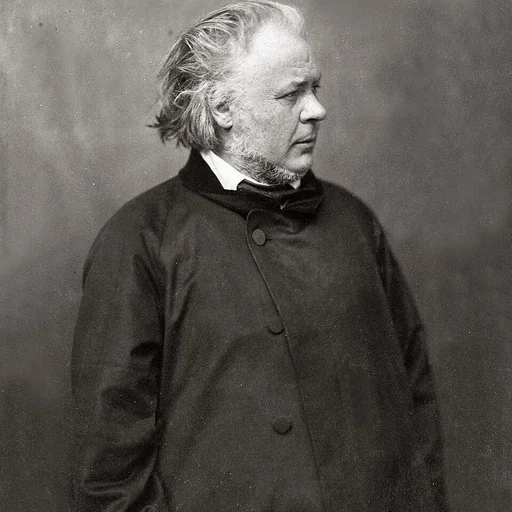
Artist
Honoré-Victorin Daumier was a French painter, sculptor, and printmaker, whose many works offer commentary on the social and political life in France, from the Revolution of 1830 to the fall of the Second French Empire in 1870.