Artwork
Un jeune homme pour qui rien n'est sacre
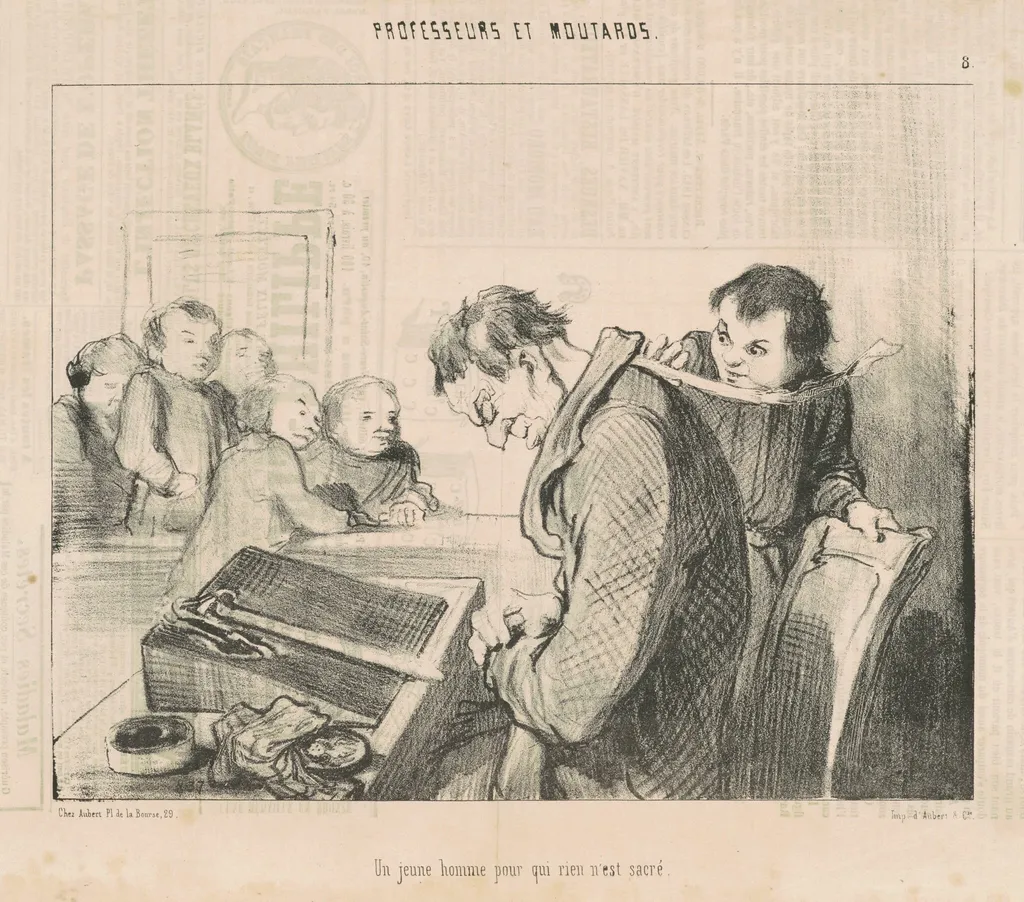
Un jeune homme pour qui rien n'est sacre is an ink print by the Romanticist artist Honoré Daumier. It dates from 1846 and is held in the collection of the National Gallery of Art. Honoré Daumée’s 1846 lithograph titled *Un jeune homme pour qui rien n’est sacré* captures a brief encounter in a classroom.
About this work
A boy stands behind a seated man at a desk. The boy holds papers while the man reads, ignoring him completely. Their expressions stay calm, but the scene feels tense.
Daumier made this in 1846. He often mocked authority in his work. Here, he shows how teachers might ignore students’ effort.
This feels like Daumier’s dry humor in action. Look up Daumier, Honoré next.
Overview
Honoré Daumée’s 1846 lithograph titled *Un jeune homme pour qui rien n’est sacré* captures a brief encounter in a classroom. A seated adult, absorbed in a document, occupies a desk while a young boy stands behind him, clutching his own papers. The figures remain composed, yet the composition conveys a subtle tension between the learner’s presence and the teacher’s indifference.
Subject & Meaning
The print juxtaposes the earnestness of the youth with the detached focus of the adult, suggesting a commentary on the hierarchical nature of education.
The print juxtaposes the earnestness of the youth with the detached focus of the adult, suggesting a commentary on the hierarchical nature of education. By portraying the boy’s attempts to be noticed as unnoticed, Daumier hints at the broader social dynamic where authority often overlooks the contributions of those beneath it, inviting viewers to reflect on power imbalances in learning environments.
Technique & Style
Executed in lithography, the work relies on bold, clean lines and a limited tonal range to delineate the figures and their surroundings. Daumier’s characteristic economy of detail emphasizes expression over ornamentation, while the stark contrast between the illuminated desk surface and the shadowed background heightens the sense of isolation and focus within the scene.
History & Provenance
Created in the mid‑1840s, the lithograph emerged during a prolific period when Daumier regularly produced satirical images of contemporary life. Though specific ownership records are sparse, the print has circulated among collectors of 19th‑century French prints and appears in several museum collections that specialize in social commentary art.
Context
The image reflects the broader climate of French society in the 1840s, a time when public education was expanding and debates over pedagogical authority were prominent. Daumier’s work often critiqued institutional power, and this piece aligns with his series of prints that expose the everyday frictions between individuals and the structures governing them.
Artist & collection

Artist
Honoré-Victorin Daumier was a French painter, sculptor, and printmaker, whose many works offer commentary on the social and political life in France, from the Revolution of 1830 to the fall of the Second French Empire in 1870.









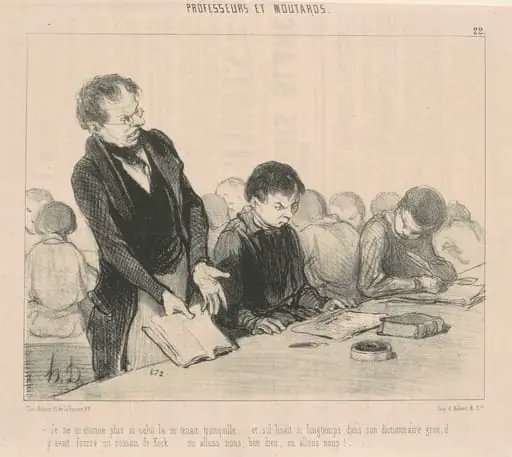 Je ne m'étonne plus si celui-la se tentaint tranquille ...
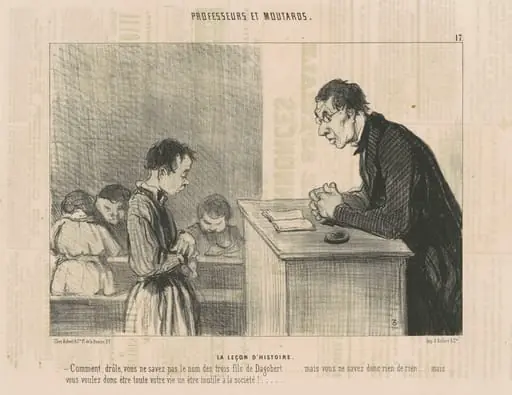 Le leçon d'histoire
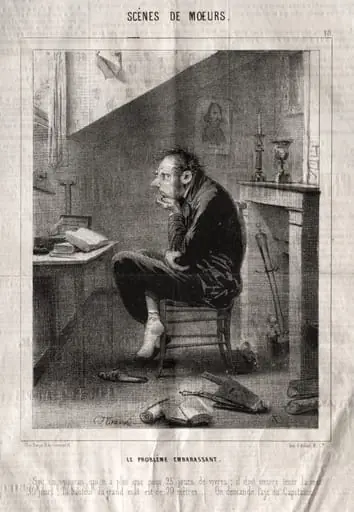 Scènes de Moeurs: Le Problême embarassant...
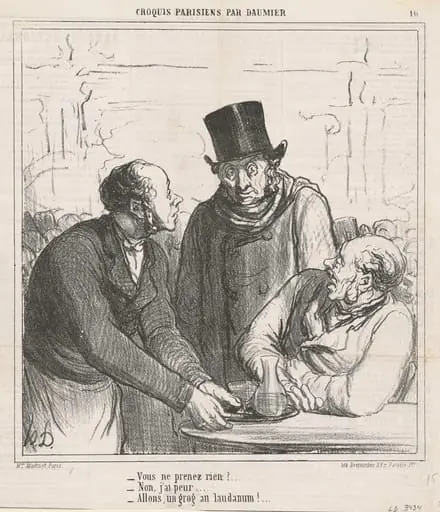 Vous ne prenez rien?
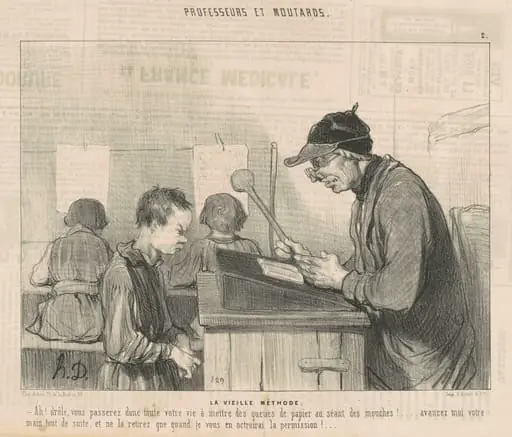 La vielle méthode
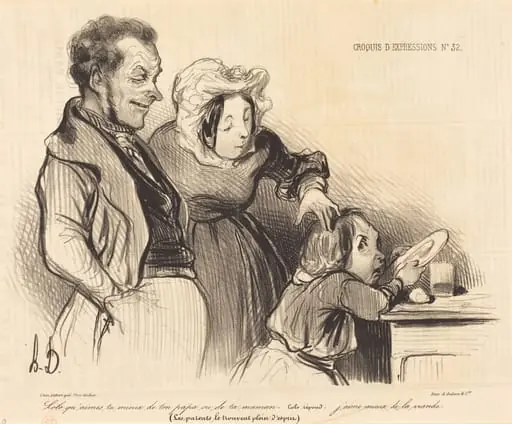 Lolo qu'aimes-tu mieux de ton papa ou de ta maman...
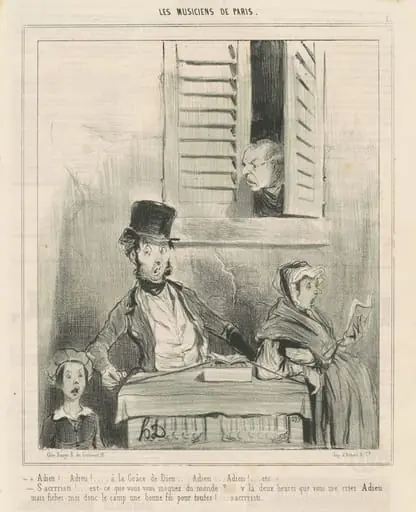 Adieu! ... A la grâce de dieu ...
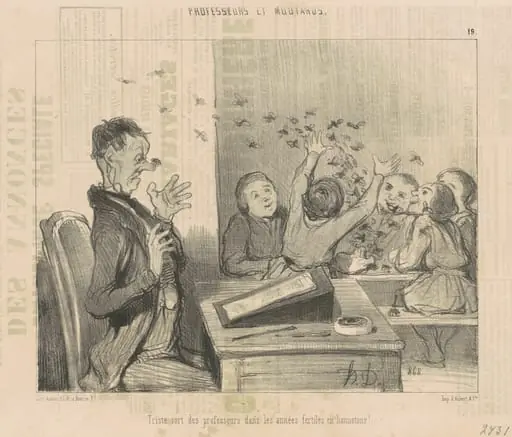 Triste sort des professeurs ...
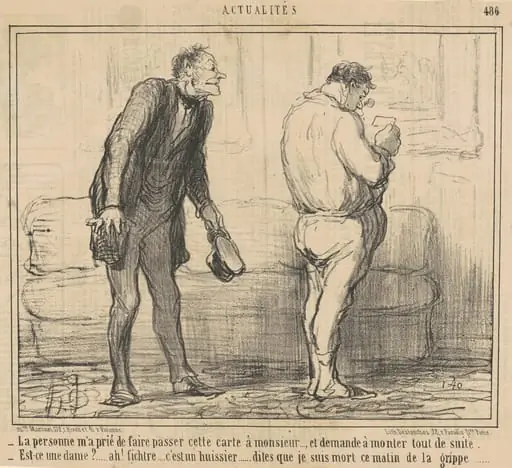 La personne ... demande a monter tout de suite ...