Artwork
Prenant le titre ... de Mr de Girardin trop au sérieux ...
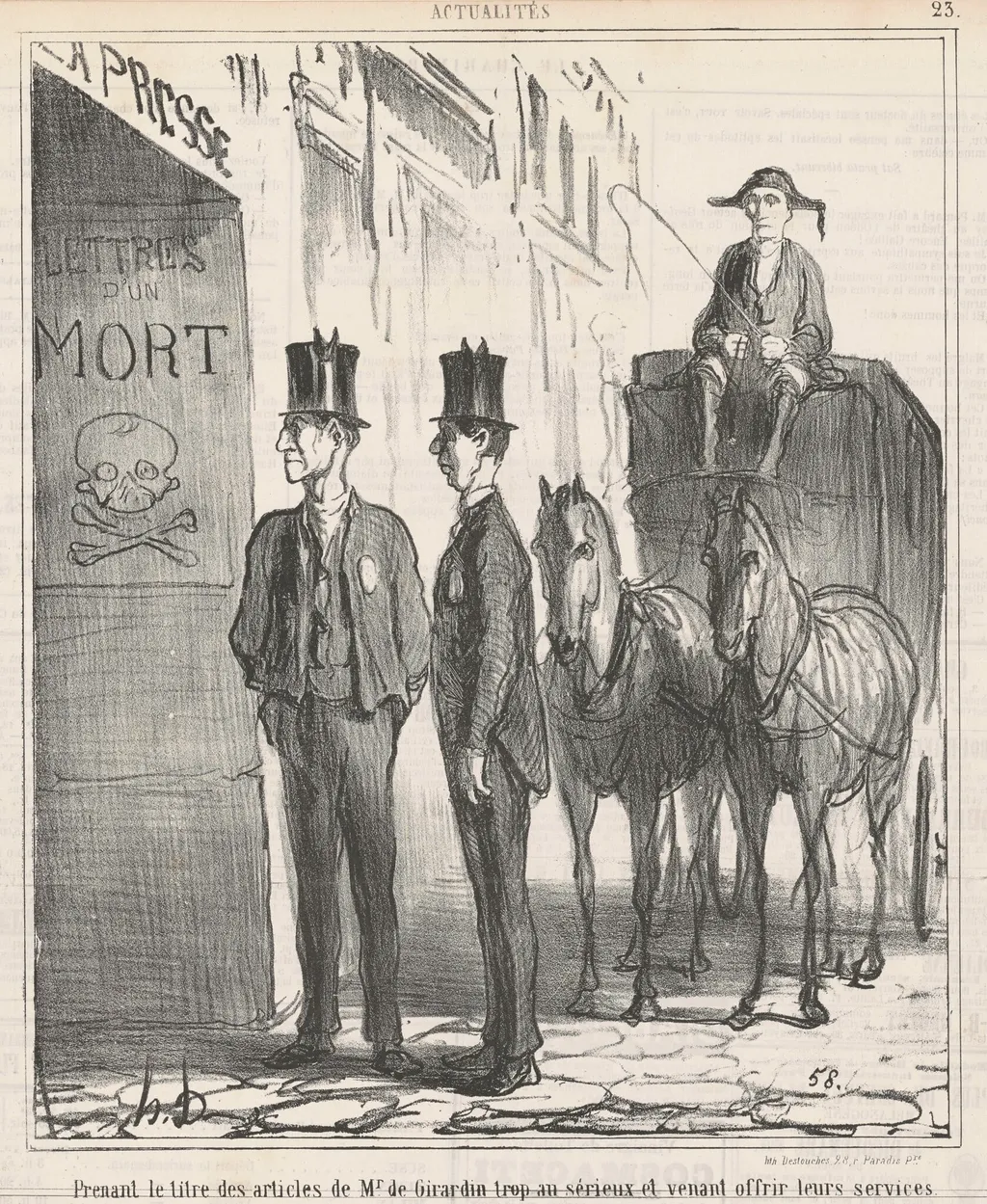
Prenant le titre ... de Mr de Girardin trop au sérieux ... is an ink print by the Impressionist artist Honoré Daumier. It dates from 1866 and is held in the collection of the National Gallery of Art.
About this work
Overview
It captures a moment of urban movement—a horse-drawn carriage passing a building marked with textual and symbolic references to press censorship.
Created in 1866 by Honoré Daumier, this lithograph is part of a series responding to the political climate of Second Empire France. It captures a moment of urban movement—a horse-drawn carriage passing a building marked with textual and symbolic references to press censorship. The work belongs to Daumier’s later period, where his focus shifted from caricature to more layered social observation, rendered with precise yet economical linework.
Subject & Meaning
The scene centers on a carriage moving through a narrow street, its driver absorbed in motion. Behind it, a building bears the words 'PRESSE' and 'LETTRES D'UN MORT,' flanked by a skull and crossbones. These elements allude to the suppression of critical journalism under Napoleon III, suggesting that the press, once vibrant, had become a graveyard of silenced voices. The carriage’s forward motion may imply public indifference to this erosion.
Technique & Style
Daumier employed lithography to achieve a dense, tonal texture with minimal strokes. The contrast between the dark, fluid outlines of the carriage and the chalky, fragmented lettering on the building creates visual tension. His use of negative space and selective detail directs attention to the inscription, transforming architectural elements into political symbols. The technique allowed for rapid reproduction, aligning with his intent to reach a broad audience.
History & Provenance
Produced during a period of intensified press censorship, the print was likely distributed through underground or limited channels. It was not widely exhibited in Daumier’s lifetime, as his political satires often faced official suppression. The work entered public collections decades later, primarily through private acquisitions and museum donations in the early 20th century, as interest in his social critiques grew.
Context
In 1866, France’s press was under strict state control following the 1852 censorship laws. Daumier, once a prolific cartoonist for satirical journals, had been imprisoned for his earlier work. This lithograph reflects his retreat from overt caricature toward allegory, using symbolic architecture to critique repression without direct confrontation. The title references a real journalist, Girardin, whose public persona was co-opted by authorities.
Legacy
Though not widely known during his lifetime, this piece exemplifies Daumier’s evolution into a chronicler of institutional decay. Later artists and critics recognized its quiet power in conveying political anxiety through mundane urban scenes. It remains a key example of how printmaking could serve as a subtle, enduring form of dissent, influencing 20th-century graphic commentary on media and power.
Artist & collection

Artist
Honoré-Victorin Daumier was a French painter, sculptor, and printmaker, whose many works offer commentary on the social and political life in France, from the Revolution of 1830 to the fall of the Second French Empire in 1870.