Artwork
The Young Courier
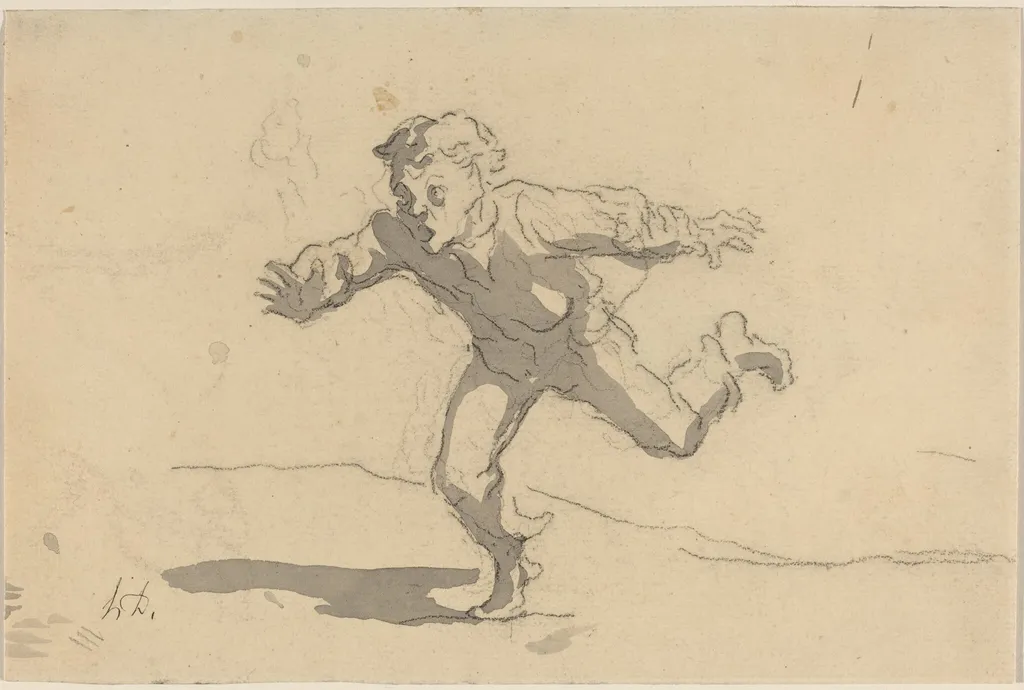
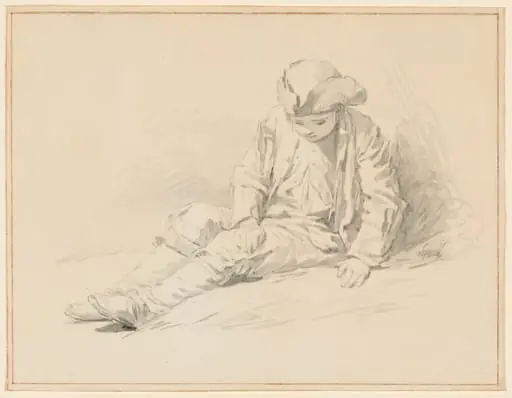
The Young Courier is a crayon drawing by the Romanticist artist Honoré Daumier. It dates from 1844 and is held in the collection of the National Gallery of Art.
About this work
Overview
Created in 1844, this drawing by Honoré Daumier is executed in black crayon and gray wash on laid paper, with a fainter figure in gray wash on the reverse.
Created in 1844, this drawing by Honoré Daumier is executed in black crayon and gray wash on laid paper, with a fainter figure in gray wash on the reverse. It belongs to a body of work where Daumier explored human movement and expression through rapid, observational sketches. Though modest in scale, the piece reflects his disciplined practice of capturing transient gestures, often as studies for larger compositions or as independent records of everyday life.
Subject & Meaning
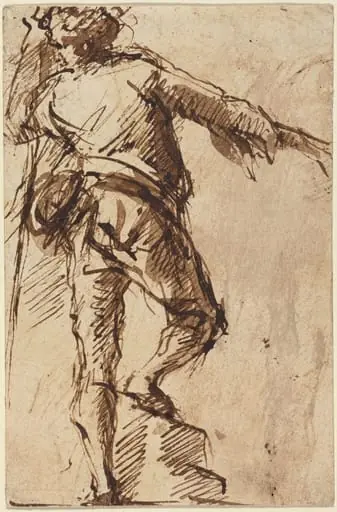
The figure is a young male courier, captured mid-stride with limbs extended and posture taut with motion. His disheveled hair and loose clothing suggest haste, while the hollowed features imply exhaustion or resolve. Daumier, who frequently depicted laborers and urban workers, presents this figure not as a hero but as a quiet testament to the physical toll of urban service. The subject embodies the anonymous laborers who kept Paris functioning, rendered with dignity through minimal means.
Technique & Style
Daumier employed quick, angular crayon lines to define the figure’s outline and musculature, then layered gray wash to model volume and shadow. The wash is applied unevenly, creating a sense of immediacy and atmospheric depth. Light pencil underdrawings are visible beneath, revealing a process of revision and refinement. The roughness of the strokes and the absence of fine detail emphasize spontaneity, aligning with Daumier’s preference for expressive immediacy over polished finish.
History & Provenance
The drawing emerged during a period when Daumier was producing hundreds of sketches for newspapers and personal study. It likely originated from his private sketchbooks, which were later dispersed after his death. The work entered public collections in the late 19th or early 20th century, preserved as part of a broader recognition of Daumier’s graphic work beyond his published caricatures. Its verso figure suggests reuse of paper, common among artists of the time.
Context
In mid-1840s France, Daumier worked under political censorship, which pushed him toward indirect social commentary. While his published cartoons targeted power structures, his drawings often focused on the lives of ordinary people. This sketch aligns with a growing interest in realism among artists, who turned away from idealized subjects to depict the rhythms and labors of the working class, reflecting broader cultural shifts in post-revolutionary society.
Legacy
Daumier’s drawings, including this one, influenced later generations of realist and modernist artists who valued expressive line and emotional truth over academic polish. Though not widely exhibited in his lifetime, his sketchbooks became foundational to 20th-century understandings of artistic process. Today, this work is studied as an example of how observation and economy of form can convey complex human presence without narrative elaboration.
Artist & collection

Artist
Honoré-Victorin Daumier was a French painter, sculptor, and printmaker, whose many works offer commentary on the social and political life in France, from the Revolution of 1830 to the fall of the Second French Empire in 1870.









![A Kneeling Man Holding a Staff [recto], by Jacopo Tintoretto](https://artifactworldgallery.com/img/jacopo-tintoretto--a-kneeling-man-holding-a-staff-recto--2f82606e21baed93-w320.webp)