Artwork
Un cauchemar de M. Bismarck
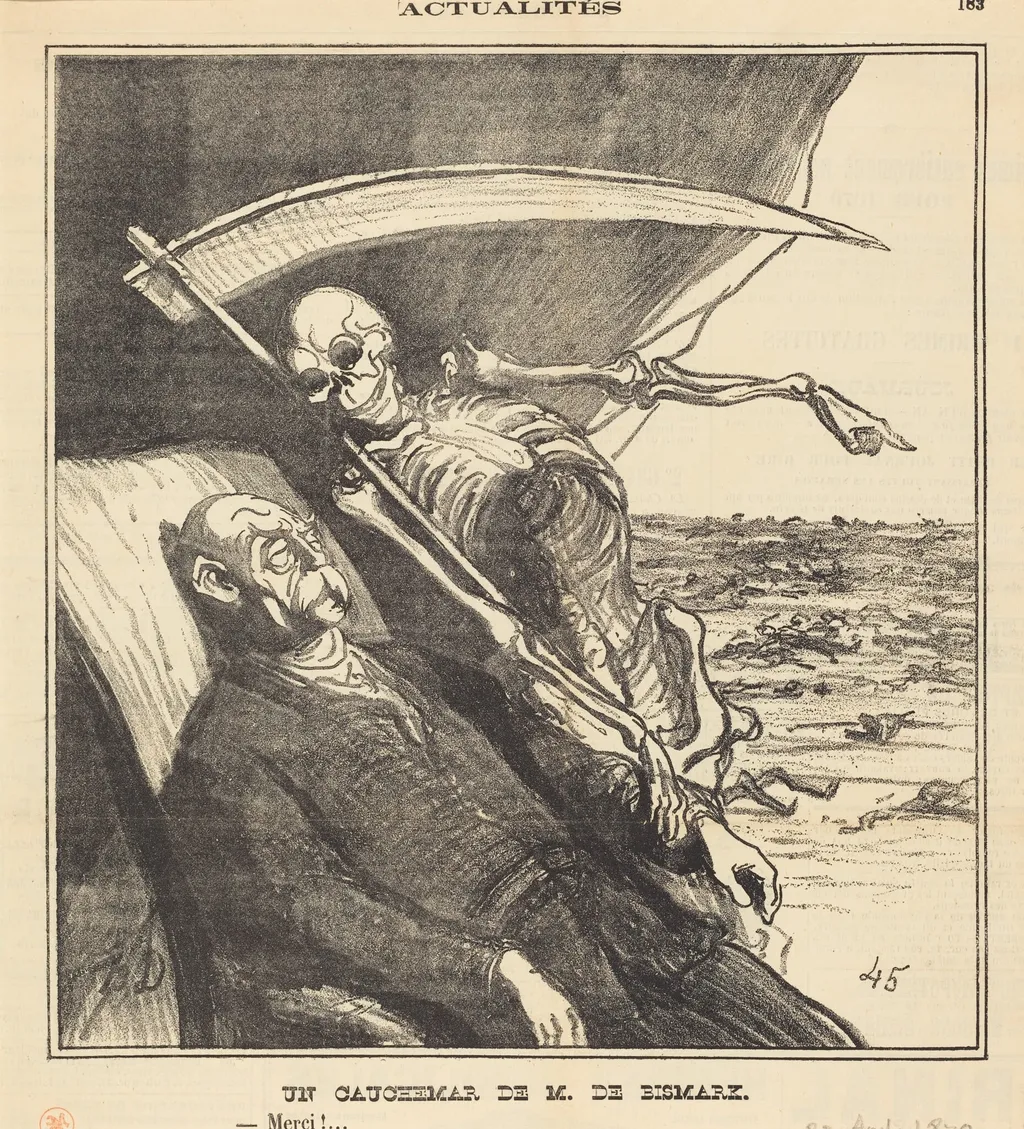
Un cauchemar de M. Bismarck is a print by the Impressionist artist Honoré Daumier. It dates from 1870 and is held in the collection of the National Gallery of Art. Created in 1870, *Un cauchemar de M.
About this work
Daumier used a gillot press on newsprint to mock France’s leaders—here Bismarck, the Prussian chancellor.
This odd print shows a sleeping woman slumped in a chair. A demon squats on her chest, grinning. A horse with fiery eyes rears above them, its mane like smoke.
It’s a political cartoon from 1870. Daumier used a gillot press on newsprint to mock France’s leaders—here Bismarck, the Prussian chancellor. The demon is satire, not myth.
Look up chiaroscuro to see how the dark shadows make the scene pop.
Overview
Created in 1870, *Un cauchemar de M. Bismarck* is a gillotype printed on newsprint by Honoré Daumier during the twilight of the Second French Empire. It belongs to a body of political satire Daumier produced for periodicals like *Le Charivari*, where he used accessible print media to critique power. The work’s rough, immediate quality reflects its mass-production context and its intent to reach a broad, politically engaged public.
Subject & Meaning
The image depicts a woman asleep in a chair, burdened by a crouching demon, while a spectral horse with glowing eyes looms above. The woman symbolizes France, the demon represents Otto von Bismarck, and the horse evokes the looming threat of Prussian militarism. Daumier transforms political anxiety into a nightmare vision, using grotesque imagery to convey the perceived violation of French sovereignty and the fragility of national peace under Bismarck’s expansionist policies.
Technique & Style
Daumier employed the gillotype process on inexpensive newsprint, allowing rapid, low-cost reproduction for newspapers. His use of stark contrasts and dense, fluid ink lines creates a dramatic chiaroscuro effect, heightening the surreal tension. The rough texture of the paper and the spontaneity of the brushwork lend urgency to the image, aligning its material form with its polemical message and the immediacy of current events.
History & Provenance
Produced in the months before the Franco-Prussian War, the print emerged amid rising tensions between France and Prussia. Daumier, long censored for his political cartoons, continued to publish critiques despite legal restrictions. This work was likely distributed through underground or semi-official channels, as official press controls tightened. Its survival in private and institutional collections reflects its resonance as a document of public dissent during a volatile political transition.
Context
The print responds to Bismarck’s manipulation of the Ems Dispatch and his role in provoking France into war. Daumier’s satire draws on a tradition of French caricature that traced back to the Revolution of 1830, using allegory to bypass censorship. In 1870, public fear of Prussian aggression was widespread, and Daumier’s imagery tapped into collective dread, framing foreign policy as a personal, supernatural assault on the nation’s body.
Legacy
Though not widely exhibited in its time, *Un cauchemar de M. Bismarck* is now recognized as a potent example of 19th-century political printmaking. It exemplifies Daumier’s ability to fuse social critique with visual invention, influencing later satirists and cartoonists. Its raw aesthetic and unflinching symbolism continue to inform how visual media can articulate political fear and resistance beyond the reach of formal discourse.
Artist & collection

Artist
Honoré-Victorin Daumier was a French painter, sculptor, and printmaker, whose many works offer commentary on the social and political life in France, from the Revolution of 1830 to the fall of the Second French Empire in 1870.









 Les arènes législatives
 Et pendant ce temps-là ils continuent à affirmer qu'elle ne s'est jamais mieux portée!
 Ou Venise commence a espérer
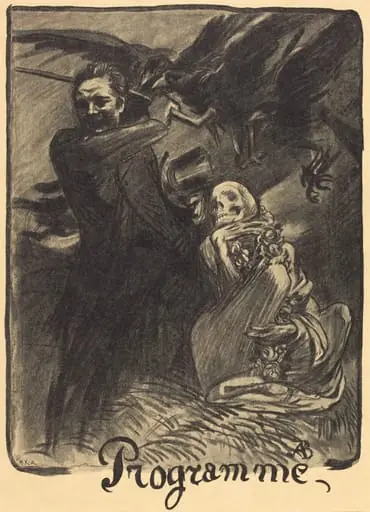 Les Honnêtes femmes; Conférence, Poésies inédites d'Henry Becque; La Parisienne
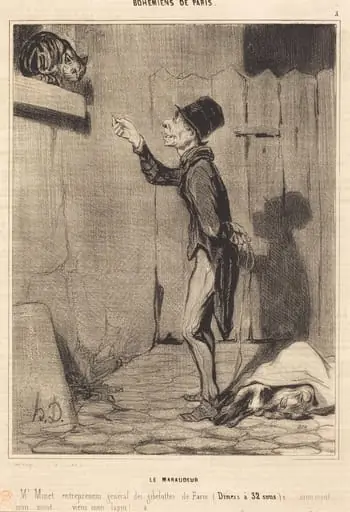 Le Maraudeur
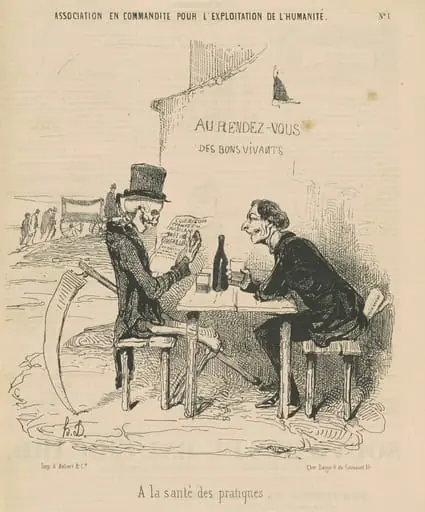 Association en commandite our l'exposition de l'humanité a la santé des pratiques
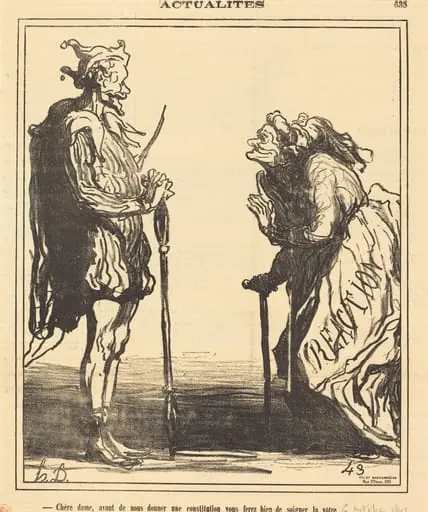 Chère dame, avant de nous donner...
 Le Vice suprème: Frontispiece
 Visite matinale d'un créancier
 Casmajou -- Ratapoil (tous deux en choeur)
 Indifferent (Indifférente)
 9 heures du soir