Artwork
Scènes de Moeurs: Le Problême embarassant...
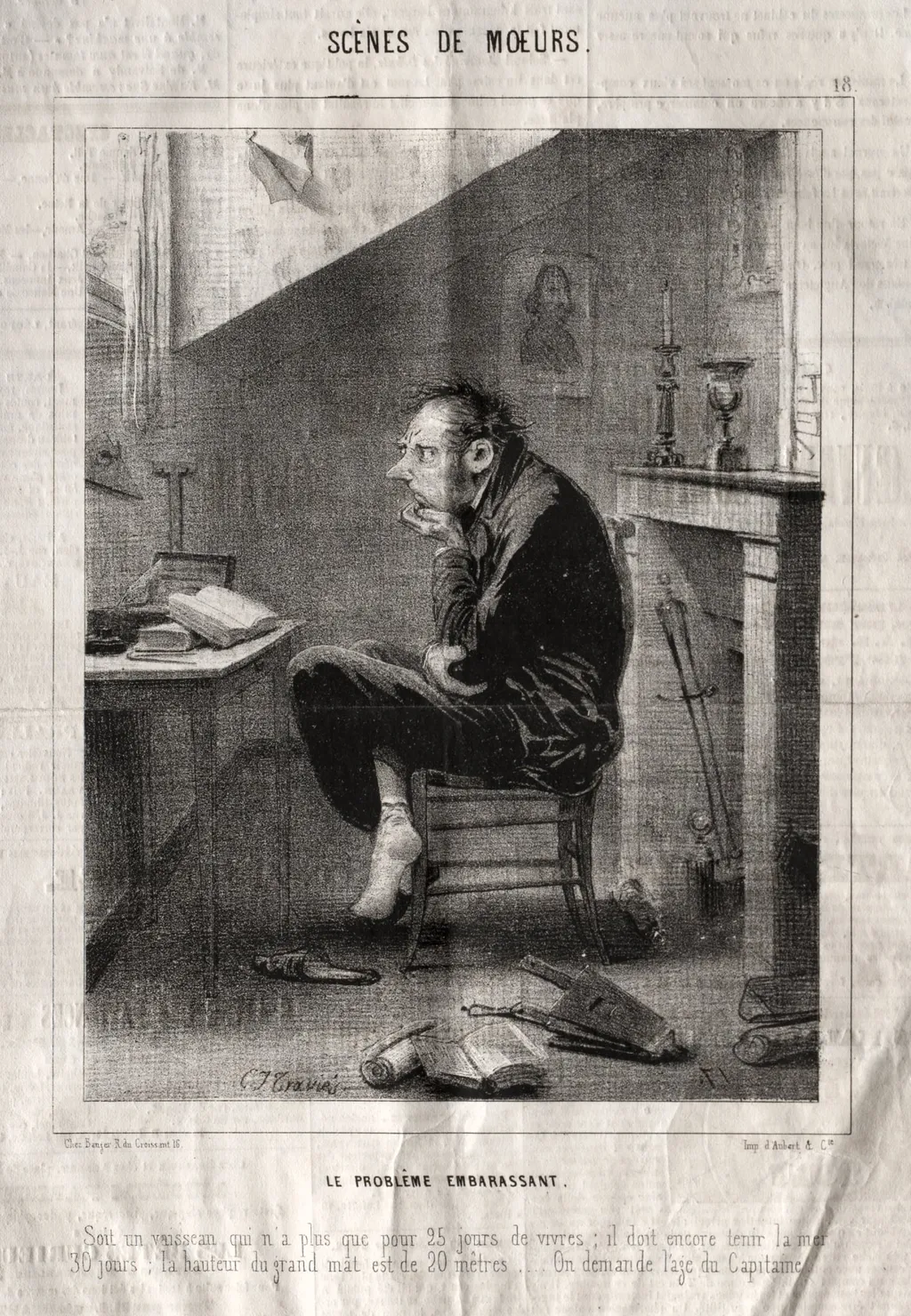
Scènes de Moeurs: Le Problême embarassant... is a print by the Romanticist artist Charles Joseph Traviès de Villers. It dates from 1838 and is held in the collection of the Cleveland Museum of Art.
About this work
Overview
Rendered in soft, muted tones, it portrays a solitary figure in a modest interior, evoking quiet tension rather than overt drama.
Created around 1838 by Charles Joseph Traviès de Villers, this lithograph is part of a series titled Scènes de Moeurs, which captures everyday moments with subtle narrative weight. The work is held in the collection of The Cleveland Museum of Art. Rendered in soft, muted tones, it portrays a solitary figure in a modest interior, evoking quiet tension rather than overt drama. The title, Le Problême embarassant, hints at an unspoken dilemma, grounding the image in a relatable human predicament.
Subject & Meaning
The figure, a sailor, sits in a dimly lit room, his posture suggesting exhaustion and resignation. With only 25 days left to live but 30 more required for his service, his predicament is both physical and existential. The cluttered desk and lingering lamp imply unfinished duties, while his slippers and rumpled jacket signal withdrawal from social formality. The title frames his plight as socially awkward—not due to moral failure, but because his suffering cannot be easily voiced or resolved.
Technique & Style
Traviès employed lithography to achieve a delicate interplay of light and shadow, using fine hatching to model form without harsh lines. The composition is tightly focused, with the figure centered against plain walls and minimal furnishings, enhancing the sense of isolation. The soft, diffused lighting—emanating from the lamp and fireplace—creates a somber, introspective mood. The technique favors atmospheric suggestion over detail, aligning with the era’s interest in psychological nuance.
History & Provenance
The print was produced during Traviès’s active period in Paris, when he contributed to illustrated periodicals documenting bourgeois and working-class life. It entered The Cleveland Museum of Art’s collection through established acquisition channels in the 20th century. While the exact early ownership is undocumented, its inclusion in the museum’s holdings reflects its recognition as a representative example of mid-19th-century French social observation in print.
Context
Emerging in the wake of Romanticism, this work reflects a shift toward intimate, psychologically charged scenes rather than grand historical narratives. Artists increasingly turned to ordinary lives to explore themes of mortality, duty, and quiet despair. Traviès’s focus on a sailor’s unspoken crisis mirrors broader cultural interest in individual suffering within rigid social structures, particularly in post-revolutionary France where personal agency remained constrained.
Legacy
Though not widely exhibited today, the print endures as a quiet example of how lithography could convey emotional depth in mass-produced imagery. Traviès’s approach influenced later illustrators who prioritized subtle narrative over spectacle. The work remains a reference point in studies of 19th-century French graphic art, valued for its restraint and its ability to evoke complex human states through minimal means.
Artist & collection

Artist
Charles Joseph Traviès de Villers
Charles-Joseph Traviès de Villers, also known simply as Traviès, was a Swiss-born French painter, lithographer, and caricaturist whose work appeared regularly in Le Charivari and La Caricature.

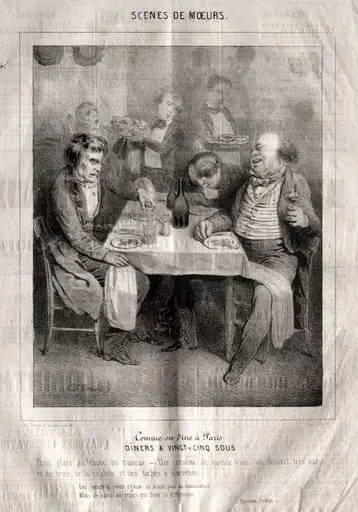 Scènes de moeurs: Comme ou dine à Paris. Diners a vingt-cing sous. Trois plates au choix du traiteur...
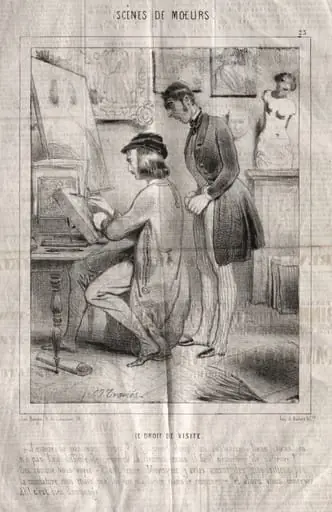 Scènes de moeurs: La Droit de visite. J'espère ne pas vous gener?...
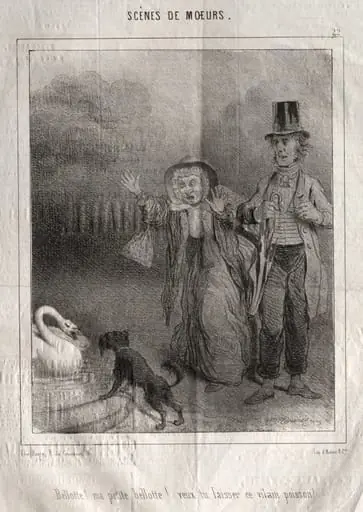 Scènes de moeurs: Bellotte! ma petite Bellote! veux-tu laisser ce vilain poisson!
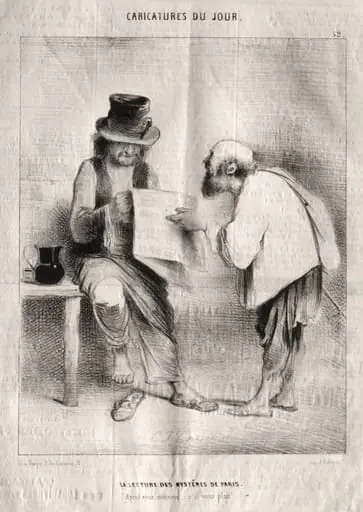 Caricatures du jour: La Lecture des mystères de Paris
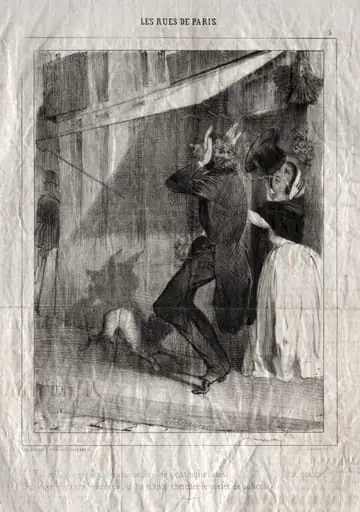 Les Rues de Paris: En voilà encore des mécaniques du cinq cent mille noms . . . c'est quelque chapelier qui aura invente ca. Ou 'on m'aille chercher le prefet de police!
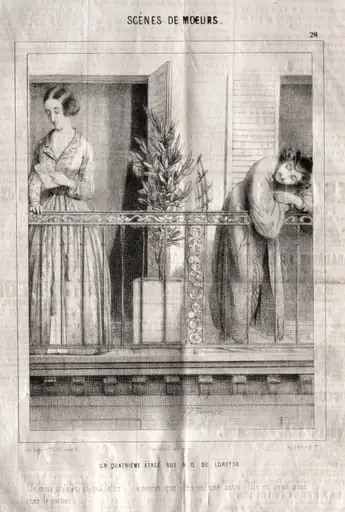 Scènes de moeurs: Un quatrieme étage rue N. D. de Lorette. Je crois qu'elle lit ma lettre...à moins que c'en soit une autre. Elle en avait neuf chez le portier
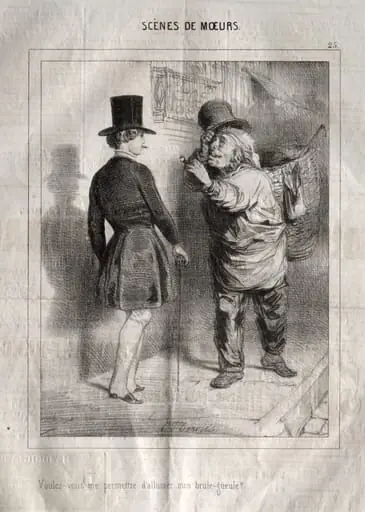 Scènes de Moeurs: Voulez-vous me permettre d'allumer mon brule-gueule?
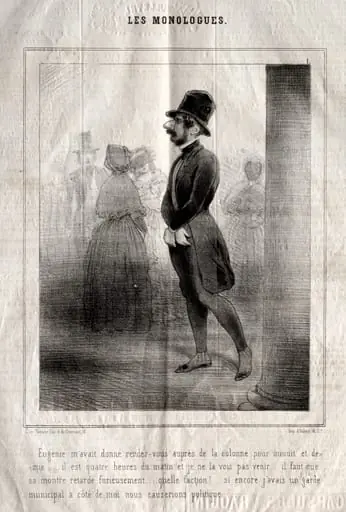 Les Monologues: Eugénie m'avait donné rendez-vous auprès de la colonne pour minuit et demie...