Artwork
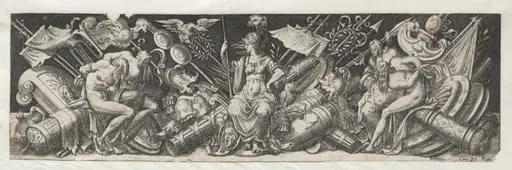
Bellona Seated on Her Trophies
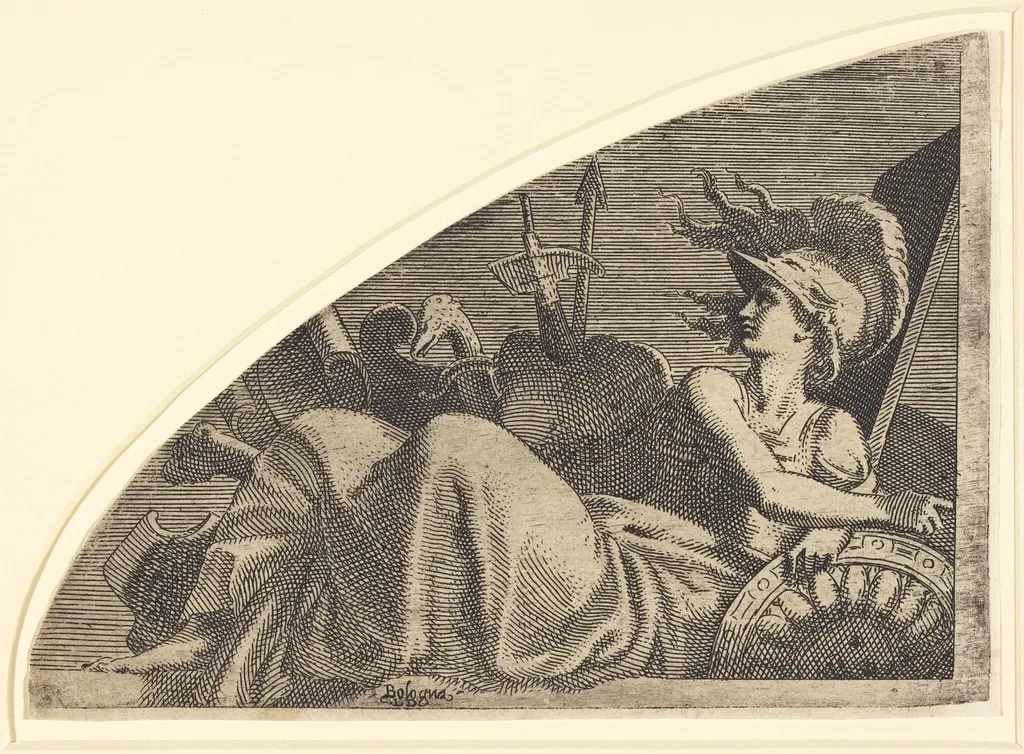
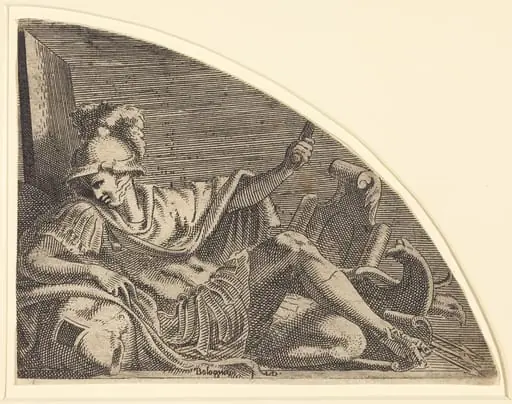
Bellona Seated on Her Trophies is an ink print by the Renaissance artist Léon Davent. It dates from 1538 and is held in the collection of the National Gallery of Art.
About this work
Overview
Created in 1538 by French printmaker Léon Davent, this etching is part of a body of work produced under the influence of the First School of Fontainebleau.
Created in 1538 by French printmaker Léon Davent, this etching is part of a body of work produced under the influence of the First School of Fontainebleau. Davent, working in the orbit of court artists like Primaticcio and Penni, translated elaborate decorative designs into printed form. The piece functions as both artistic record and stylistic export, disseminating the Mannerist aesthetic of Fontainebleau beyond the palace walls through the medium of print.
Subject & Meaning
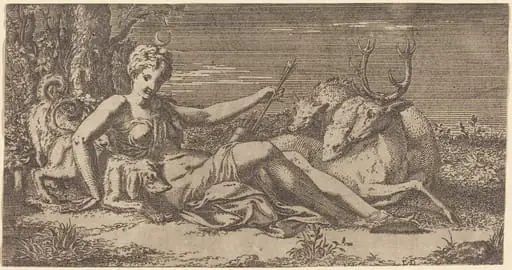
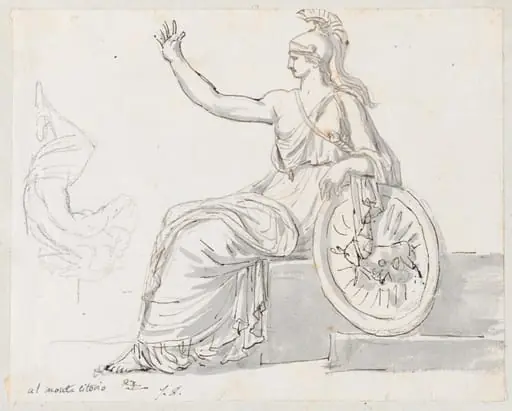
The figure of Bellona, Roman goddess of war, is depicted seated amid the wreckage of battle—broken spears, shields, and a dented helmet. Her posture suggests exhaustion rather than triumph. A small dog rests in her lap, contrasting with the weapons at her side. The image does not glorify conquest but evokes the weight of conflict, offering a quiet allegory on the toll of war, possibly reflecting contemporary anxieties in mid-16th-century France.
Technique & Style
Davent employed etching to achieve fluid, expressive lines that convey texture and movement. Sharp, incised strokes define the intricate folds of Bellona’s hair and the metallic surfaces of armor, while swirling, rhythmic lines in the background suggest chaos and motion. The absence of color emphasizes tonal contrast and linear energy, characteristic of Fontainebleau’s graphic style, which prioritized dynamic composition over naturalistic detail.
History & Provenance
The print emerged from the workshop culture of Fontainebleau, where artists collaborated to produce prints as records of frescoes and stucco reliefs. Davent’s etchings, including this one, were likely circulated among collectors and artists across Europe. Though no early ownership records are documented, its survival in major print collections indicates its recognition as a representative example of French Mannerist printmaking from the 1530s.
Context
In the 1530s, the French court under Francis I was actively importing Italian Mannerist ideals, and Fontainebleau became a hub for hybrid artistic production. Prints like Davent’s served to translate elaborate palace decorations into portable formats, making the court’s visual language accessible beyond its walls. This work reflects a broader trend of using classical mythology to explore political and emotional themes within a refined, intellectual artistic milieu.
Legacy
Davent’s etching contributed to the standardization of Mannerist graphic styles in Northern Europe. While not widely known today, his prints influenced later generations of printmakers by demonstrating how etching could convey complex allegories with emotional nuance. The work remains a key example of how printmaking functioned as both documentation and artistic innovation during the early Renaissance in France.
Artist & collection

Artist
Léon Davent (French pronunciation: ) was a French printmaker in the mid 16th century, closely associated with the First School of Fontainebleau.