Artwork
Baalbec
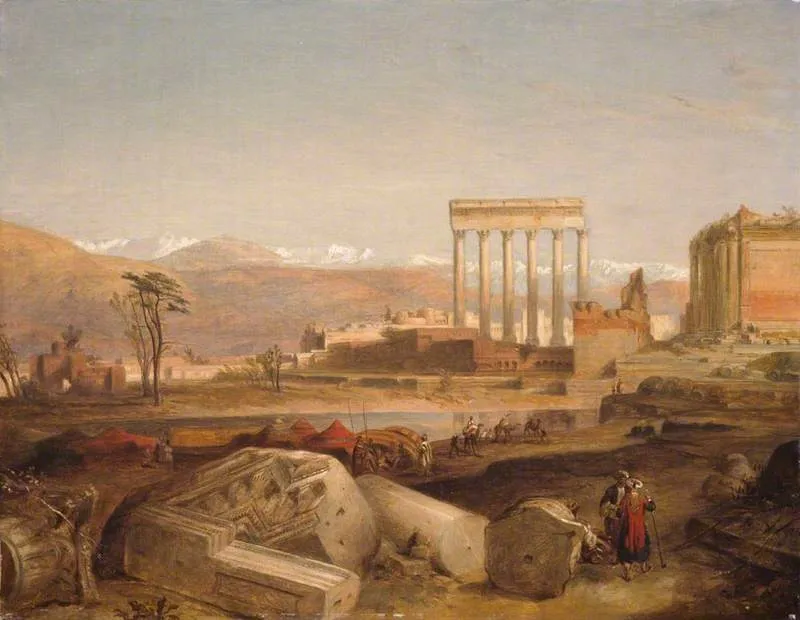
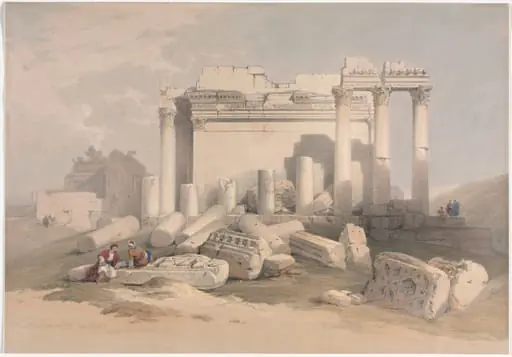
Baalbec is an oil painting by David Roberts. It dates from 1842 and is held in the collection of the National Galleries Scotland.
About this work
Overview
The painting is part of the Scottish National Gallery’s collection and reflects Roberts’ transition from theatrical scene-painting to topographical realism.
Painted in 1842, *Baalbec* is an oil on canvas work by Scottish artist David Roberts, capturing the ancient ruins of the Lebanese site in precise detail. It emerged from his two-year journey through Egypt and the Levant, during which he recorded architectural remains with scholarly intent. The painting is part of the Scottish National Gallery’s collection and reflects Roberts’ transition from theatrical scene-painting to topographical realism.
Subject & Meaning
The scene centers on the monumental stone remains of Baalbek, a Roman-era complex in modern-day Lebanon, rendered with attention to structural decay and weathering. Figures and animals in the foreground—travelers, guides, and pack animals—introduce human scale and quiet activity, contrasting the silence of the ruins. The composition suggests neither worship nor nostalgia, but a sober observation of time’s passage over human achievement.
Technique & Style
Roberts employed layered oil paint to achieve fine detail in the stonework, using subtle gradations of light to model surfaces and enhance spatial depth. The cool, clear atmosphere of the background, with snow-tipped mountains, balances the warm tones of the ruins. His brushwork is controlled and precise, avoiding romantic embellishment; the effect is documentary rather than dramatic, emphasizing architectural accuracy over emotional intensity.
History & Provenance
Created after Roberts’ return from his 1838–1840 travels, *Baalbec* was produced during a period of heightened public interest in Near Eastern antiquities. It preceded his widely distributed lithographic series on the region, which helped popularize his imagery. The painting entered the Scottish National Gallery’s holdings in the 19th century, where it remains as part of a broader collection of British Orientalist works.
Context
Roberts painted during a time when European travelers and scholars were increasingly documenting the Middle East’s ancient sites, often through the lens of colonial curiosity. His work aligned with archaeological efforts of the era, offering visual records for audiences unfamiliar with the region. Unlike later Orientalist painters, Roberts prioritized fidelity to observed detail over exoticized fantasy, distinguishing his approach within the genre.
Legacy
*Baalbec* stands as a representative example of Roberts’ contribution to 19th-century topographical art. His method of combining travelogue with artistic precision influenced subsequent generations of artists and illustrators documenting historical sites. Though less celebrated than his lithographs, the painting endures as a quiet testament to his commitment to visual accuracy and the cultural weight of ruins.
Artist & collection
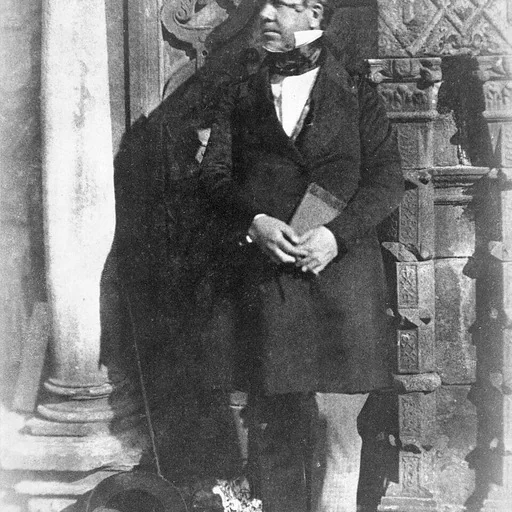
Artist
David Roberts (24 October 1796 – 25 November 1864) was a Scottish painter. He is especially known for The Holy Land, Syria, Idumea, Arabia, Egypt, and Nubia, a prolific series of detailed lithograph prints of Egypt and…