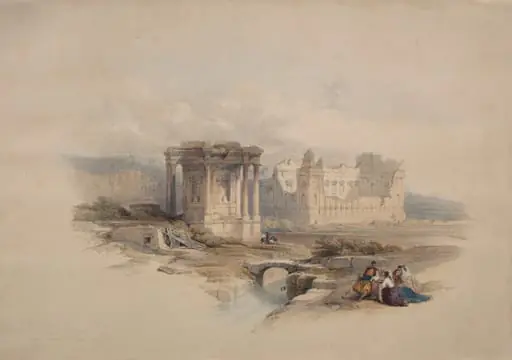
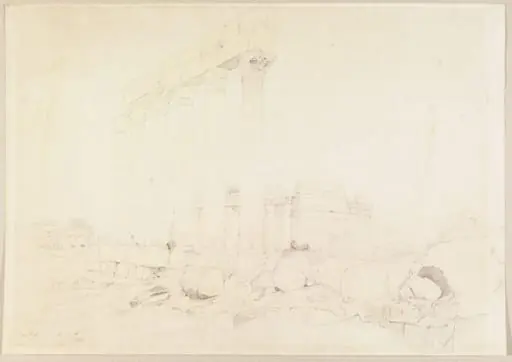
Artwork
Baalbek
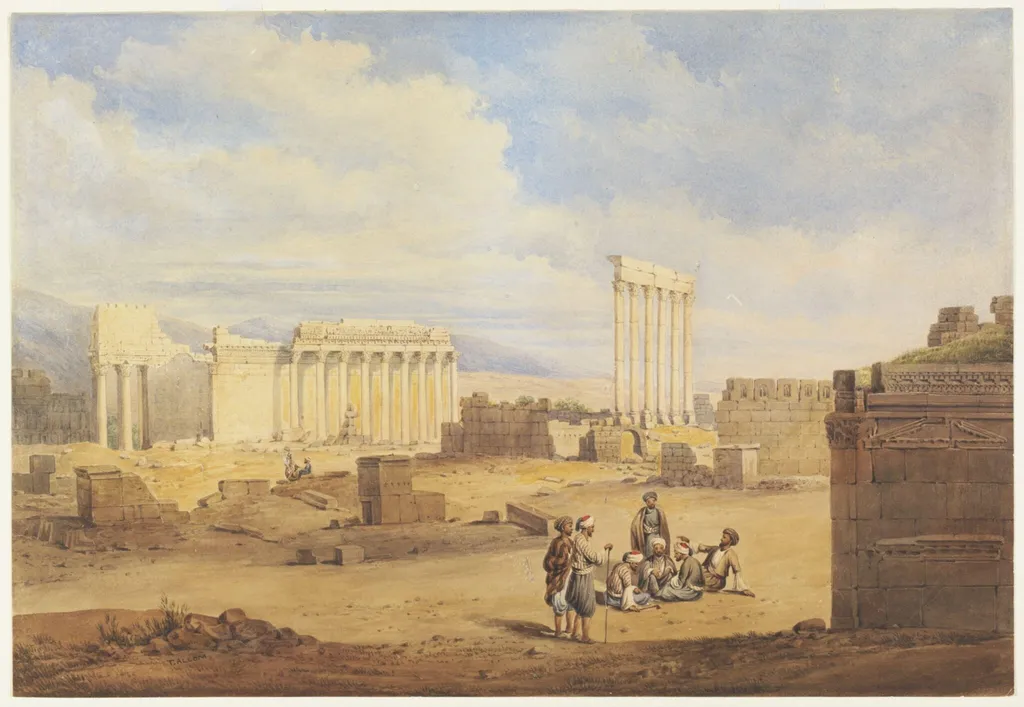
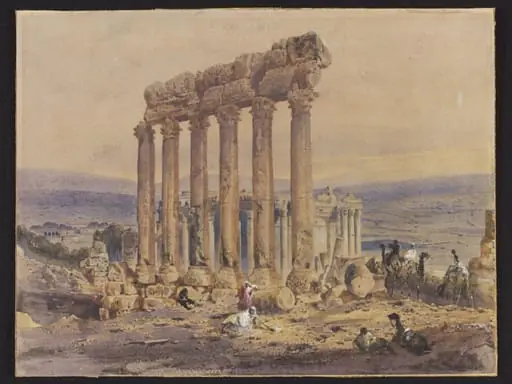
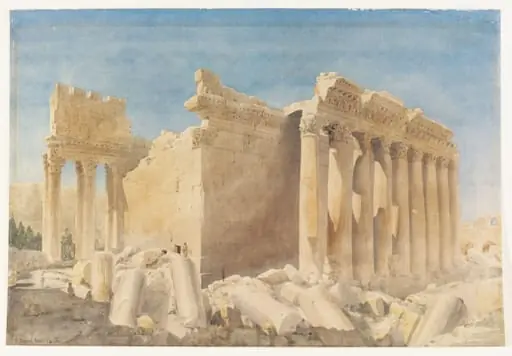
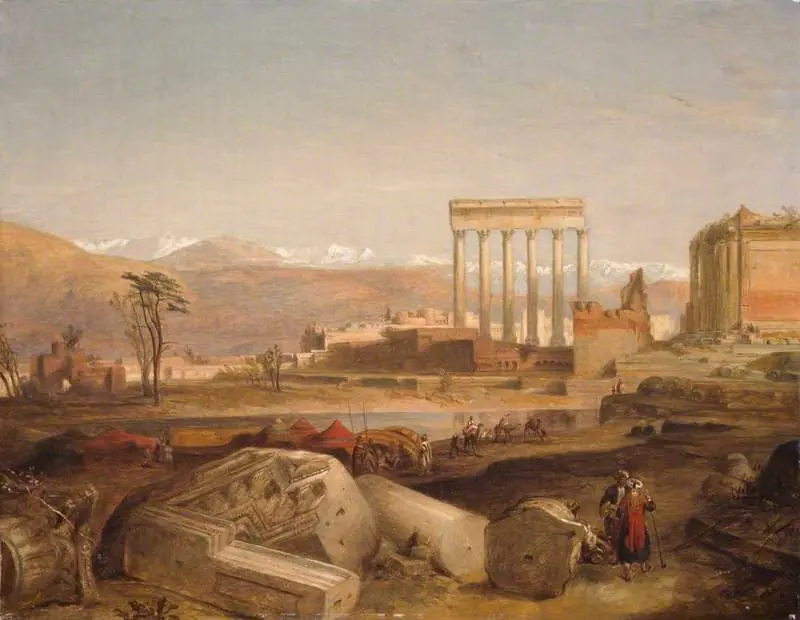
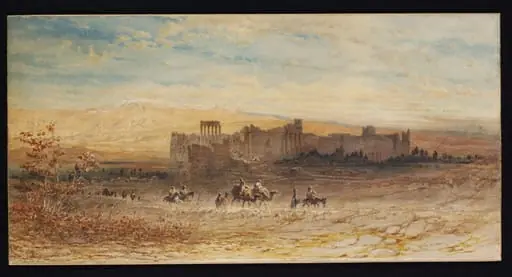
Baalbek is a watercolor work on paper by the Romanticist artist Antonio or Anton Schranz. It dates from 1837 and is held in the collection of the Victoria and Albert Museum. This watercolour by Antonio Schranz Jr.
About this work
Overview
Executed on paper and mounted on a card with handwritten notes, it belongs to a series produced during a journey likely undertaken with a private patron.
This watercolour by Antonio Schranz Jr. captures a landscape of ancient ruins in Baalbek, created during his travels in the Ottoman Empire between late 1836 and mid-1837. Executed on paper and mounted on a card with handwritten notes, it belongs to a series produced during a journey likely undertaken with a private patron. The work reflects the artist’s engagement with archaeological sites across the eastern Mediterranean, following his departure from Malta in April 1836 and return in December 1839.
Subject & Meaning
The scene portrays figures—some standing, others seated—amid the remnants of a monumental ancient structure. The presence of people suggests observation or quiet contemplation rather than active excavation. The ruins, composed of massive stone columns and fragmented masonry, evoke a sense of time’s passage. The composition emphasizes the quiet coexistence of human presence and enduring architecture, without narrative or dramatic intervention.
Technique & Style
Schranz employed delicate watercolour washes to render the weathered stone surfaces and atmospheric sky. Earth tones—beige, ochre, and gray—dominate the palette, with muted greens suggesting distant vegetation. The soft clouds and even light indicate a focus on naturalism over theatrical effect. Fine linework defines architectural details, while the transparency of the medium allows the paper’s texture to subtly influence the tonal gradations.
History & Provenance
The drawing is one of several produced during Schranz’s extended journey through the eastern Mediterranean, beginning in Malta and extending into Anatolia. Related works are documented in the Benaki Museum in Athens and a private collection in Malta. The inclusion of handwritten inscriptions on the mounts implies these were compiled as a personal or patron-commissioned record, possibly intended for private circulation rather than public exhibition.
Context
Schranz’s travels coincided with a period of growing European interest in classical antiquities of the Levant. His work aligns with the tradition of topographical watercolours made by travellers documenting ancient sites, often for scholarly or aristocratic audiences. Unlike later archaeological surveys, his approach prioritized visual observation over precise measurement, reflecting a Romantic-era sensibility toward ruins as evocative landscapes.
Legacy
Schranz’s Baalbek watercolour contributes to a modest but significant body of 19th-century visual records from the region. While not widely exhibited, its presence in institutional and private collections underscores its role as a personal document of early travel and observation. The work remains a quiet testament to the engagement of minor artists with the cultural landscapes of the Ottoman Empire during a time of shifting archaeological interest.
Artist & collection
Artist
Antonio Schranz made watercolours of Egyptian and Levantine sites in the 1830s–40s.

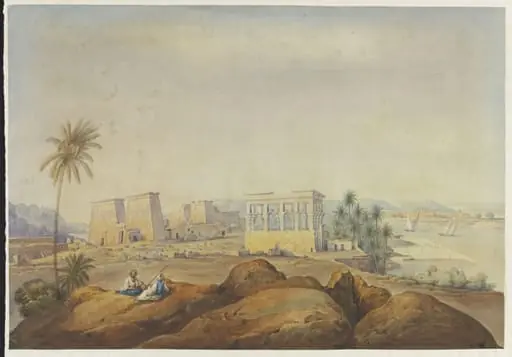 The Temple of Isis and Kiosk of Trajan on the Island of Philae
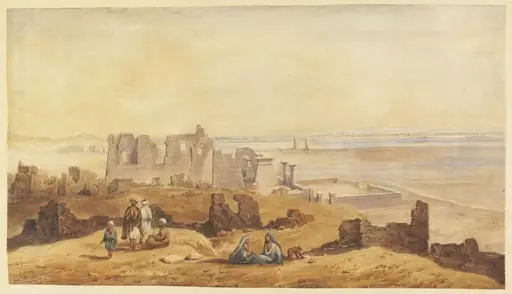 Luxor: the West Bank, with the Temple of Ramesses III at Madinat Habu; looking east towards the Nile
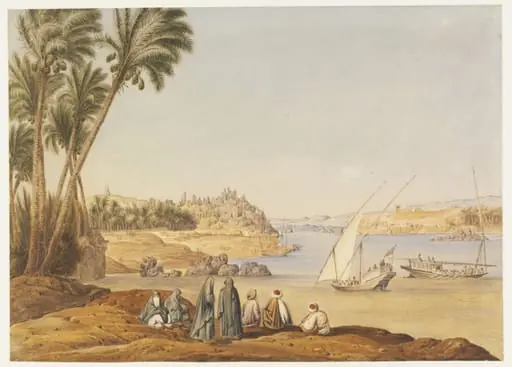 Aswan; looking south up the Nile
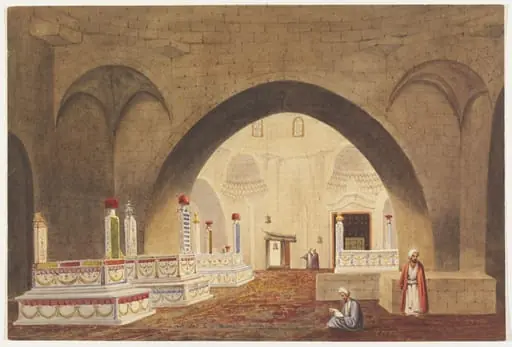 Mausoleum of Mehmet Ali and his family at Cairo
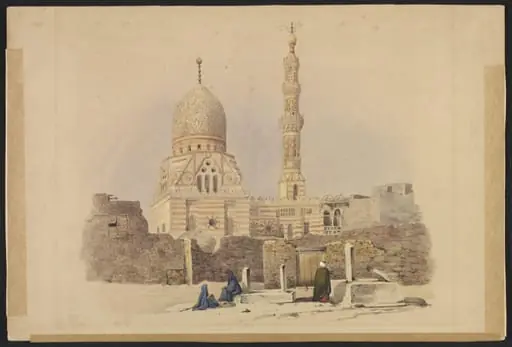 Mosk of Kaed Bey Cairo -
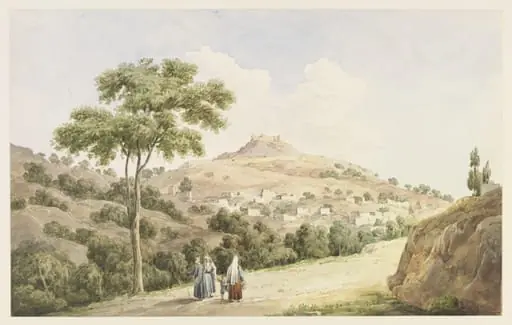 Saffed
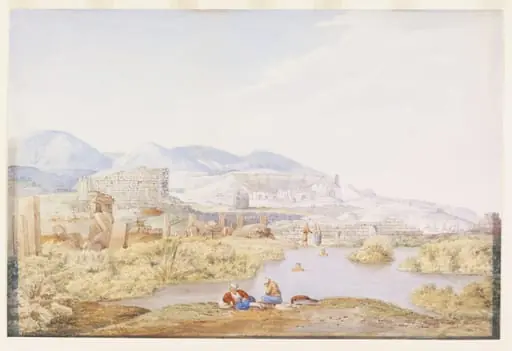 Hierapolis - Natural Hot Spring. Phrygia
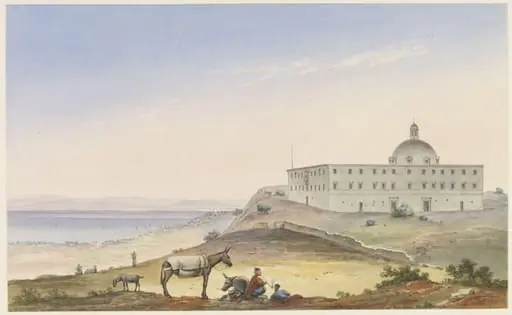 Convent on Mount Carmel