Artwork
Jerusalem from the Mount of Olives
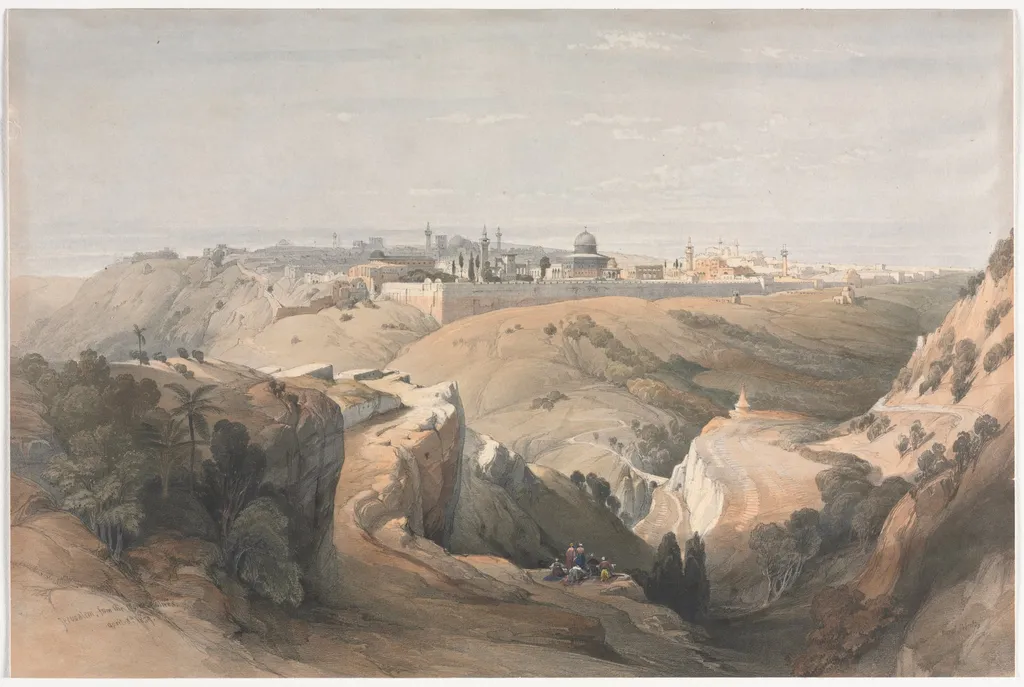
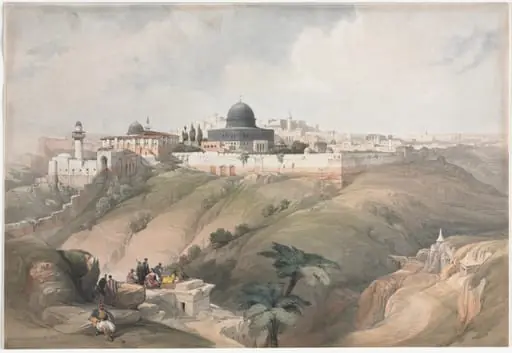
Jerusalem from the Mount of Olives is a print by the Romanticist artist David Roberts. It dates from 1839 and is held in the collection of the Cleveland Museum of Art.
About this work
Overview
The image captures Jerusalem as viewed from the Mount of Olives, emphasizing the city’s elevated position against a barren landscape.
David Roberts, a Scottish artist, produced this lithograph in 1839 during a multi-year journey through the Levant. It is one of many works documenting his observations of the Near East, combining topographical accuracy with atmospheric detail. The image captures Jerusalem as viewed from the Mount of Olives, emphasizing the city’s elevated position against a barren landscape. Roberts’ approach blended documentary intent with aesthetic composition, reflecting his growing reputation as a travel artist.
Subject & Meaning
The scene presents Jerusalem not as a religious symbol but as a physical place, its architecture rising from rocky terrain under a pale sky. The distant domes and towers are rendered with precision, while the foreground features sparse human figures that underscore the city’s isolation. The composition invites contemplation of scale and distance, suggesting a quiet reverence for the landscape rather than overt narrative or theological commentary.
Technique & Style
Roberts employed lithography to achieve fine gradations of tone and texture, using muted earth tones—browns, greens, and soft blues—to convey the arid environment. The contrast between the jagged, shadowed foreground and the luminous cityscape creates a sense of depth and ethereal distance. Tiny figures scale the path, reinforcing the vastness of the terrain. His technique prioritizes clarity and atmospheric effect over dramatic flourish, aligning with 19th-century topographical traditions.
History & Provenance
Created during Roberts’ 1838–1840 expedition through Egypt, Sinai, Palestine, and Syria, this print was part of a larger series published in the early 1840s. The lithographs were widely distributed and helped shape European perceptions of the region. Roberts’ detailed field sketches served as the basis for these works, which were later compiled into illustrated volumes. His election to the Royal Academy in 1841 followed the public reception of this body of work.
Context
Roberts’ work emerged within the broader European fascination with the Orient, yet his approach diverged from romanticized fantasy. He relied on direct observation and precise rendering, influenced by archaeological and travel literature of the time. While his images were consumed through the lens of Orientalism, his commitment to topographical fidelity set him apart from more stylized contemporaries, grounding his vision in empirical study.
Legacy
Roberts’ lithographs of Jerusalem and other sites became reference points for later artists and scholars. His method of combining travel documentation with artistic composition influenced how the Middle East was visually represented in 19th-century Europe. Though his work is now viewed critically within postcolonial discourse, its technical precision and observational rigor remain notable for their contribution to the history of visual ethnography.
Artist & collection
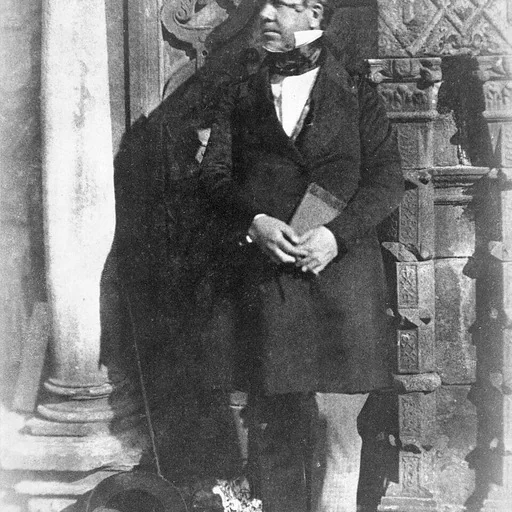
Artist
David Roberts (24 October 1796 – 25 November 1864) was a Scottish painter. He is especially known for The Holy Land, Syria, Idumea, Arabia, Egypt, and Nubia, a prolific series of detailed lithograph prints of Egypt and…

 Jerusalem
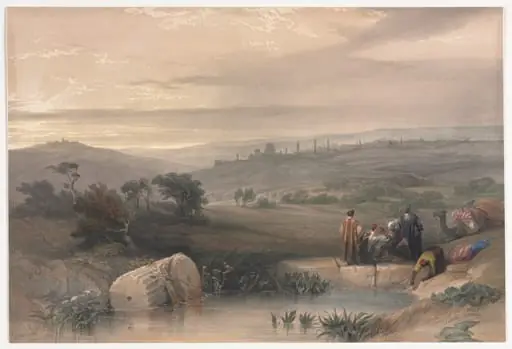 Jerusalem from the North
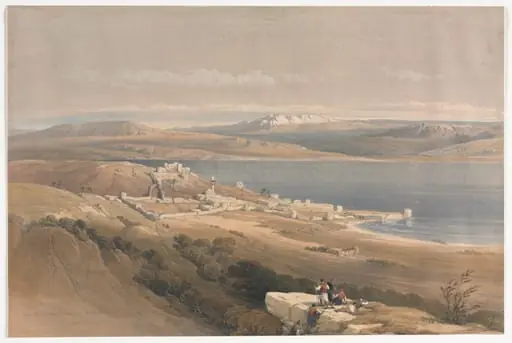 City of Tiberias on the Sea of Galilee, looking towards Hebron
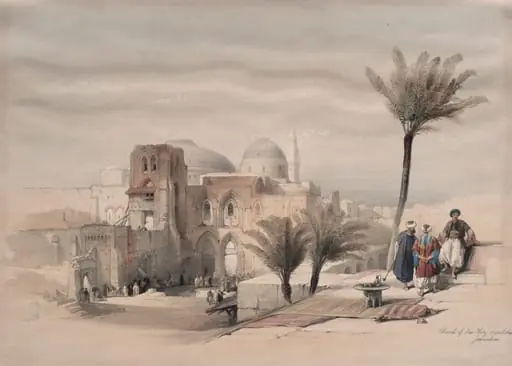 Church of the Holy Sepulchre, Jerusalem
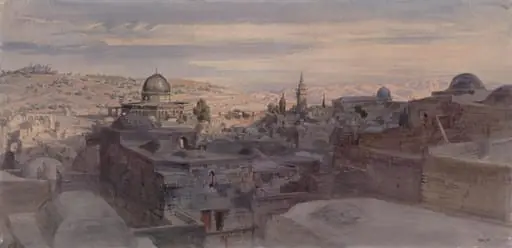 Jerusalem
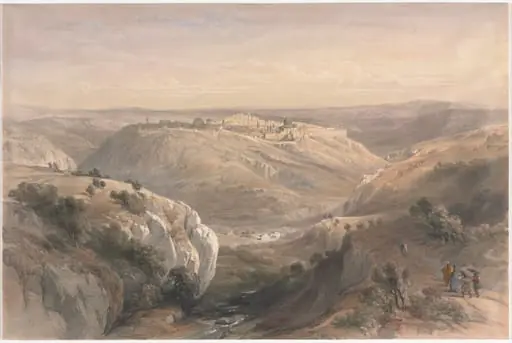 Jerusalem from the South
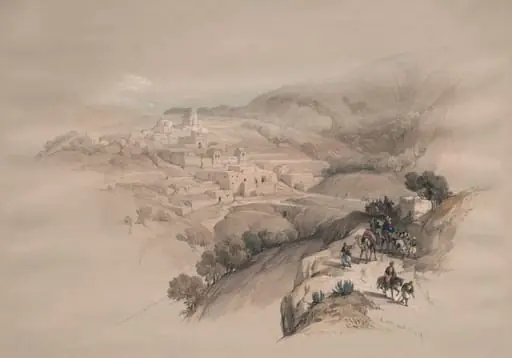 Bethany
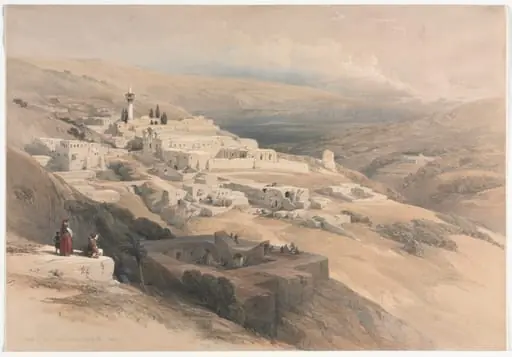 Convent of the Terra-Santa, Nazareth
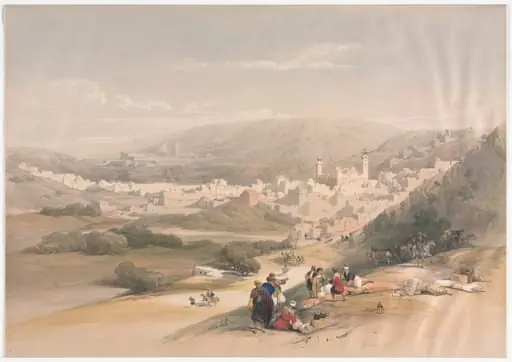 Hebron
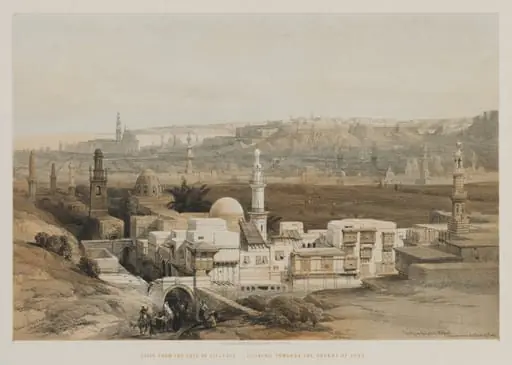 Egypt and Nubia, Volume III: Cairo from the Gate of Citzenib, Looking towards the Desert of Suez