Artwork
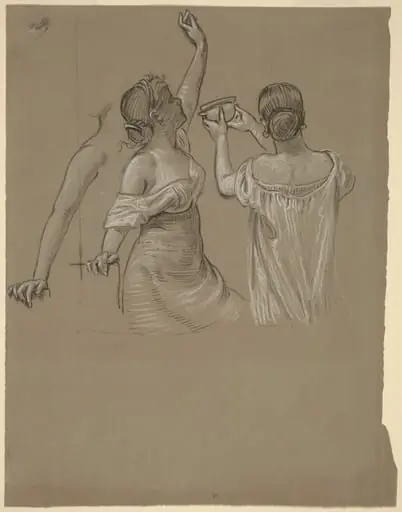
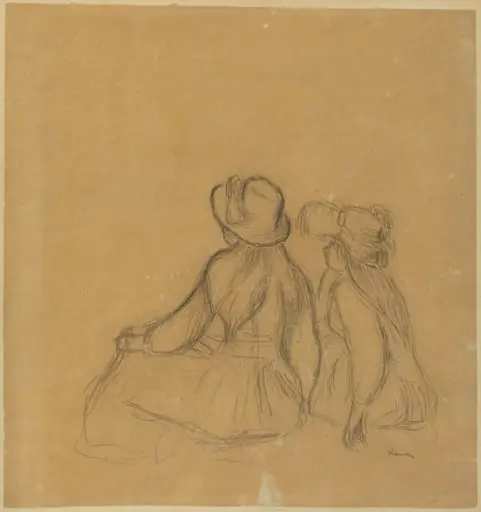
Study for "Mary Cassatt at the Louvre" [recto]
![Study for "Mary Cassatt at the Louvre" [recto], by Edgar Degas, graphite, 1879](https://artifactworldgallery.com/img/edgar-degas--study-for-mary-cassatt-at-the-louvre-recto--a781f434ac682895-w1024.webp)
Study for "Mary Cassatt at the Louvre" [recto] is a graphite drawing by the Impressionist artist Edgar Degas. It dates from 1879 and is held in the collection of the National Gallery of Art.
About this work
Overview
This graphite and blind-stylus drawing, created by Edgar Degas around 1879, serves as a study for his work *Mary Cassatt at the Louvre*. Executed on wove paper with faint grid lines, the recto features two quick sketches.
Subject & Meaning
The drawing depicts two figures in profile: on the left, a woman (identified as Mary Cassatt, an American artist and Degas' collaborator) stands with her back turned, dressed in a simple, low-necklined dress, with her hair up and an object in her left hand; on the right, a child sits on the ground, facing away, with one arm resting on their knee.
Technique & Style
Degas employed graphite and a blind stylus to create light, guiding lines, suggesting a preparatory step for a larger work. The faint grid lines on the paper aided in accurately placing the figures, reflecting his meticulous approach to composition.
History & Provenance
Created circa 1879, this study is characteristic of Degas' preparatory process, though specific provenance details (ownership history) are not provided in the available information.
Context
While often associated with the Impressionist movement, Degas preferred the term 'realist'. This work reflects his broader practice of capturing contemporary life, frequently collaborating with fellow artists like Mary Cassatt.
Legacy
This study exemplifies Degas' methodical creative process. His use of sketches like this one influenced his final artworks, demonstrating the importance of preliminary drawings in his overall oeuvre.
Artist & collection
Artist
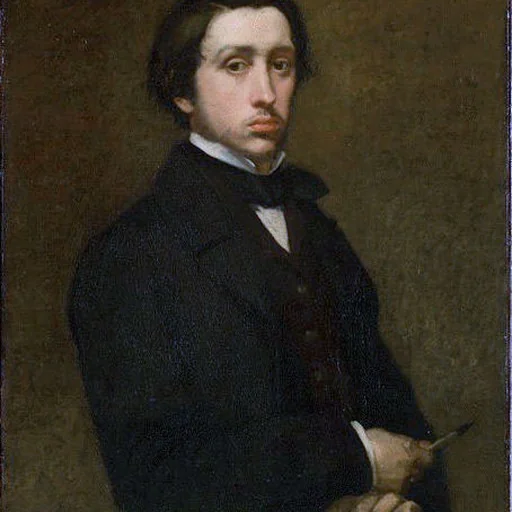
Born Hilaire-Germain-Edgar De Gas on 19 July 1834 in Paris, Edgar Degas came from an affluent banking family with aristocratic roots and spent his childhood among the cultivated circles of the French capital.

![Sheet of Studies [recto and verso], by John Flaxman](https://artifactworldgallery.com/img/john-flaxman--sheet-of-studies-recto-and-verso--92409dcb1ad1b47a-w320.webp)
![The Fitting [recto], by Mary Cassatt](https://artifactworldgallery.com/img/mary-cassatt--the-fitting-recto--bdf1c75791eec1a5-w320.webp)