Artwork
Portrait of Madame Delâtre
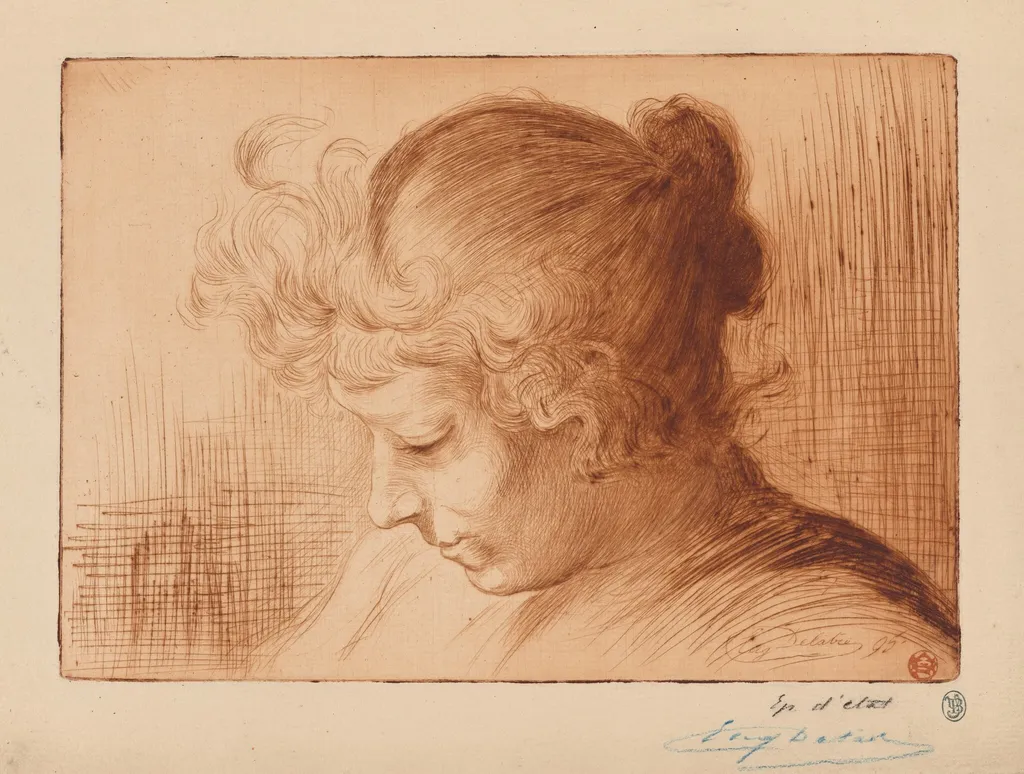
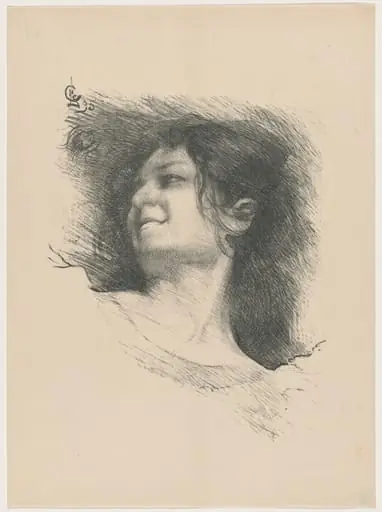
Portrait of Madame Delâtre is an ink print by the Impressionist artist Eugène Delâtre. It dates from 1895 and is held in the collection of the National Gallery of Art.
About this work
Overview
Eugène Delâtre’s Portrait of Madame Delâtre is an 1895 print executed as an etching with dry‑point elements, rendered in a striking red hue on laid paper. The work presents a solitary female figure, her dark attire contrasting with a largely blank background, and captures her gaze directly toward the viewer.
Subject & Meaning
The composition focuses on a woman dressed in a dark gown, her face rendered with precise, angular lines that create a sense of three‑dimensionality. Her steady, forward‑looking stare invites contemplation of her identity and presence, while the minimal background emphasizes her individuality.
Technique & Style
Delâtre combined traditional etching with dry‑point, a process in which a metal plate is incised with a needle, allowing the resulting burr to retain extra ink. This technique yields velvety, deep lines that give the portrait its rich tonal quality, especially evident in the facial modeling.
History & Provenance
Created in 1895, the print is known from a proof edition, indicating it was likely produced in limited numbers. It remains associated with Delâtre’s oeuvre of portraiture, though specific details of its ownership history are not extensively documented.
Context
During the late nineteenth century, French printmakers like Delâtre explored the expressive possibilities of dry‑point within the broader revival of graphic arts. The use of a singular red ink aligns with contemporary experiments in color printmaking, distinguishing the work from monochrome counterparts.
Artist & collection

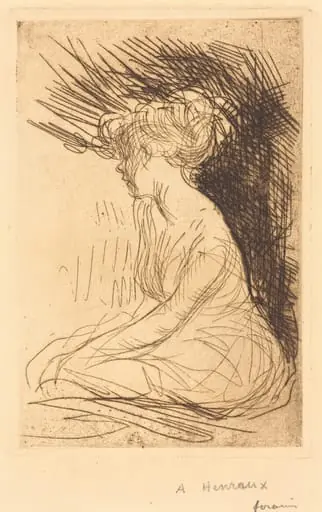 Femme assise de profil (Woman Seated in Profile)
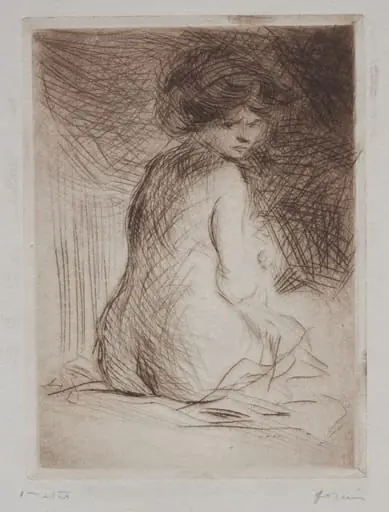 Seated Nude Woman from the Back
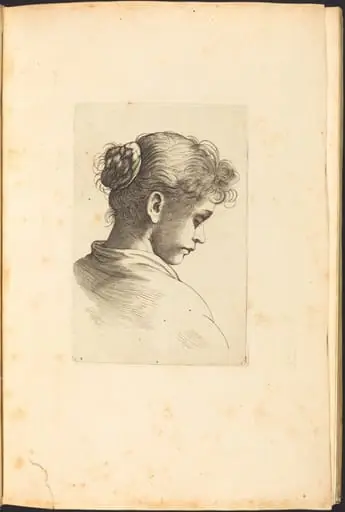 Print from Drawing Book
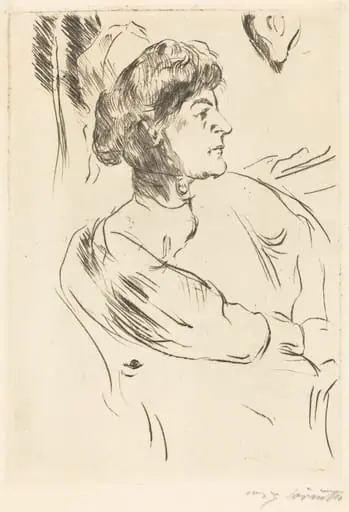 Krankenschwester (Nurse)
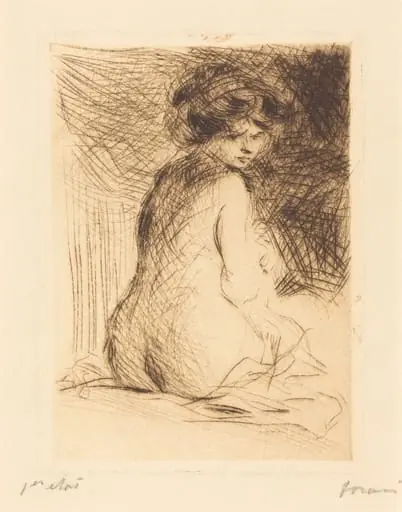 Femme nue vue de dos (Nude Woman Seen from the Back)
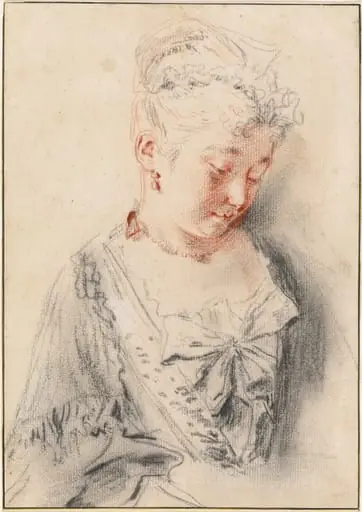 Seated Woman Looking Down
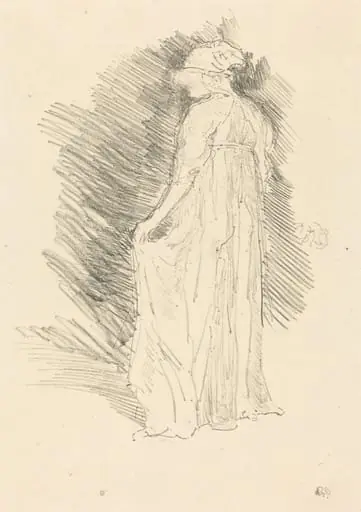 The Draped Figure, Back View
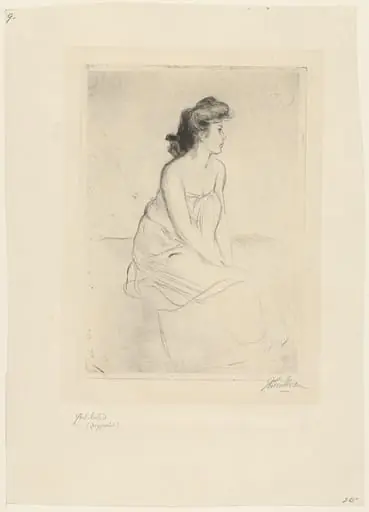 Untitled
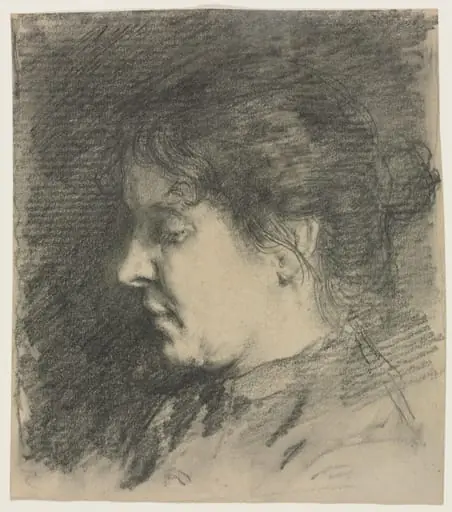 Sarah H. Crone
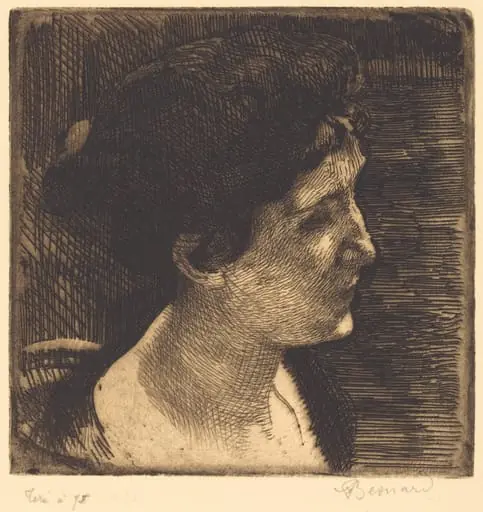 Woman in Full Profile (Grand profil de femme)
 Etude de femme
 Woman in Court Dress