Artwork
Le petit épicier (Chandlery)
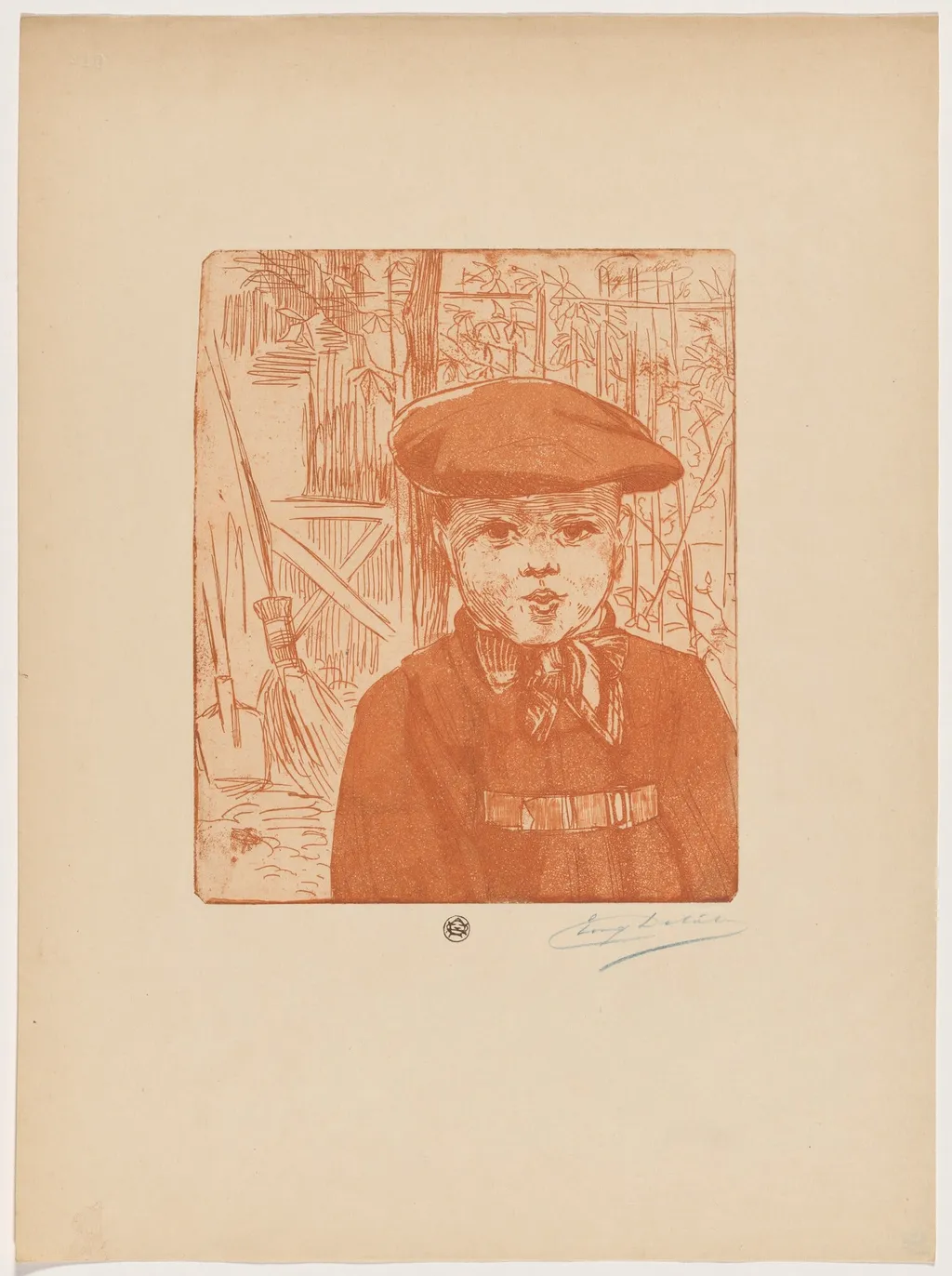
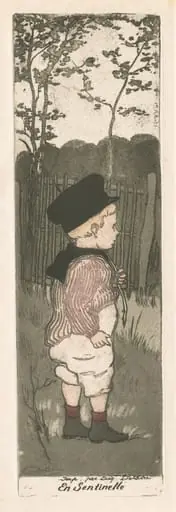
Le petit épicier (Chandlery) is an ink print by the Impressionist artist Eugène Delâtre. It dates from 1895 and is held in the collection of the National Gallery of Art.
About this work
Overview
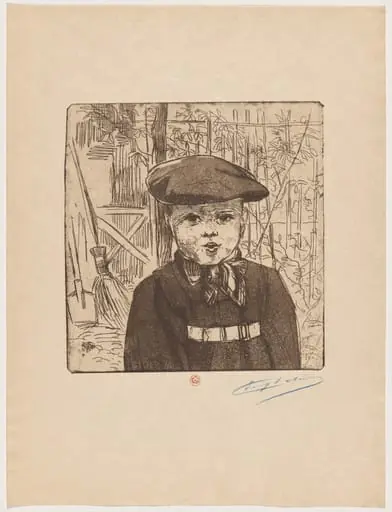
Created in 1895, Le petit épicier (Chandlery) is a print by Eugène Delâtre that combines etching with aquatint on a sheet of heavy Japan paper. Rendered entirely in reddish‑brown tones, the work presents a compact composition that balances line and tone, giving the image a muted, warm atmosphere.
Subject & Meaning
The scene centers on a young boy wearing a flat cap and a striped shirt, his expression solemn as he stands before a shop counter. The counter is crowded with assorted tools, jars, and other merchant wares, suggesting a modest retail environment—perhaps a small grocery or chandlery—where the boy is poised to serve.
Technique & Style
Delâtre employed a dual process: a traditional line etching to define forms, overlaid with aquatint to produce broad, velvety areas of tone. The aquatint’s reddish hue unifies the composition, while the sketch‑like, rapid lines convey a sense of immediacy. The darkest passages, notably the boy’s face, emerge from the softer background, creating subtle contrast.
History & Provenance
The print was issued in the late nineteenth century, a period when French printmakers frequently explored mixed techniques to achieve atmospheric effects. While specific exhibition records are scarce, the work has been catalogued in several collections of Delâtre’s prints, confirming its place within his output of genre scenes depicting everyday life.
Context
Delâtre’s interest in everyday subjects aligns with the broader realist tendencies of the 1890s, when artists turned toward the depiction of ordinary labor and domestic spaces. The choice of a small shop interior reflects contemporary social interest in the lives of working‑class youths and the modest commercial settings that populated French towns.
Artist & collection