Artwork
Flora and Mercury
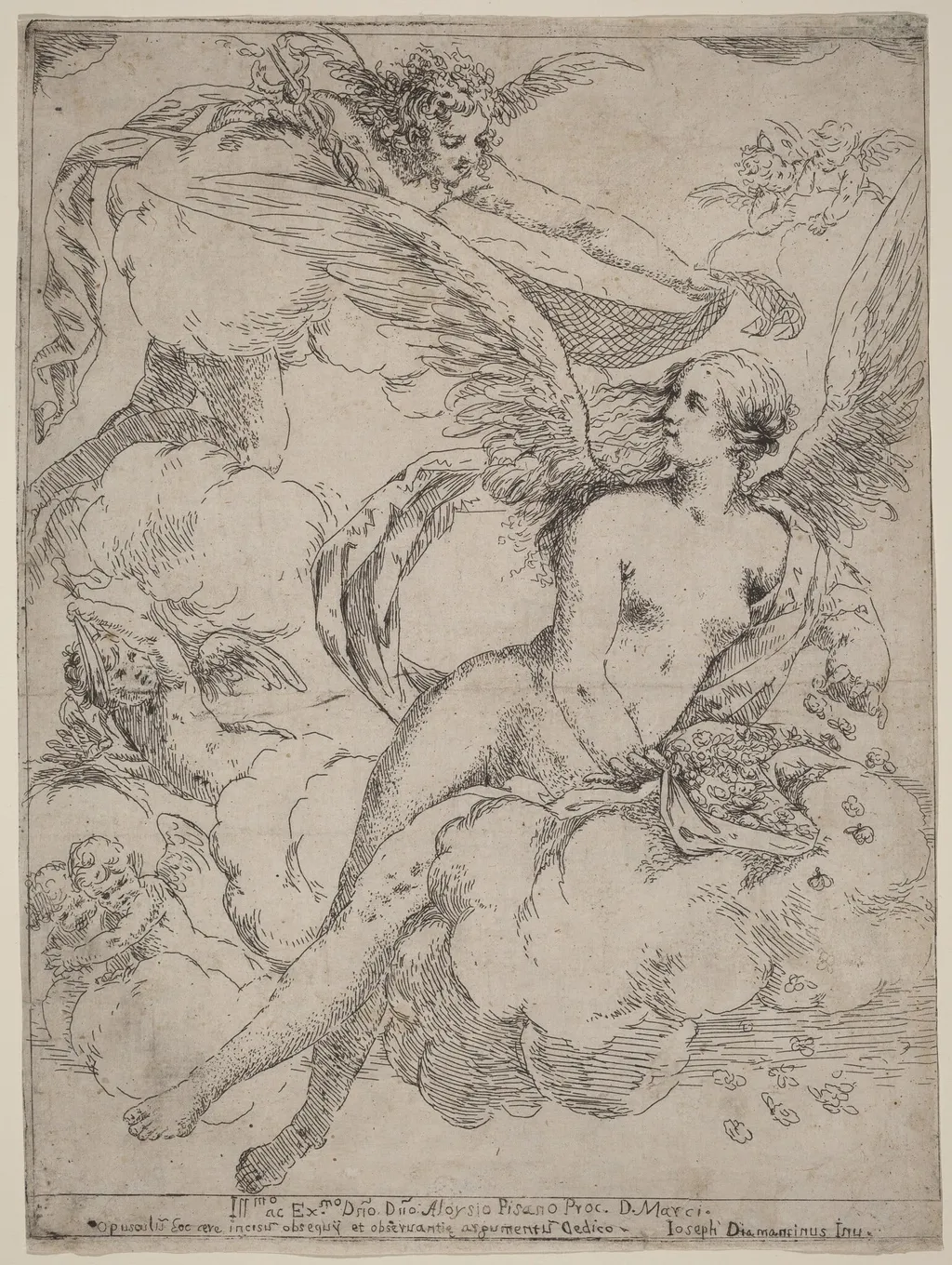
Flora and Mercury is an ink print by the Baroque artist Giuseppe Diamantini. It dates from 1695 and is held in the collection of the National Gallery of Art.
About this work
Overview
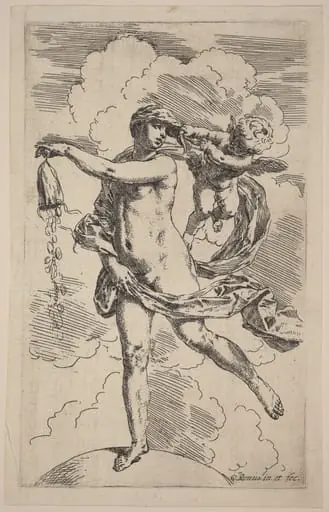
Giuseppe Diamantini’s etching Flora and Mercury, executed in 1695, presents a compact composition on laid paper. The print depicts two mythological figures entwined among a profusion of vines and blossoms, rendered in a densely worked line that fills the surface with intricate botanical detail.
Subject & Meaning
The winged male figure, bearing a caduceus, is identified as Mercury, the Roman messenger god, while the female figure, with loose hair and an upward gesture, represents Flora, the deity of flowers. Their interlaced forms suggest a narrative interaction, perhaps alluding to the union of spring’s fertility with the swift movement of the divine messenger.
Technique & Style
Diamantini employed traditional copper‑plate etching, using a fine, scratchy line to model foliage, drapery, and anatomy. The layered cross‑hatching creates depth and texture, especially in the dense foliage that surrounds the figures. The print’s busy surface exemplifies the Baroque taste for elaborate detail and dynamic composition.
History & Provenance
Created toward the end of the 17th century, the work reflects Diamantini’s activity in Venice, where he produced a range of mythological prints for the market. The etching has survived in several impressions held by European collections, indicating its circulation among connoisseurs of the period.
Artist & collection