Artwork
Gloria
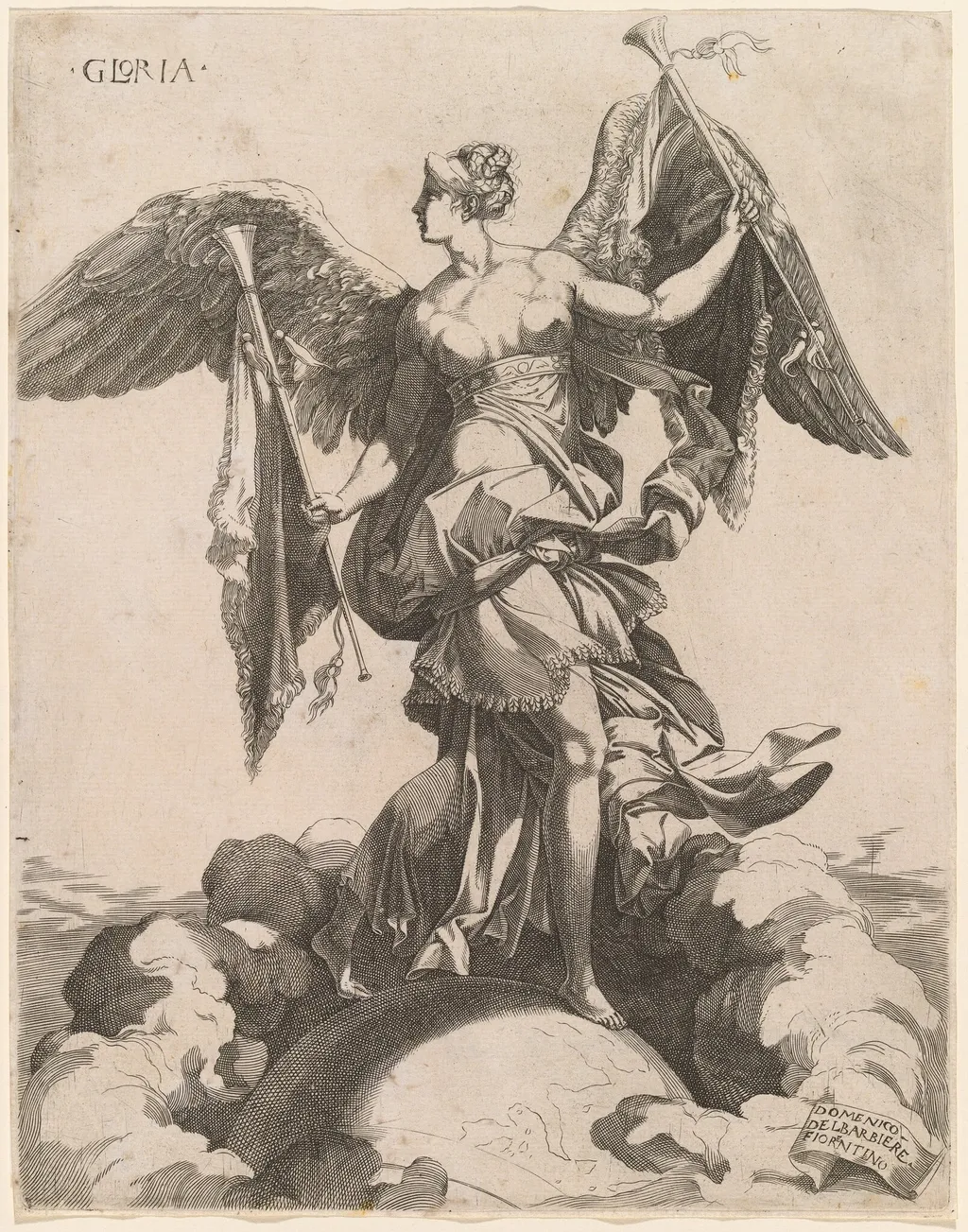
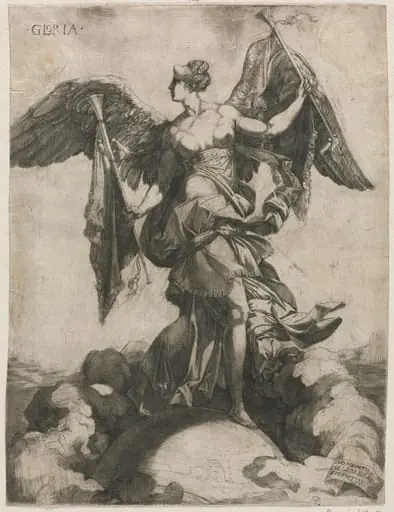
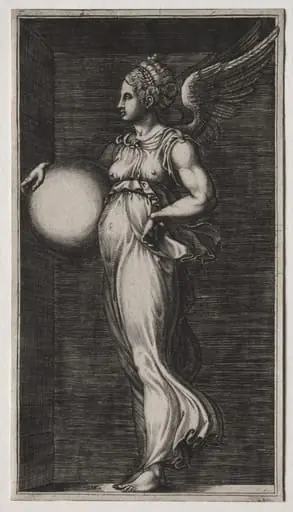
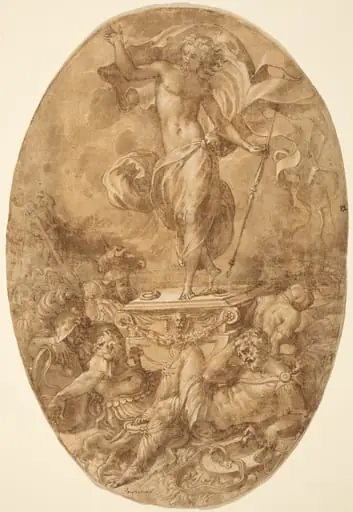
Gloria is an ink print by the Renaissance artist Domenico del Barbiere. It dates from 1542 and is held in the collection of the National Gallery of Art.
About this work
Overview
Having trained in Italy and later worked at the French courts of Fontainebleau and Meudon under Primaticcio and Rosso Fiorentino, he returned to Troyes in 1541.
Domenico del Barbiere, a Florentine artist active in the mid-16th century, produced the engraving *Gloria* in 1542. Having trained in Italy and later worked at the French courts of Fontainebleau and Meudon under Primaticcio and Rosso Fiorentino, he returned to Troyes in 1541. Though known for stucco and fresco, this print reveals his engagement with the graphic arts, translating monumental decorative themes into intimate, detailed compositions.
Subject & Meaning
The central figure is a winged woman standing on a cloud, holding a banner in one hand and a trumpet in the other. Her flowing robe and upward gaze suggest celestial movement and proclamation. The attributes—flag and horn—traditionally signify triumph and announcement, positioning her as an allegorical embodiment of glory. Her serene expression and poised stance convey dignity rather than action, emphasizing symbolic presence over narrative drama.
Technique & Style
Executed in fine-line engraving on laid paper, the work demonstrates precise control of cross-hatching and delicate tonal gradations. The figure is rendered with rhythmic contours that enhance the sense of motion, while the background remains minimally modeled, focusing attention on the form. The composition reflects Mannerist tendencies: elongated proportions, elegant poses, and a heightened sense of idealized grace over naturalism.
History & Provenance
Created after Barbiere’s return to Troyes in 1541, the engraving likely served as a standalone print or a preparatory study for larger decorative projects. Its survival suggests circulation among collectors or artists familiar with the Fontainebleau style. No definitive early ownership records exist, but its technical quality aligns with prints produced by artists working between Italian and French artistic circles in the 1540s.
Context
Barbiere’s work emerged during a period when Italian Mannerist aesthetics were being absorbed into French court art. The allegorical figure of Glory resonated with Renaissance humanist ideals, often used in royal and ecclesiastical settings to symbolize divine favor or political ascendancy. This print reflects the transnational exchange of motifs, as Italian-trained artists adapted classical symbolism for northern European patrons.
Legacy
Though not widely reproduced or cited in major art historical narratives, *Gloria* remains a testament to the fluid movement of artists and ideas across 16th-century Europe. It exemplifies how engraving functioned as a vehicle for disseminating stylistic innovations beyond fresco and sculpture. Barbiere’s print contributes to understanding the role of graphic arts in the transmission of Mannerist visual language.
Artist & collection

Artist
Domenico del Barbiere (c. 1506 – c. 1570) was a Florentine artist of the Renaissance period, also referred to as Domenico Fiorentino, and, in France, Dominique Florentin. He settled and married at Troyes in France…