Artwork
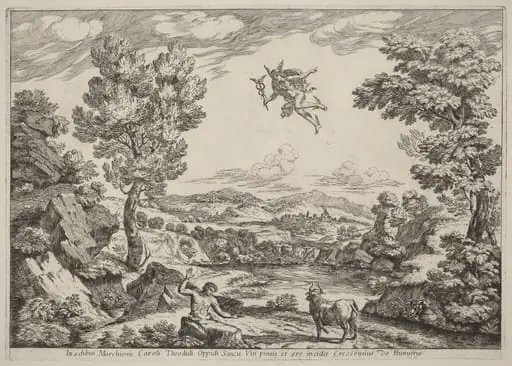
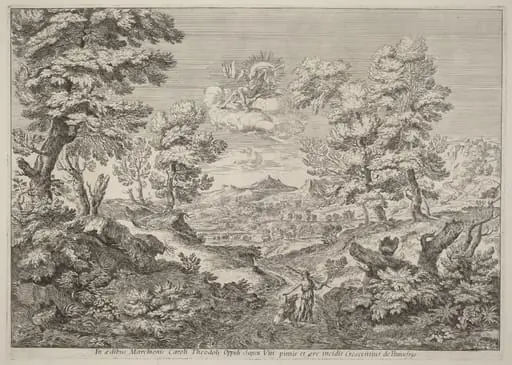
A Man Showing Mercury the Eagle of Jupiter
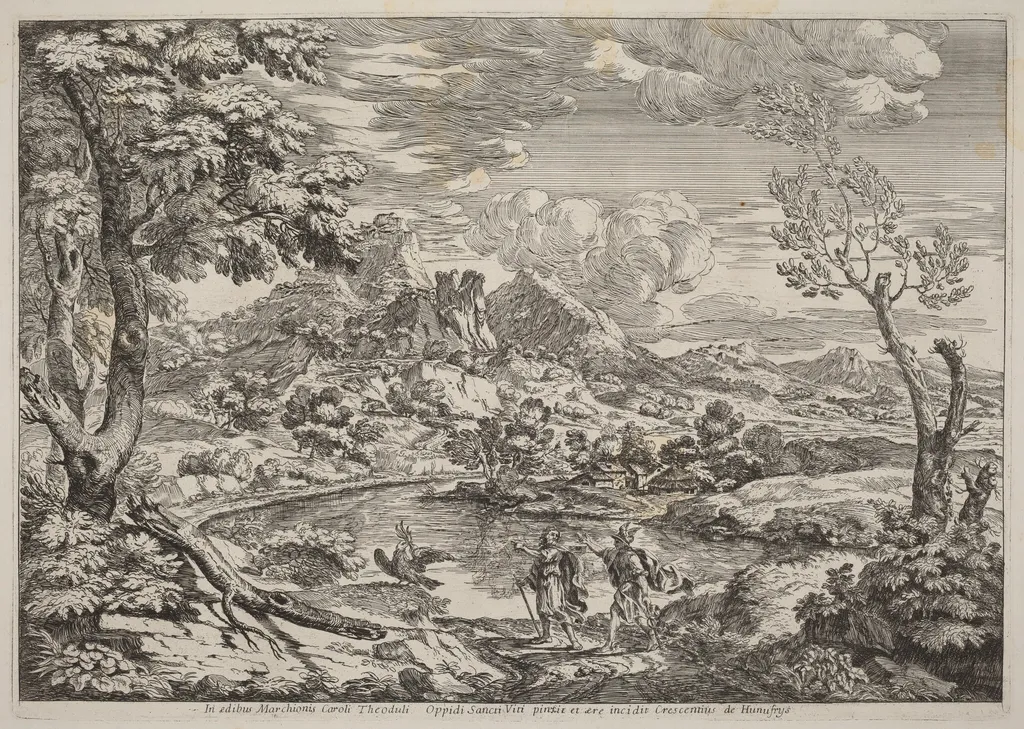
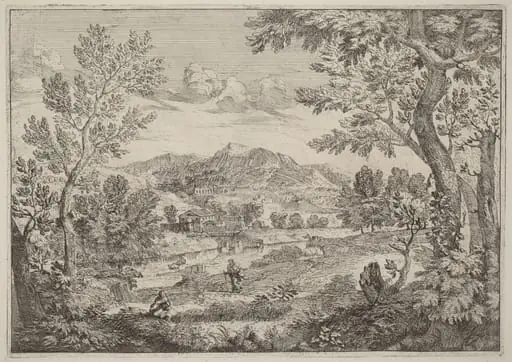
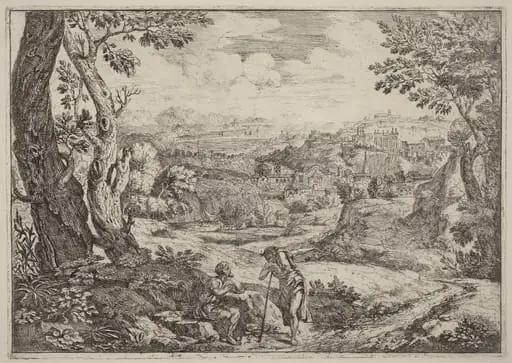
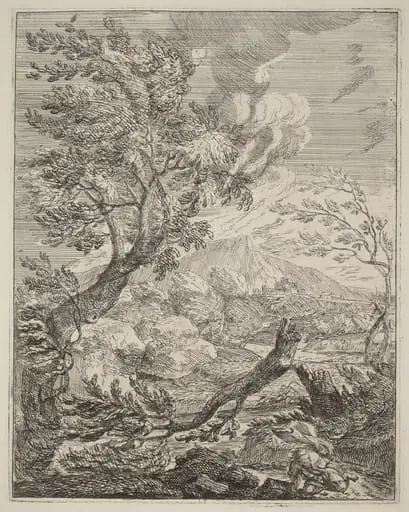
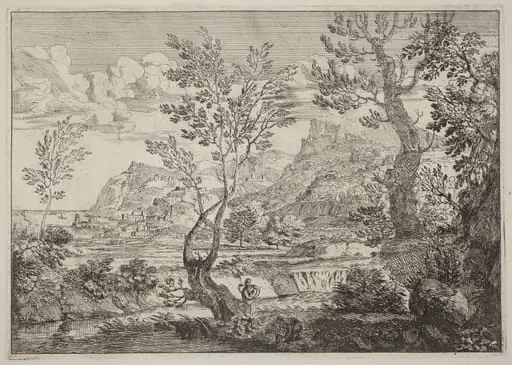
A Man Showing Mercury the Eagle of Jupiter is an ink print by the Baroque artist Crescenzio Onofri. It dates from 1696 and is held in the collection of the National Gallery of Art.
About this work
Overview
The scene centers on a man directing the attention of Mercury toward an eagle perched in a tree, set against a backdrop of tangled foliage and a winding stream.
Created in 1696 by Crescenzio Onofri, this black-and-white etching depicts a mythological encounter in a dense natural setting. The scene centers on a man directing the attention of Mercury toward an eagle perched in a tree, set against a backdrop of tangled foliage and a winding stream. The composition is intricate, with fine linear details defining the foliage, water, and cloud-filled sky, characteristic of Onofri’s meticulous approach to landscape and narrative.
Subject & Meaning
The scene references the myth of Jupiter’s eagle, a symbol of divine authority, and Mercury, the messenger god. The man’s gesture implies he is revealing the eagle’s presence to Mercury, possibly as a sign or omen. Though the exact narrative is not documented, the interaction suggests a moment of revelation or divine communication, common in Baroque interpretations of classical mythology where nature and myth intertwine.
Technique & Style
Onofri employed etching to render fine, controlled lines that model texture and depth. The leaves, bark, and ripples in the water are defined by dense, cross-hatched strokes, creating a sense of volume without color. The swirling clouds and layered foliage demonstrate a mastery of atmospheric perspective, while the composition’s busyness reflects the Baroque preference for dynamic, immersive landscapes over idealized simplicity.
History & Provenance
The print was produced in Rome during the late 17th century, a period when etching was widely used for both artistic and reproductive purposes. Onofri, known for his topographical and mythological landscapes, likely created this work for collectors interested in classical themes rendered with naturalistic detail. No early ownership records are widely documented, but it appears in later 18th-century European print collections.
Context
In late Baroque Rome, artists often blended mythological subjects with detailed natural settings to appeal to educated patrons. Onofri’s work aligns with a tradition of landscape etchers who used classical narratives as frameworks for observational rendering. His focus on atmospheric effects and botanical accuracy reflects broader trends in Roman artistic circles, where scientific observation and mythological storytelling coexisted.
Legacy
Though not widely reproduced or studied today, Onofri’s etching exemplifies the quiet sophistication of Roman printmaking in the late 1600s. It preserves a moment when myth was not merely illustrated but embedded within a believable natural world. The work contributes to understanding how classical themes were sustained in visual culture through technical precision rather than grandeur.
Artist & collection