Artwork
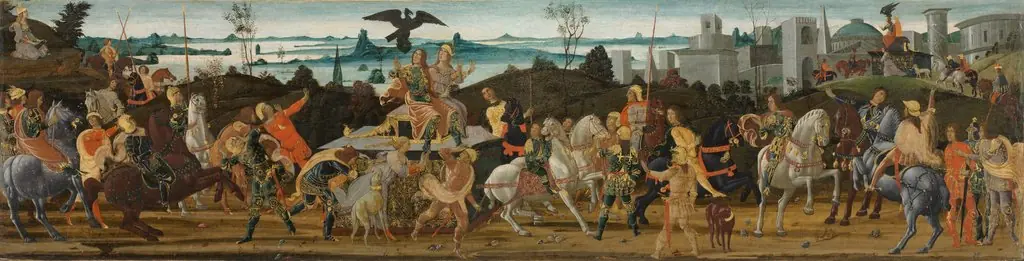
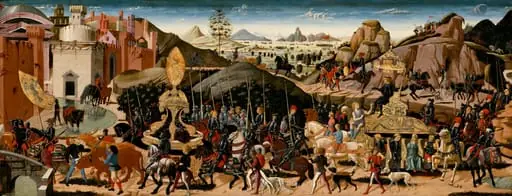
Julius Caesar and the Crossing of the Rubicon (scene from the story of Alexander the Great)
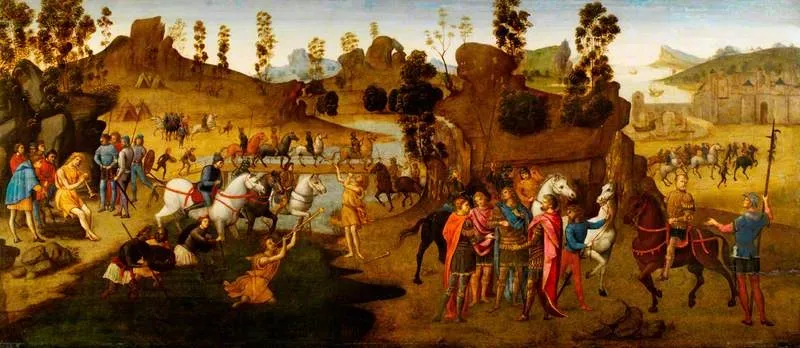
Julius Caesar and the Crossing of the Rubicon (scene from the story of Alexander the Great) is a tempera painting by the Early Renaissance artist Domenico Ghirlandaio. It dates from 1481 and is held in the collection of the Victoria and Albert Museum.
About this work
Overview
Julius Caesar and the Crossing of the Rubicon, a tempera painting from circa 1481, is attributed to Domenico Ghirlandaio, a prominent Florentine artist of the early Renaissance. Despite its title, the scene is actually inspired by the legend of Alexander the Great, reflecting the era's blending of historical and mythological themes.
Subject & Meaning
The painting's subject matter appears to be misattributed in its title, as the depicted scene aligns more closely with narratives surrounding Alexander the Great rather than Julius Caesar's infamous river crossing. The actual event or moment from Alexander's story is not immediately clear from the composition.
Technique & Style
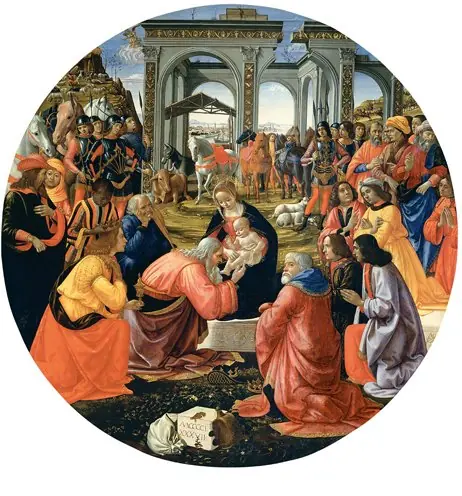
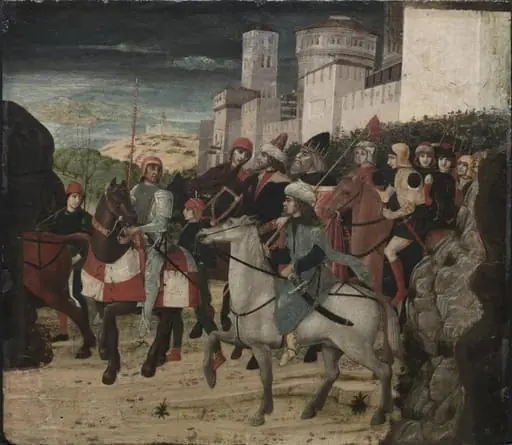
Executed in tempera, the work showcases early Renaissance stylistic elements. The composition features a dense, active scene with multiple figures, both mounted and on foot, set against a detailed landscape of trees, hills, and water, characteristic of the period's attention to detail and spatial composition.
History & Provenance
Created within the prolific output of Ghirlandaio's large Florentine workshop, which included family and apprentices, the painting is now part of the collection at the Victoria and Albert Museum.
Context
The work's creation around 1481 places it within the flourishing early Renaissance in Florence, where Ghirlandaio's workshop played a significant role in producing artworks that blended myth, history, and emerging Renaissance aesthetics.
Legacy
While the painting itself may not be widely recognized by its incorrect title, it contributes to the broader understanding of Ghirlandaio's workshop output and the early Renaissance's thematic and stylistic explorations. Correct attribution of its subject matter to Alexander the Great's legend could enhance its scholarly significance.
Artist & collection
Artist
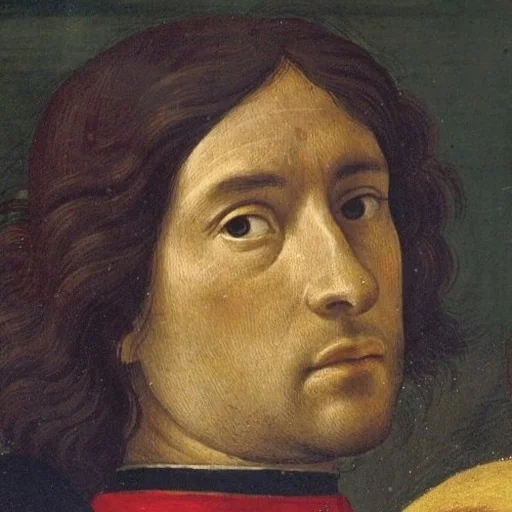
Domenico di Tommaso Curradi di Doffo Bigordi (2 June 1448 – 11 January 1494), professionally known as Domenico Ghirlandaio (also spelt as Ghirlandajo), was an Italian Renaissance painter born in Florence.