Artwork
View of the Castle Sant'Angelo and the Ospedale di Santo Spirito [recto]
![View of the Castle Sant'Angelo and the Ospedale di Santo Spirito [recto], by Étienne Dupérac, ink, 1559](https://artifactworldgallery.com/img/etienne-duperac--view-of-the-castle-sant-angelo-and-the-ospedale-di-santo-spi--b09ebaffc1ffa770-w1024.webp)
View of the Castle Sant'Angelo and the Ospedale di Santo Spirito [recto] is an ink drawing by the Renaissance artist Étienne Dupérac. It dates from 1559 and is held in the collection of the National Gallery of Art. This mid-16th-century drawing depicts two prominent Roman landmarks along the Tiber River.
About this work
Overview
This mid-16th-century drawing depicts two prominent Roman landmarks along the Tiber River. Étienne Dupérac rendered the Castel Sant’Angelo on the right bank and the Ospedale di Santo Spirito on the left in meticulous brown ink. The composition balances architectural precision with atmospheric effects, framing the scene through the river’s expanse and a modest boat adrift in the foreground.
Subject & Meaning
Dupérac’s choice to unite these structures along the Tiber underscores their shared urban significance without overt narrative commentary.
The drawing juxtaposes military and charitable institutions, emblematic of Rome’s dual identity. Castel Sant’Angelo, originally Emperor Hadrian’s mausoleum, had evolved into a papal fortress, while the Ospedale di Santo Spirito served as a major hospital and welfare center. Dupérac’s choice to unite these structures along the Tiber underscores their shared urban significance without overt narrative commentary.
Technique & Style
Executed in pen and brown ink, the work employs dense hatching and cross-hatching to model forms and suggest texture. Dupérac’s linear precision delineates brickwork, water, and foliage with equal attentiveness, achieving spatial depth through overlapping planes and diminishing scale. The restrained palette and controlled strokes reflect the conventions of Renaissance topographical draftsmanship.
History & Provenance
Created around 1559, the drawing likely originated during Dupérac’s Roman sojourn, where he documented ancient and contemporary architecture. Its survival on laid paper—common for preparatory studies—suggests it may have served as a reference for prints or larger compositions. The sheet’s subsequent ownership history remains unrecorded, though it entered modern collections as an independent work.
Context
Dupérac’s drawing emerges from a period of renewed interest in Rome’s urban fabric, spurred by humanist scholarship and papal patronage. Artists and architects frequently sketched the city’s landmarks to study their proportions or preserve their appearance before renovations. This work aligns with such documentary impulses, offering a snapshot of mid-Cinquecento Rome before later Baroque transformations.
Artist & collection


![View of the Tiber; Copy of a Roman Sculpture of a Bacchante [verso], by Étienne Dupérac](https://artifactworldgallery.com/img/etienne-duperac--view-of-the-tiber-copy-of-a-roman-sculpture-of-a-bacchante-v--102e2a97a120fe3b-w320.webp) View of the Tiber; Copy of a Roman Sculpture of a Bacchante [verso]
View of the Tiber; Copy of a Roman Sculpture of a Bacchante [verso]![Orthographia Partis Interioris Templi Divi Petri [Interior View of Saint Peter's Basilica], by Étienne Dupérac](https://artifactworldgallery.com/img/etienne-duperac--orthographia-partis-interioris-templi-divi-petri-interior-vi--59b448ec2f3049cc-w320.webp) Orthographia Partis Interioris Templi Divi Petri [Interior View of Saint Peter's Basilica]
Orthographia Partis Interioris Templi Divi Petri [Interior View of Saint Peter's Basilica] The Coronation of Cosimo I de' Medici
![Orthographia Partis Exterioris Templi Divi Petri [Exterior View of Saint Peter's Basilica], by Étienne Dupérac](https://artifactworldgallery.com/img/etienne-duperac--orthographia-partis-exterioris-templi-divi-petri-exterior-vi--97a194b60abe7fac-w320.webp) Orthographia Partis Exterioris Templi Divi Petri [Exterior View of Saint Peter's Basilica]
Orthographia Partis Exterioris Templi Divi Petri [Exterior View of Saint Peter's Basilica]![Areae et Palatii Pontificii Vaticani Topographia [A Papal Blessing in Saint Peter Square], by Étienne Dupérac](https://artifactworldgallery.com/img/etienne-duperac--areae-et-palatii-pontificii-vaticani-topographia-a-papal-ble--d33d6f094b73f039-w320.webp) Areae et Palatii Pontificii Vaticani Topographia [A Papal Blessing in Saint Peter Square]
Areae et Palatii Pontificii Vaticani Topographia [A Papal Blessing in Saint Peter Square]![Capitolii Sciographia [View of the Roman Capitol], by Étienne Dupérac](https://artifactworldgallery.com/img/etienne-duperac--capitolii-sciographia-view-of-the-roman-capitol--e85f3f07c1ca1e5c-w320.webp) Capitolii Sciographia [View of the Roman Capitol]
Capitolii Sciographia [View of the Roman Capitol]![Ichnographia Templi Divi Petri [Plan of Saint Peter's Basilica in Rome], by Étienne Dupérac](https://artifactworldgallery.com/img/etienne-duperac--ichnographia-templi-divi-petri-plan-of-saint-peter-s-basilic--f1844fd1b6664111-w320.webp) Ichnographia Templi Divi Petri [Plan of Saint Peter's Basilica in Rome]
Ichnographia Templi Divi Petri [Plan of Saint Peter's Basilica in Rome] Narcissus
 View of the Janiculum Hill Seen from the Tiber (recto)
 Landscape with Shepherds Driving Away a Wolf
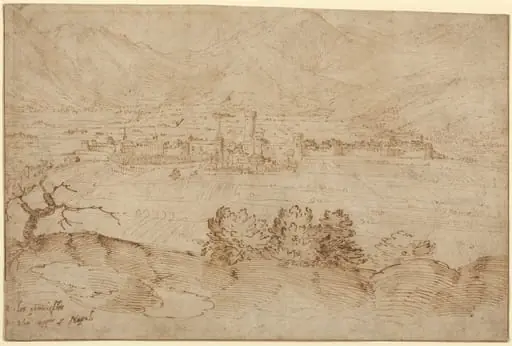 View of Fondi
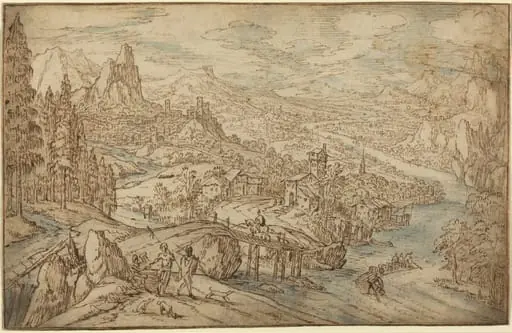 River Landscape
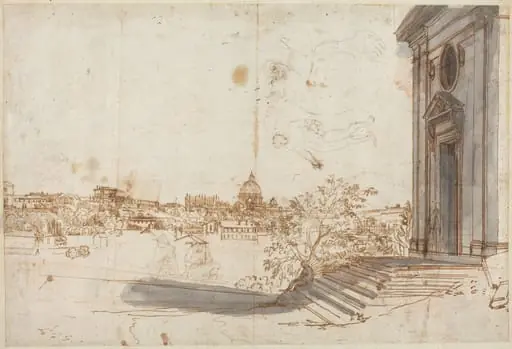 A View of Rome from Santa Maria del Priorato
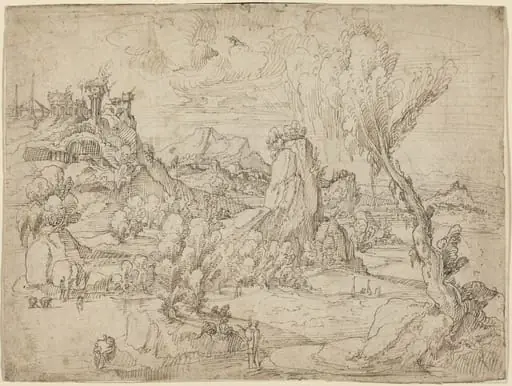 Landscape with the Baptism of Christ
 View of a Castle (recto)
 River Landscape with the Temptation of Christ
 Landscape with Fortress and River
 Landscape with High Cliffs, River, and City