Artwork
Life Study of a Female
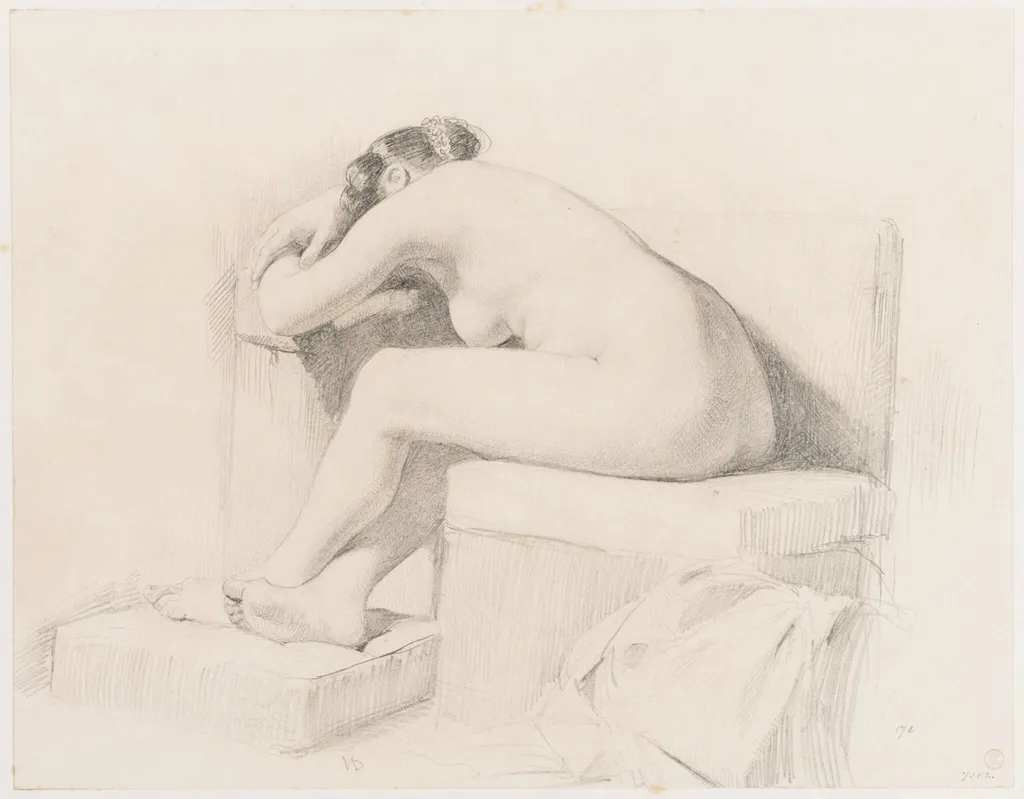
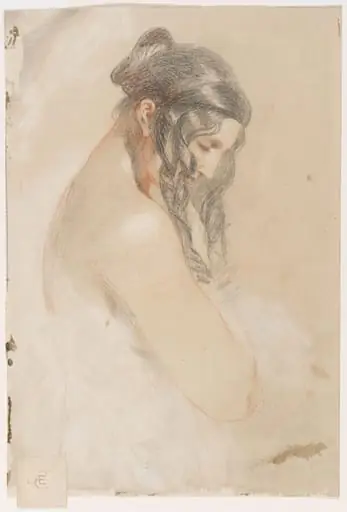
Life Study of a Female is a drawing by William Dyce. It dates from 1850 and is held in the collection of the Victoria and Albert Museum.
About this work
Overview
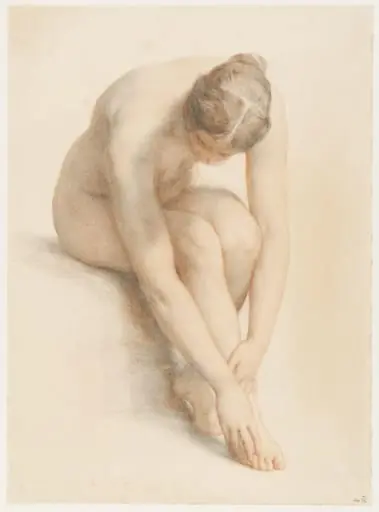
Rendered with careful attention to form, the figure is nude and positioned with her body turned left, head bowed, and hands clasped before her face.
This chalk drawing by William Dyce captures a seated female figure in a quiet, introspective posture. Rendered with careful attention to form, the figure is nude and positioned with her body turned left, head bowed, and hands clasped before her face. Her legs are crossed, and her feet rest on a low step. The chair is minimal, and the background is entirely unadorned, focusing attention solely on the figure’s presence and stillness.
Subject & Meaning
The figure’s closed posture—head lowered, hands shielding the face—suggests inward reflection or emotional withdrawal. There is no narrative context, and the absence of setting or symbolism invites interpretation centered on vulnerability and solitude. The title references a 'medium,' yet the drawing offers no clues to spiritual or occult associations; the meaning remains anchored in the physical and psychological stillness of the pose.
Technique & Style
Dyce employs chalk to model the figure with subtle gradations of tone, using cross-hatching to define volume and contour. The lines are deliberate but not overly detailed, allowing light and shadow to suggest musculature and the softness of skin. The plain background enhances the three-dimensionality of the form, emphasizing the artist’s skill in rendering the human body through tonal contrast rather than outline.
History & Provenance
Created during Dyce’s engagement with life drawing practices in the 1830s–40s, this work reflects his commitment to anatomical study. It likely originated from academic or private sessions, common among artists refining their observational skills. The drawing remains in private or institutional collections, with no public record of exhibition during the artist’s lifetime, suggesting it was intended as a study rather than a finished work.
Context
In mid-19th-century Britain, life drawing was central to artistic training, particularly within institutions like the Royal Academy. Dyce, though later known for religious murals, maintained a rigorous practice of figure studies. This drawing aligns with contemporary European traditions of anatomical observation, where the nude was studied not for idealization but for understanding structure and expression.
Legacy
Though not widely exhibited, this drawing exemplifies Dyce’s disciplined approach to form and his respect for the human figure as a subject of quiet dignity. It contributes to a broader understanding of his artistic development, revealing the foundational studies that informed his later, more public works. Its restraint and focus continue to resonate as an example of 19th-century academic drawing at its most attentive.
Own this work as a print
Artist & collection
Artist
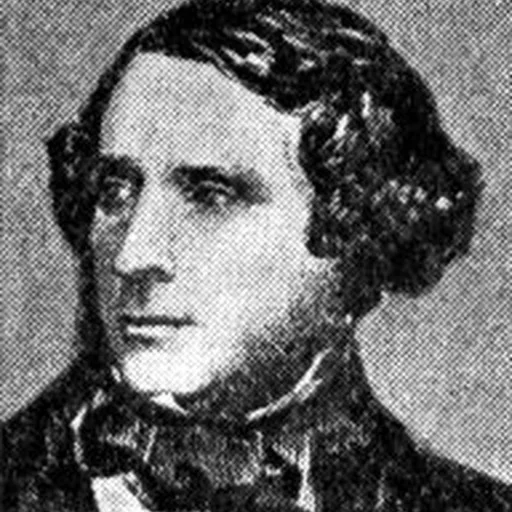
William Dyce (; 19 September 1806 in Aberdeen – 14 February 1864) was a Scottish painter, who played a part in the formation of public art education in the United Kingdom, and the South Kensington Schools system.