Artwork
Ponte Vecchio, Florence
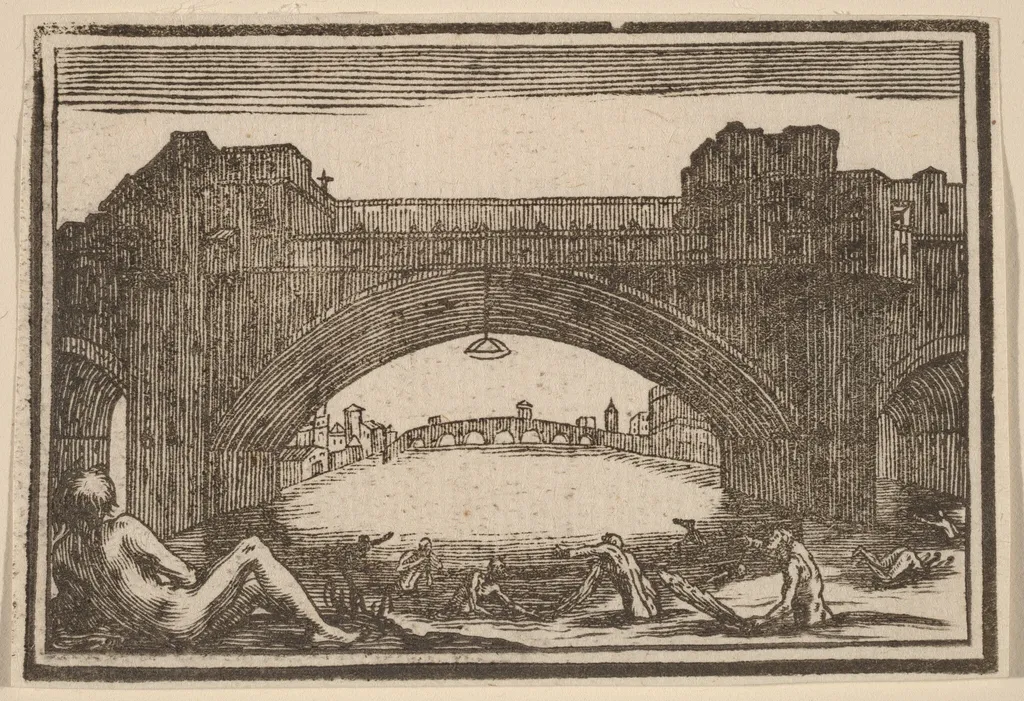
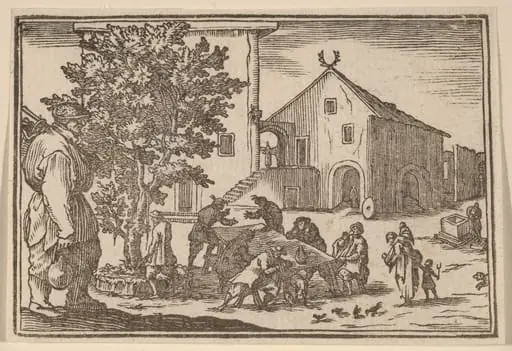
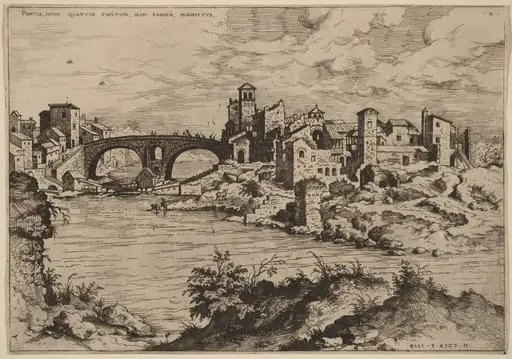
Ponte Vecchio, Florence is an ink print by the Baroque artist Edouard Eckman. It dates from 1621 and is held in the collection of the National Gallery of Art.
About this work
Overview
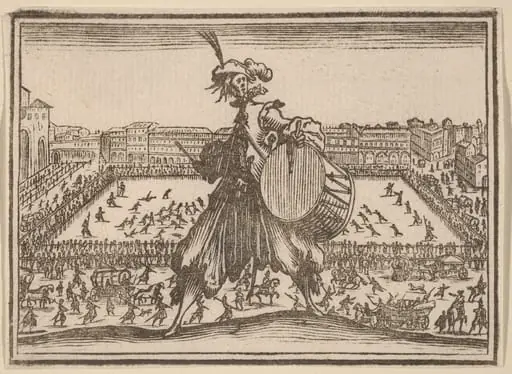
Created in 1621 by Edouard Eckman, this woodcut depicts the Ponte Vecchio in Florence, rendered in monochrome on laid paper.
Created in 1621 by Edouard Eckman, this woodcut depicts the Ponte Vecchio in Florence, rendered in monochrome on laid paper. The composition centers on the stone bridge spanning the Arno River, flanked by structures along its length. Below, figures rest on the riverbank, suggesting a quiet, everyday scene. The print’s simplicity and precision reflect the technical discipline of early 17th-century printmaking.
Subject & Meaning
The image captures the Ponte Vecchio not as a grand monument but as a lived-in urban feature. The presence of figures lounging on the grass implies a moment of repose, grounding the bridge in daily life rather than ceremonial importance. The modest scale of the town beyond the central arch reinforces the print’s focus on ordinary human activity within a familiar landscape.
Technique & Style
Eckman employed the woodcut method, carving lines into a wooden block to produce a bold, linear image. Shading and depth are achieved through varying densities of inked lines, not tonal gradations. The architecture is rendered with clear, deliberate strokes, while the figures are simplified yet expressive. The absence of color emphasizes form and structure, typical of Northern European print traditions of the period.
History & Provenance
The print originates from the early 17th century, a time when woodcuts were widely used for topographical and travel-related imagery. Though Eckman’s biography remains sparse, this work aligns with the period’s interest in documenting European landmarks. Its survival suggests it was likely circulated among collectors or used as a reference for travelers and artists interested in Italian architecture.
Context
In 1621, Florence was a center of artistic and commercial activity, and the Ponte Vecchio, lined with shops since the Middle Ages, was a well-known landmark. While grander depictions of the bridge emerged later, Eckman’s version offers a quieter, more intimate view. It reflects a growing European interest in recording real places with observational accuracy, rather than idealized or allegorical interpretations.
Legacy
This woodcut stands as a modest but enduring record of the Ponte Vecchio in its pre-modern state. It contributes to a broader corpus of early modern prints that document urban landscapes with documentary intent. Though not widely known today, it remains a valuable artifact for understanding how travelers and artists perceived and recorded Italian cities during the early Baroque era.
Artist & collection