Artwork
Title Page for "The Capricci"
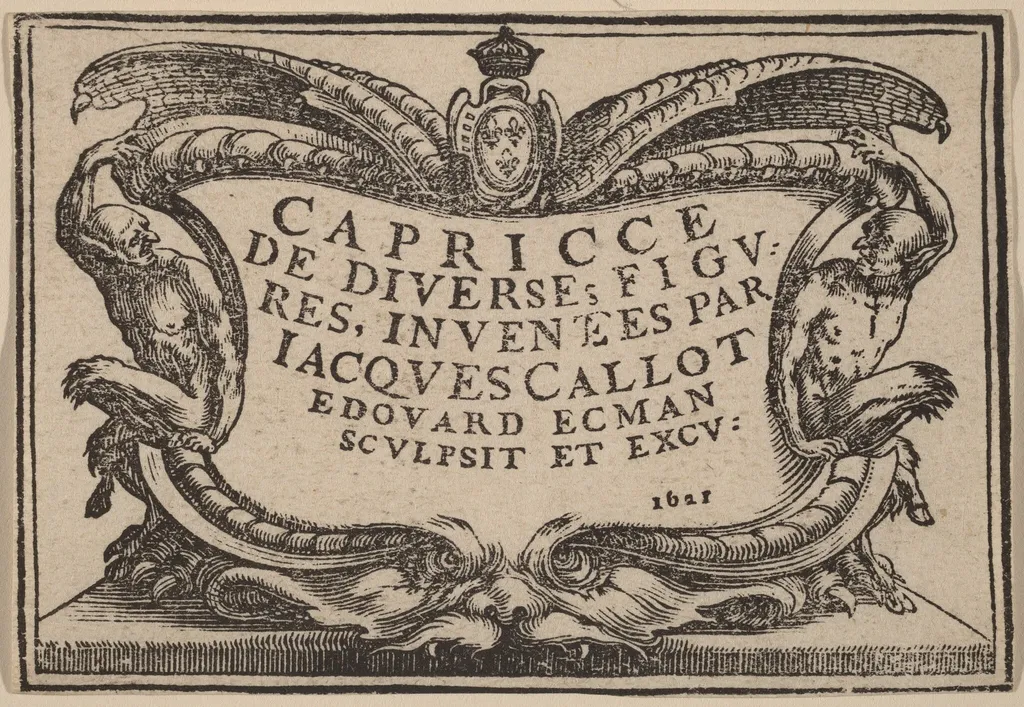
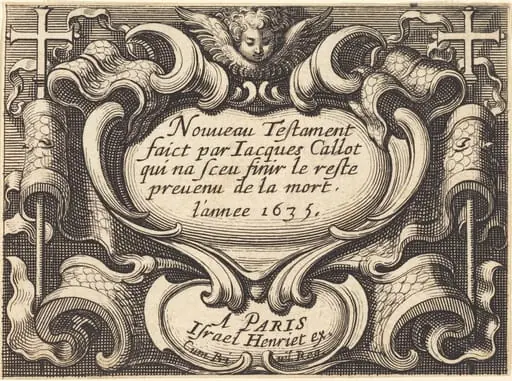
Title Page for "The Capricci" is an ink print by the Baroque artist Edouard Eckman. It dates from 1621 and is held in the collection of the National Gallery of Art. This 1621 woodcut serves as the title page for a collection of prints titled 'The Capricci.
About this work
Overview
The composition is rendered in black ink on laid paper, characteristic of early 17th-century printmaking.
This 1621 woodcut serves as the title page for a collection of prints titled 'The Capricci.' Created by Edouard Eckman, it features an elaborate border framing the printed text. The composition is rendered in black ink on laid paper, characteristic of early 17th-century printmaking. The design emphasizes formality through decorative elements and structured typography, aligning with the conventions of scholarly and artistic publications of the period.
Subject & Meaning
The title page announces the work of Jacques Callot, identifying him as the inventor of the capricci—fantastical, imaginative figures. Two allegorical figures flank the text, likely symbolizing creativity and artistic lineage. The crown above reinforces the elevated status of the subject matter, suggesting the prints belong to a refined, almost royal tradition of invention. The design elevates the capricci from mere sketches to objects of cultural significance.
Technique & Style
Executed as a woodcut, the image relies on bold, linear contrasts typical of the medium. The ornate border is carved with fine, interwoven patterns, while the cursive lettering mimics contemporary manuscript scripts. The use of laid paper, with its visible chain lines, adds texture and authenticity. Eckman’s carving demonstrates precision in rendering both decorative motifs and legible typography, balancing ornamentation with clarity.
History & Provenance
Produced in 1621, this print accompanied a series of etchings by Jacques Callot, published under Eckman’s supervision as engraver and publisher. Eckman, active in Nancy and Paris, was known for his collaborations with artists and printers. The print likely circulated among collectors and print enthusiasts in France and the Low Countries, serving as both an advertisement and a ceremonial frontispiece for Callot’s inventive compositions.
Context
In early 17th-century Europe, print collections like 'The Capricci' reflected a growing interest in artistic fantasy and individual expression. The use of elaborate title pages was standard among publishers seeking to distinguish their editions. Eckman’s design aligns with broader trends in print culture, where visual grandeur legitimized the content and appealed to elite audiences interested in the intersection of art, literature, and craftsmanship.
Legacy
This title page remains a documented example of how print publishers framed artistic innovation during the Baroque era. While Eckman’s name is less remembered than Callot’s, this work illustrates the collaborative nature of print production. Its design influenced later title pages in artistic portfolios, preserving the tradition of elevating print collections through symbolic and typographic grandeur.
Artist & collection