Artwork
Bathing Girls
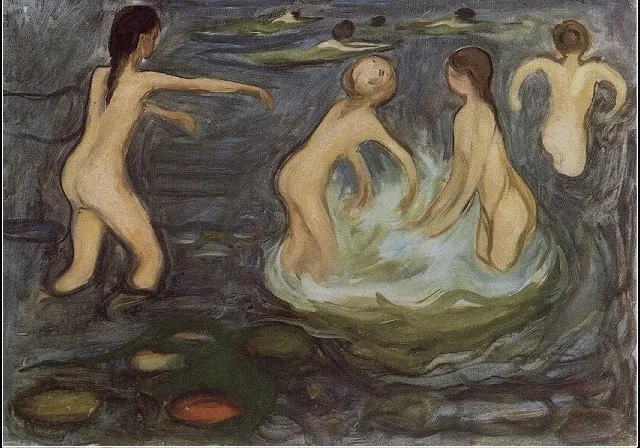
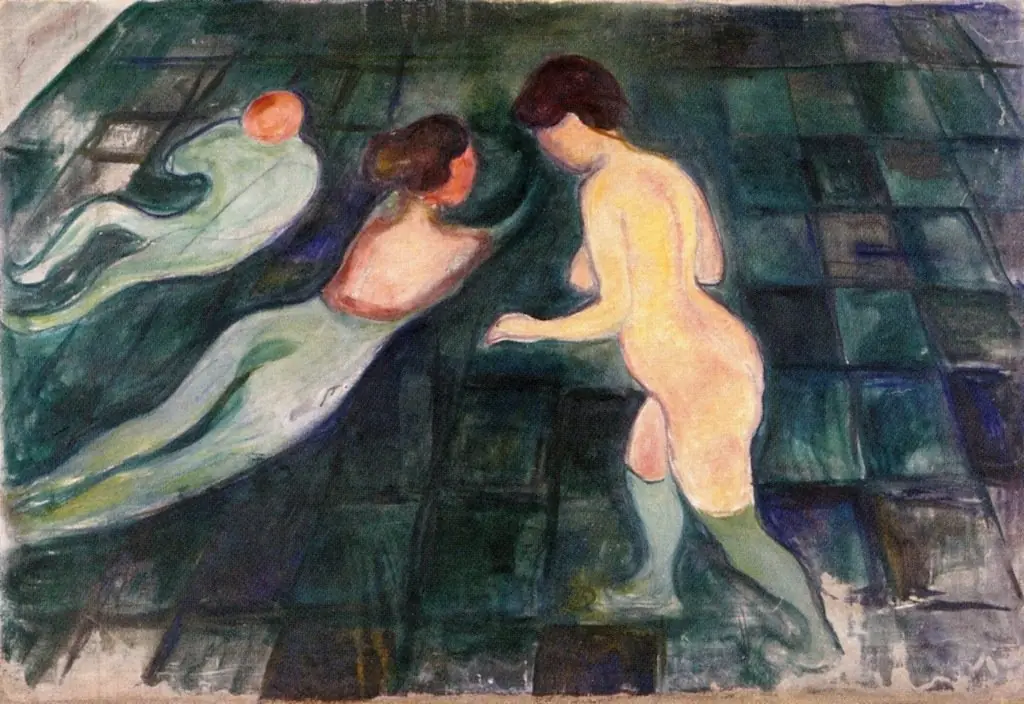
Bathing Girls is an oil painting by the Post-Impressionist artist Edvard Munch. It dates from 1899 and is held in the collection of the Munch Museum.
About this work
Overview
Though rooted in observed reality, the painting moves beyond literal representation, conveying mood through simplified forms and restrained color.
Edvard Munch painted *Bathing Girls* in 1899 using oil on canvas. The work belongs to a series of intimate, naturalistic scenes he produced during a period of deep personal reflection. Though rooted in observed reality, the painting moves beyond literal representation, conveying mood through simplified forms and restrained color. It is held today in the Munch Museum in Oslo, where it remains part of the artist’s enduring legacy.
Subject & Meaning
The painting shows four nude women in a quiet, secluded body of water, their postures suggesting solitude and mutual awareness without interaction. One figure turns away entirely, another faces the viewer with a calm gaze, while the central pair engage in a silent, mirrored stillness. The absence of narrative or action invites contemplation of vulnerability, privacy, and the human form in nature, themes recurrent in Munch’s exploration of inner life.
Technique & Style
Munch employed loose, fluid brushwork to render the figures and water, avoiding sharp definition in favor of atmospheric suggestion. The skin tones, pale and luminous, emerge from a dark, muted background, creating a stark contrast that heightens the figures’ presence. The water is rendered as an indistinct, shadowy plane, dissolving boundaries between bodies and environment. This approach aligns with post-impressionist tendencies toward emotional resonance over optical accuracy.
History & Provenance
Created during Munch’s mature period, *Bathing Girls* emerged after his formative years in Oslo and Berlin, where he absorbed Symbolist ideas and psychological themes from writers like Hans Jæger. The painting was retained by the artist throughout his life and later entered the collection of the Munch Museum upon its founding, ensuring its preservation as a key example of his exploration of human intimacy and natural settings.
Context
In late 19th-century Norway, depictions of nude figures in natural settings were uncommon in public art, often viewed as too intimate or unrefined. Munch’s choice to portray women in private moments challenged conventional norms, aligning with broader European shifts toward psychological realism. His work diverged from academic traditions, favoring emotional truth over idealized beauty, reflecting a cultural moment ripe for redefining artistic subject matter.
Legacy
Though less widely known than *The Scream*, *Bathing Girls* exemplifies Munch’s sustained interest in the human condition through quiet, unadorned scenes. Its influence can be seen in later Nordic artists who embraced introspective realism. The painting endures as a quiet testament to his ability to convey psychological depth through minimal gesture and atmospheric tone, reinforcing his role in modern art’s turn toward inner experience.
Artist & collection

Artist
Edvard Munch ( MUUNK; Norwegian: ; 12 December 1863 – 23 January 1944) was a Norwegian painter.